

























































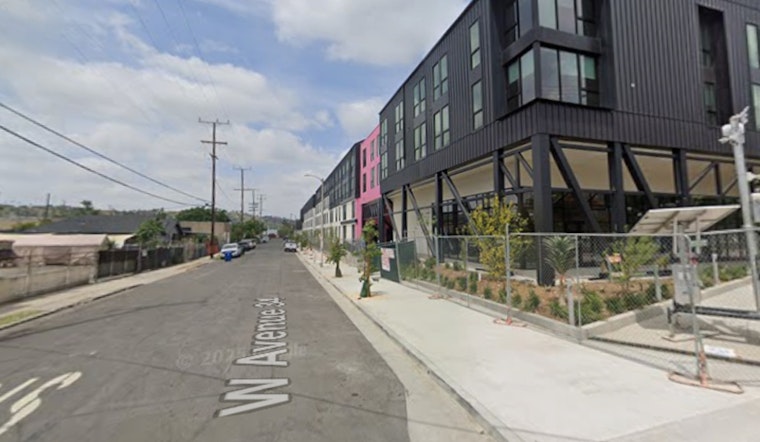
The new A34 complex has officially opened in Lincoln Heights near the A Line's Heritage Square Station, but plenty of locals are not exactly rolling out the welcome mat. What now stands on a former industrial lot, three large buildings spread over roughly five acres, is already fueling arguments about whether the sleek marketing matches the street-level reality and whether digging for construction stirred up old contamination. Longtime neighbors also warn that the project could speed up displacement, even with some units reserved at below-market rents.
Project by the numbers
As reported by Urbanize LA, A34 at 131 W. Avenue 34 stacks 468 studio, one- and two-bedroom apartments above roughly 16,000 square feet of ground-floor retail, with parking for about 311 vehicles. The Max Collaborative partnered with The Pinyon Group to develop the site, and KFA Architecture led the design.
Renderings vs. reality
Developer materials leaned hard on landscaped courtyards, public art, and tree-lined paseos, a language the Max Collaborative uses to describe the project on its A34 page. The finished visuals, though, highlight the stucco-and-metal facades and the project’s solid massing more than the airy greenways promised in some of the early renderings. Recent photography used in coverage underscores that contrast and was supplied by architectural photographer Hunter Kerhart.
Neighbors’ contamination and displacement concerns
Residents who objected during the entitlement process warned that excavation for foundations and subterranean parking could disturb decades-old industrial contaminants and pressed state regulators to widen testing and oversight. Those objections show up in public comment letters filed with regulators and entered into the public record. Community groups urged the Department of Toxic Substances Control to expand soil and vapor sampling and to release the sampling results publicly. The community filings in the city record flag concerns about a nearby contaminated plume and call for DTSC oversight (City Clerk).
Legal and regulatory
The A34 approvals used the city’s Transit Oriented Communities program, which grants extra density and reduced parking in exchange for on-site affordable units and a recorded affordability covenant, typically for a minimum of 55 years under the TOC guidelines. How state and city agencies ultimately handle subsurface testing and any required remediation or vapor-intrusion controls will determine whether neighbor concerns about potential health risks are fully addressed (Los Angeles City Planning).
Housing trade-offs
Developers and project materials state that A34 reserves 66 apartments for very low-income households for 55 years and 192 for moderate-income renters, with the remaining units offered at market rates. That income mix helped the project qualify for TOC incentives. Contractor and project pages also point to more than an acre of programmed open space and community amenities included in the overall build-out (CDP Builders).
The first building is reported open, leasing is underway, and developers and contractors say the remaining buildings will follow (Los Angeles Business Journal). Leasing pages list floor plans, amenities, and advertised rent ranges, giving prospective tenants a closer look at what it costs to move in (Avenue 34). Community groups, meanwhile, say they will keep pushing for transparent test results, local-serving retail tenants, and hiring practices that benefit longtime residents.





