

























































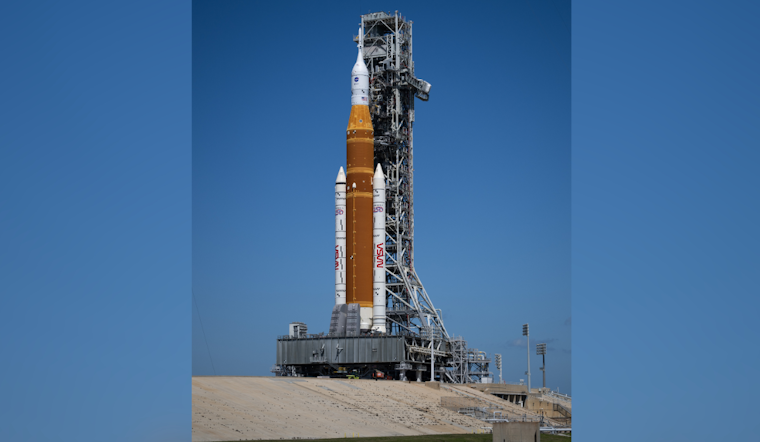
At Cape Canaveral, the countdown to a crewed trip around the moon is ticking right alongside a very terrestrial problem: the people helping keep the launch range safe are on the job, but some are not getting paid.
NASA is pressing ahead with final launch preparations for the Artemis II lunar test flight, even as a Department of Homeland Security funding lapse leaves Coast Guard personnel who help secure Florida’s launch corridor working through the uncertainty. Ground teams at Kennedy Space Center are closing out checks on the Space Launch System rocket and Orion capsule while political negotiations over DHS money drag on in Washington. The result is a split-screen moment for locals, with moon-bound hardware on the pad and unpaid federal workers still out on the water.
NASA still targeting early-April liftoff
NASA completed its Flight Readiness Review on March 12 and polled “go” to proceed toward an April launch attempt, according to NASA. Mission managers have said they plan to move the SLS rocket and Orion spacecraft to Launch Complex 39B the week of March 19 to support a potential April 1 liftoff, with backup opportunities through April 6 and April 30. Officials emphasize that the target date is still conditional on final closeouts and on-pad work.
Coast Guard continues excepted operations
The Coast Guard has directed personnel to continue excepted activities during the funding lapse, but some civilian staff and support contractors are facing delayed pay, according to the U.S. Coast Guard. The service has activated support programs, including no-interest loans and family assistance funds, to help members and civilian employees who miss paychecks. Commanders warn that extended funding gaps wear down morale even as uniformed crews keep critical missions going.
Coast Guard's role on launch day
On launch day, Coast Guard cutters and small boats enforce temporary maritime safety and security zones, clear the waters off Cape Canaveral, and stand ready for search and rescue. Those powers are spelled out in federal navigation rules that let the Seventh Coast Guard District and the Captain of the Port in Jacksonville close waters for space vehicle operations.
These regulated navigation areas are the legal tool that keeps commercial traffic and boatloads of spectators out of harm’s way during liftoffs. Keeping that maritime perimeter fully staffed is a very concrete, operational reason the funding lapse matters to nearby communities and businesses, separate from the political tug-of-war playing out in Washington.
Local scene and political fallout
WKMG’s ClickOrlando first highlighted the uncomfortable pairing of an imminent lunar launch and Coast Guard operations affected by the funding impasse. Community groups and military charities have stepped in with short-term aid for affected families, according to the Coast Guard Foundation. National coverage has tracked the broader DHS funding fight and various emergency pay maneuvers that will determine how quickly unpaid workers are made whole. Local tourism operators and small businesses that depend on launch-day crowds say they are watching two calendars at once: pad work and congressional votes.
What to watch next
Watch for official launch-day notices and published range closures as NASA closes out pad work; the agency’s schedule still centers on early-April opportunities, with exact liftoff times released in the days before an attempt. In parallel, lawmakers in Washington are debating how and when to pay DHS personnel and resolve the lapse, a political outcome that will dictate how long Coast Guard crews, TSA officers, and other frontline workers wait for back pay, according to Federal News Network.



.jpg)