

























































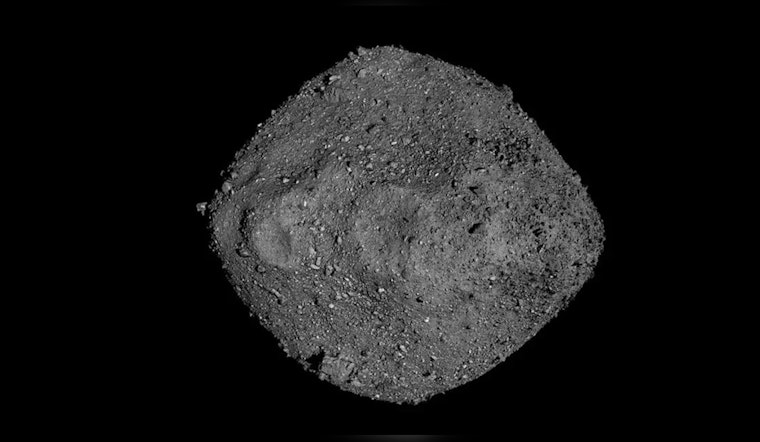
Tiny bits of asteroid Bennu that landed in Houston are doing a lot more than sitting in a display case. Scientists at NASA’s Johnson Space Center say the fragments have finally solved a years long mystery about how Bennu heats up and cools off. Inside the grains, they found dense networks of cracks and odd, sponge like textures that make the surface behave very differently from what Earth based thermal telescopes had suggested, forcing a fresh look at how researchers use thermal infrared data to judge the surfaces of small bodies across the solar system.
What the samples showed
A multidisciplinary team led by Andrew Ryan has published new work that pins Bennu’s unexpectedly low thermal inertia on those internal fracture networks running through its boulders. The study models how heat moves through the rock using X ray CT scans and laboratory thermography on tiny sample particles, and it appears in Nature Communications.
How lab scans scaled to boulders matched spacecraft data
Working inside gloveboxes at Johnson Space Center, researchers used X ray computed tomography along with lock in thermography to map the crack networks and measure how heat flowed through millimeter scale grains. “It turns out that they’re really cracked too, and that was the missing piece of the puzzle,” Ryan said in NASA Science. When the team scaled those heat flow models up to the size of whole boulders, the results lined up with what the OSIRIS REx spacecraft had already measured at Bennu.
Why Earth based telescopes were fooled
Before OSIRIS REx ever pulled into orbit, infrared observations from instruments such as the Spitzer Space Telescope pointed to Bennu having low thermal inertia, a signal that usually means a surface covered in fine, sandy regolith. Once OSIRIS REx started sending back sharp images, though, it revealed a landscape littered with boulders, a clear mismatch that was flagged in early mission papers and reviews. Those pre arrival expectations and the conflict with the spacecraft imagery are laid out in OSIRIS REx mission analyses in Nature Astronomy, and the new sample based work shows that widespread cracking inside boulders can mimic the thermal signature that had been attributed to loose sand.
A slow, careful unboxing
The OSIRIS REx sample canister returned to Earth in September 2023, then headed straight to Houston, where curators spent months on meticulous preliminary work. They were able to access some material early on, but two stubborn fasteners refused to budge, so the team had to design custom, curation approved tools to remove them. Engineers finally freed those fasteners in January 2024, opening the door to a fuller disassembly and detailed study, as reported by Space.com. All that painstaking curation and imaging meant scientists could examine the internal crack networks without exposing the grains to Earth’s atmosphere.
What this means for future studies
Planetary scientists say the findings will reshape how they read telescope based thermal maps, with ripple effects for asteroid hazard assessments and planning future sample return missions. “We can finally ground our understanding of telescope observations of the thermal properties of an asteroid through analyzing these samples from that very same asteroid,” Ron Ballouz said in NASA Science. From here on out, when surveys flag an asteroid with low thermal inertia, scientists will have to consider internal cracking along with fine dust when they infer surface texture from afar.
See a sliver in Houston
For anyone who wants to lay eyes on a piece of this story, Space Center Houston rolled out a public display in March 2024 featuring a 0.15 gram sliver of Bennu, one of only three Bennu samples on public view anywhere. The exhibit, and the behind the scenes curation work at Johnson Space Center, drew local coverage when it opened, as reported by the Houston Chronicle. The rest of the 121.6 grams that OSIRIS REx brought home remains set aside for scientific analysis and long term curation at Johnson Space Center.
Researchers emphasize that this is only the beginning. The returned samples provide a direct bridge from tiny grains in the lab to models of whole asteroids in space, and more studies and new lab techniques are expected to sharpen how scientists interpret distant worlds. For now, Bennu is a pointed reminder that small chips of rock, and the cracks hidden inside them, can overturn big ideas about how our solar system came together.





