

























































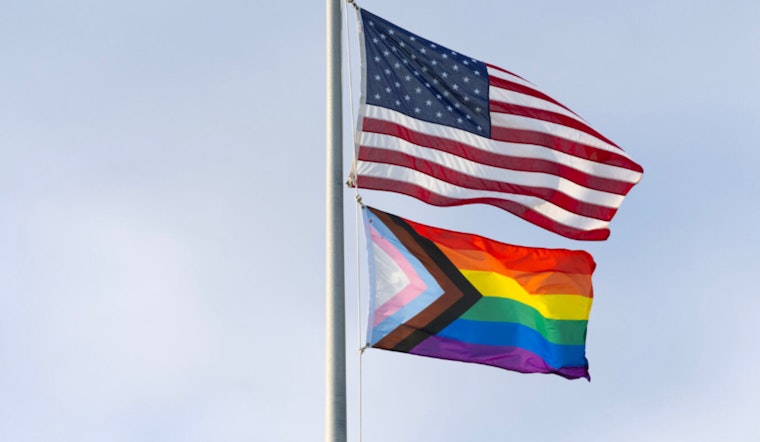
A veteran Los Angeles County engineer is taking his employer to federal court, arguing he should not have to walk under a Pride flag to do his job.
Eric Batman, a senior civil engineer with the Los Angeles County Department of Public Works, sued the county on Tuesday, seeking permission to work from home every June when the Progress Pride Flag is flown at his building. The federal complaint argues that being required to work in a facility flying the flag forces Batman to choose between his religious beliefs and his employment, and it asks a judge to declare that the county violated his religious and civil rights protections.
Batman has worked for the county for 24 years and supervises flood-control and stormwater facilities from an office in suburban Alhambra, according to the San Francisco Chronicle. The suit says he was promoted to senior civil engineer in 2015 and that, instead of granting his requested accommodation, supervisors previously told him to use a back entrance or seek counseling. His lawyers argue that the county refused to engage in the interactive Title VII process that is required for evaluating religious accommodations.
The complaint was filed by Liberty Counsel, which is framing the clash as a religious-rights case, according to the group’s news release. Mat Staver, Liberty Counsel’s chairman, said in the statement that the Constitution “does not allow the government, or a government employer, to put citizens in the impossible position of choosing between their conscience and their livelihood,” as reported by Liberty Counsel. The filing lists attorneys Daniel Schmid and Nicolai Cocis as Batman’s counsel.
County Policy And Pride Displays
Los Angeles County supervisors voted in 2024 to direct departments to raise the Progress Pride Flag over county facilities during June, according to Los Angeles County. The motion called for flag-raising ceremonies at county buildings, including the Kenneth Hahn Hall of Administration in downtown Los Angeles, and asked departments to explore ways to recognize Pride Month. Batman’s lawyers say that the policy means his worksite will display the flag each June, triggering his request to work remotely during that period.
Legal Implications
The complaint cites Title VII and the First and Fourteenth Amendments, and it leans on the U.S. Supreme Court’s 2023 decision in Groff v. DeJoy, which tightened the standard employers must meet to deny religious accommodations. Under Groff, courts require an employer to show that an accommodation would cause a substantial increased cost to its operations, a standard Batman’s lawyers say the county cannot meet here, as summarized by SCOTUSblog. Attorneys who follow religious-accommodation disputes have noted that Groff has made these cases more fact-specific and more focused on the particular burdens any proposed accommodation would impose.
Local Precedent
Batman’s lawsuit is the latest in a run of county workplace battles over Pride displays. In 2024, a Los Angeles County lifeguard filed a federal suit after conflicts about raising the Progress Pride Flag at beach stations, a widely reported clash that highlighted how flag policies can collide with employees’ religious objections, according to UPI. Those earlier disputes show the county has repeatedly faced religious-accommodation demands tied to Pride-related displays.
Batman’s complaint asks the federal court for a declaration that the county violated his rights and seeks unspecified damages. It also recounts earlier instances, the filing says, when he was advised to avoid the building’s front entrance during Pride events rather than receive an accommodation. The Department of Public Works did not immediately respond to a request for comment, according to the San Francisco Chronicle. The county has not yet filed a response, and the case’s schedule in the Central District of California has not been set.
With Pride Month approaching in June, the lawsuit lands in the middle of a broader national tug-of-war between workplace inclusion policies and religious-accommodation rights, a conflict federal courts are still sorting out in the post-Groff era. How the Central District handles Batman’s request could shape how other county employers approach similar accommodation demands in the coming years.





