

























































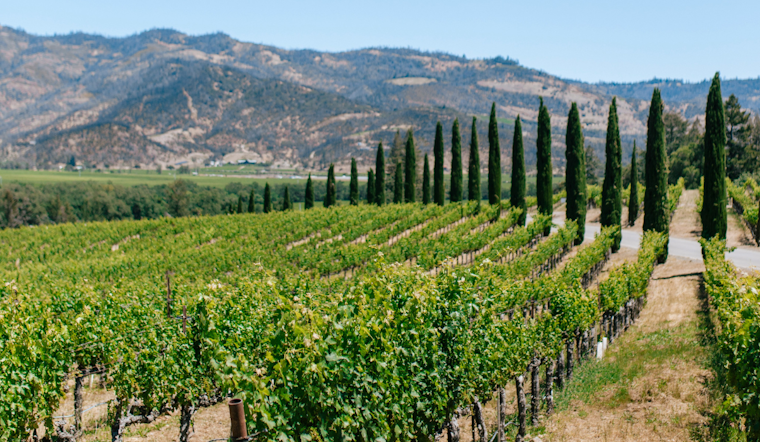
Napa and Sonoma wine country is suddenly full of vine graveyards. Piles of cut canes line the ends of rows, tractors sit idle, and whole blocks are getting ripped out as growers try to cut costs and sidestep buyers who simply are not showing up. Tens of thousands of acres have already come out of production, and industry leaders warn that even more could be pulled in 2026 as wineries wrestle with heavy inventories and slipping demand. The ripple effects are already visible: quieter crush pads, fewer tasting-room pours, and more land being rethought as farmers decide whether to replant, leave fields fallow, or switch to entirely different crops.
Vineyards Are Coming Out Fast
Fresh field mapping puts some hard numbers behind what locals are seeing. As of August 2025, about 477,475 acres of winegrape vines were planted statewide, with roughly 38,134 acres removed between October 2024 and August 2025. Growers describe that level of takeout as unprecedented in recent memory.
The state-level accounting, produced through a Land IQ mapping project and summarized for reporters, is giving regional associations and buyers their first field-verified baseline as acreage starts to shift. The mapping effort, as reported by Agri-Pulse, is already being used to guide replanting decisions and policy talks.
Why Growers Expect The Pullouts To Keep Coming
At the industry’s January trade meeting, speakers were blunt that this correction is not finished. Allied Grape Growers president Jeff Bitter told attendees that another roughly 40,000 acres may be taken out in 2026 as the market tries to claw its way back to balance.
Coverage of the Unified Wine & Grape Symposium has also flagged a sharp slide in shipments. Average monthly winery shipments have fallen from about 55 million cases in 2015 to roughly 46 million in 2024, with an estimated 43 million in 2025. That drop has left hundreds of thousands of tons of grapes effectively stranded in surplus inventory. Those projections and warnings were detailed in reporting by the Napa County Times.
Oversupply, Imports And Younger Drinkers
Analysts say this is not one simple problem, it is a stack of them. Years of big crushes have collided with declining consumption, a growing stream of cheap bulk imports, and a generational drop in routine wine drinking.
Trade and industry reporting has pointed to rising volumes of foreign bulk and tank wine on the market, which undercut domestic grapes at the low end. At the same time, the Silicon Valley Bank State of the US Wine Industry report warns that clearing wholesale inventory could take through 2026 and that structural shifts in drinking habits among younger adults will complicate any recovery.
For context and recent figures on these trends, see reporting from Wine Enthusiast and the SVB State of the US Wine Industry report.
How Farmers Are Fighting Back
On the ground, growers are responding in very different ways. Some are ripping out low-margin blocks that no longer pencil out. Others are replanting with varieties that are more market-friendly or more drought-tolerant, betting on a future where they farm fewer acres but with higher value.
Some operations are shifting land use entirely. In Lodi and parts of the Central Coast, growers reported double-digit acreage removals through 2024 and early 2025. Premium producers on the North Coast, meanwhile, are leaning into quality, focusing on selective replanting and long-term brand value rather than pure volume. Those regional snapshots and the broader industry conversation were summarized by Agri-Pulse.
Policy Fights And The Road Ahead
Industry leaders and analysts are now looking hard at what policy can and cannot fix. They are calling for clearer market signals and targeted changes, from trade tweaks aimed at slowing the flow of low-cost bulk imports to coordinated marketing campaigns that actually speak to younger drinkers. Some are also openly advocating for coordinated acreage reduction to speed up the reset.
The Silicon Valley Bank report has noted public calls for as much as 50,000 acres of net vineyard removals to help bring supply back in line with demand. Statewide coverage is tracking how these proposals collide with local water rules, rising labor costs, and long-running land-use debates over what can and should be grown where.
For a broad state-level view on those pressures, see reporting by the Los Angeles Times and the SVB industry study.
For wine country residents, the near term likely means more vine piles at the edge of every valley road, quieter harvest seasons, and an industry that looks a little different every year. Producers that can retool, by tightening SKUs, finding new markets, or planting varieties that match future demand, could emerge from this correction as smaller but stronger businesses.





