

























































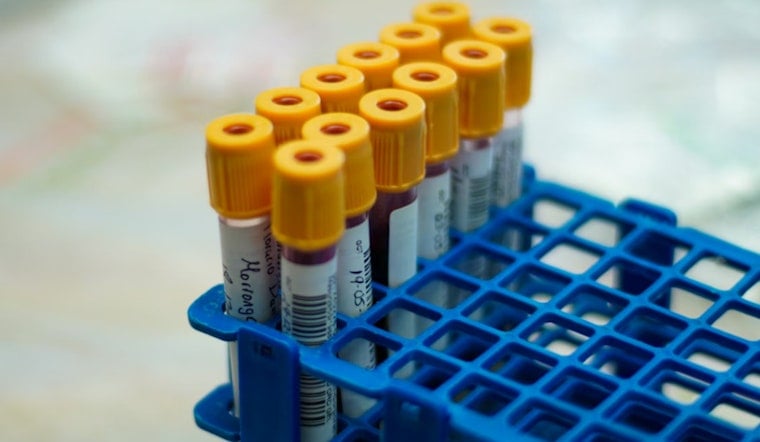
Boston scientists say a routine blood draw might spot the earliest changes of Alzheimer’s long before the brain lights up on high-tech scans, potentially shifting how and when the disease is caught.
Teams at Mass General Brigham, working with the Harvard Aging Brain Study, report that a blood marker called plasma phosphorylated tau 217, or pTau217, appears to flag people who are on an Alzheimer’s trajectory years before symptoms appear. If the results hold up in larger and more diverse groups, the test could help screen people for prevention trials and cut back on pricey brain imaging.
Study Published in Nature Communications
The findings, published April 14 in Nature Communications, center on a mass spectrometry method that measures the percentage of pTau217 in blood, known as %pTau217. Researchers examined how this measure tracked with amyloid and tau PET scans and with long-term thinking and memory.
They report that people with higher baseline %pTau217 accumulated Alzheimer’s brain changes faster over time and were more likely to experience later cognitive decline. In other words, a higher number on this blood test tended to foreshadow both worsening brain scans and future memory problems.
pTau217 Rises Before PET Scans Turn Positive
The team analyzed blood samples and PET scans from hundreds of cognitively healthy volunteers. They found that rising pTau217 levels often showed up before an amyloid PET scan crossed the line into “positive,” while very low pTau217 levels went hand in hand with a very low risk of building up amyloid over many years.
“We used to think PET detection was the earliest sign, but pTau217 can be detected years earlier,” lead author Hyun‑Sik Yang, MD, said in a statement to Mass General Brigham.
Local Impact and Trial Recruitment
Researchers and local clinicians say pTau217 could become a scalable first-step screen to find people who are likely to develop amyloid pathology. That kind of triage could make prevention trials cheaper and faster to run, by reserving PET scans and other intensive testing for those whose blood work suggests higher risk.
Boston coverage of the paper has underscored how Mass General Brigham investigators are helping “push back the clock” on detecting Alzheimer’s in the clinic, as reported by the Boston Herald. The approach could be especially useful at Boston-area memory centers that already follow patients in large long-running studies.
Where Blood Tests Fit Into Care
The U.S. Food and Drug Administration cleared the first blood test to help diagnose Alzheimer’s in May 2025, a milestone that has accelerated the shift toward using plasma biomarkers in clinics. The agency signed off on Fujirebio’s Lumipulse G pTau217/β‑amyloid 1‑42 plasma ratio for adults who already have cognitive symptoms and stressed that results must be read alongside a full clinical evaluation, according to the FDA.
Clinicians point out that FDA clearance for symptomatic adults is not the same as a green light to start screening healthy people who feel fine, no matter how tempting a simple blood draw might sound.
Guidelines Urge Caution
Professional groups are already trying to put guardrails around this fast-moving science. In July 2025, the Alzheimer’s Association released its first clinical practice guideline for blood-based biomarker tests, recommending that they be used primarily in specialty memory clinics and paired with confirmatory testing when results are positive.
The guidance, presented at the Alzheimer’s Association International Conference, also warned that not all blood tests are created equal. The group advised clinicians to pay close attention to each assay’s accuracy and to interpret any result in full clinical context, rather than treating a single lab value as a verdict.
Study Specifics: Who Was Tested and for How Long
The new analysis drew on data from the Harvard Aging Brain Study and included 317 cognitively unimpaired adults, ages 50 to 90, who were followed for an average of about eight years. At baseline, %pTau217 was strongly tied to how much cortical amyloid was already present on PET scans.
In statistical terms, baseline %pTau217 yielded an area under the curve of roughly 0.94 for distinguishing between people with and without amyloid on PET, the authors report in Nature Communications.
What’s Next: Validation and Equity
Next up are larger validation studies that include more diverse participants and real-world clinic settings, along with work on how to fold blood biomarkers into everyday care without swamping patients and doctors with false alarms.
Experts still see unanswered questions about how well such tests will perform in primary care and how to communicate results in a way that is honest and clear. The need for confirmatory testing and careful counseling looms large in a recent JAMA analysis of early blood-test clearances, which highlights just how much fine print comes with a seemingly simple vial of blood.





