

























































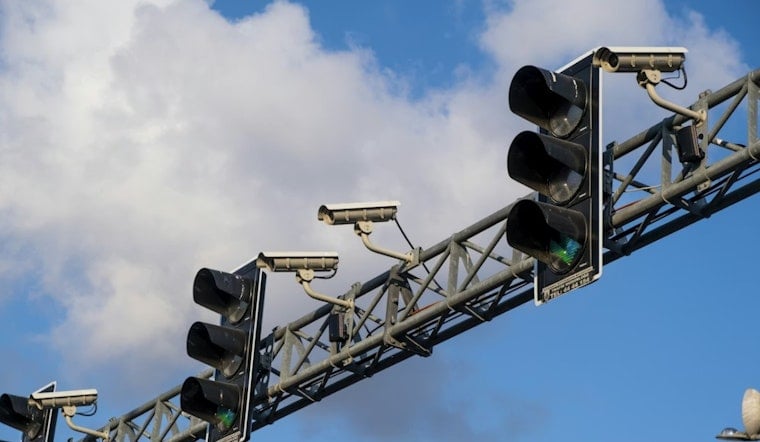
If you are the kind of driver who treats the speed limit as a suggestion, Colorado lawmakers are eyeing you. A bill moving through the state Senate would let automated speed cameras issue civil penalties when a vehicle's average speed tops the posted limit by as little as 6 miles per hour. That would be a big shift from current photo-enforcement practice in Colorado, where fines typically kick in only at higher overages, even as the state and local governments ramp up camera corridors on highways and in work zones.
What SB26-152 Would Change
Senate Bill 26-152 would ratchet down the trigger for automated tickets and overhaul how camera-detected violations are handled. The proposal creates a new penalty schedule, spells out how vendors are paid and sets up a process that allows a registered owner to show they were not the driver at the time of the violation. The measure, sponsored by Sens. Matt Ball and Byron Pelton, also tightens public-notice rules and phases in certain penalty increases, according to the Colorado General Assembly.
New penalties and warnings
Under the draft penalty grid, most drivers clocked about 6 to 9 mph over the posted limit would receive a written warning for a first offense. There is a catch, though. In school zones and construction corridors, that first infraction in the same speed band can carry a fine instead of a free warning.
As reported by the Denver Gazette, the low-range fine in those higher-risk areas would be about $40, while people caught driving 25 mph or more above the limit could see fines of around $120. The draft bill also doubles maximum penalties inside school and work zones and builds in phased increases that would take effect in later years.
Where this matters now
Colorado is not starting from scratch. The state has already begun rolling out automated vehicle-identification systems in work zones, including along CO-119 and on stretches of I-25 north of Denver, where the systems generally flag vehicles averaging about 10 mph or more over the posted limit, according to Colorado Politics.
State speed-enforcement materials describe these camera notices as civil penalties, not criminal citations, and the Colorado Department of Transportation lists a $75 civil penalty at some pilot locations. Program pages also say that active enforcement zones and warning periods will be posted online so drivers can see where cameras are in play.
Signage and owner defenses
The bill would require public notice before any new corridor is activated and would mandate permanent or temporary signs at least 300 feet before the cameras, a move meant to make enforcement clearly visible to motorists, as reported by the Denver Gazette.
SB26-152 also spells out a process that allows a registered owner to submit an affidavit or other evidence showing another person had care, custody, or control of the vehicle when the violation occurred. If that showing is accepted, the notice can be dismissed. The proposal has drawn criticism from privacy and fairness advocates, while supporters argue that stricter automated enforcement will boost safety in high-risk corridors.
What’s next
SB26-152 was introduced on March 31, and the legislature's bill page lists committee activity on April 29. The measure is currently under consideration in the Senate. Lawmakers can still amend the proposal in committee or on the floor before a final vote, so the specific speed thresholds and fine amounts could change as the bill moves forward, according to the Colorado General Assembly.




