

























































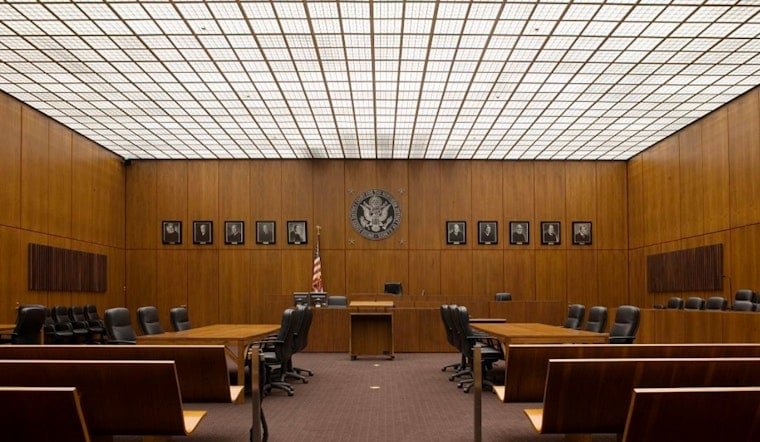
Former Loretto Hospital chief financial officer Anosh Ahmed is back in Chicago after a stint abroad, a return that could speed up federal court action in two sweeping fraud cases tied to the West Side safety net hospital.
Ahmed is accused in an alleged $15 million embezzlement scheme involving vendor payments at Loretto Hospital and is also named in a separate, far larger indictment over purportedly bogus COVID-19 testing claims. Together, the cases have turned a small community hospital into the focus of a sprawling federal investigation.
As reported by Crain's Chicago Business, Ahmed recently returned to the United States after leaving around the time some of the charges were unsealed. According to that outlet, prosecutors and the U.S. Attorney's Office did not immediately respond to questions about his status or next steps.
Federal prosecutors first charged Ahmed and two co-defendants in 2024, alleging they siphoned more than $15 million from Loretto Hospital by routing bogus invoices and payments through sham vendors, according to the Chicago Sun-Times. A later superseding indictment expanded the picture: prosecutors say Ahmed and others used stolen patient data and sham laboratory arrangements to submit fraudulent COVID-19 testing claims, seeking roughly $894.5 million and receiving about $293 million in reimbursements, as reported by WBEZ. The government is pursuing forfeiture of assets it claims are tied to the alleged schemes.
A federal court filing disclosed in January stated that Ahmed was arrested in Belgrade on Nov. 30, 2025, and that the United States submitted a formal extradition package in late January, according to reporting by WTTW. Those filings indicated he remained in Serbian custody while prosecutors sought extradition. Crain's has since reported that he has returned to the U.S. following that process. Court records reviewed by multiple outlets show a July 2026 trial date on the calendar, though defense attorneys have asked for a continuance.
What prosecutors allege
In the embezzlement case, the indictment includes counts of wire fraud, embezzlement and money laundering. Prosecutors allege that Ahmed and his co-defendants created sham vendor companies and used falsified invoices to pull money out of the hospital, according to the Chicago Sun-Times.
The separate COVID-19 testing indictment paints an even bigger alleged fraud. Prosecutors say the scheme relied on fake collection sites, scrambled or misused patient lists and non-operational laboratories in order to bill for testing and generate reimbursements, a narrative detailed by Block Club Chicago and other outlets. On paper, it looked like a vast testing operation. Prosecutors contend much of it existed only to move money.
What is next in court
If Ahmed is now in U.S. custody, a fresh arraignment and a more concrete pretrial schedule could follow relatively quickly. Court papers and public reporting indicate prosecutors had been pushing for a July 2026 trial date, while defense lawyers have been arguing for more time.
Coverage in CFO and previously filed court documents outline a series of timing disputes over discovery, extradition, and how long it will take to prepare for a complex financial trial that spans both traditional hospital contracting and pandemic-era testing programs.
Local fallout
The federal allegations have revived scrutiny of how Loretto Hospital was run during the pandemic, particularly its relationships with vendors and the way high-demand health services were rolled out on the West Side. Earlier stories raised questions about certain vaccine events and who benefited from them, as well as how some contractors got in the door.
Block Club Chicago reporting from 2021 and 2025 detailed Loretto's vaccine controversies and connections between particular vendors and former hospital executives. Community advocates say that history makes the new indictments feel less like a surprise and more like confirmation of long-standing worries about who was really being served.
Legal implications
The charges Ahmed faces carry serious penalties under federal law. Wire fraud statutes typically authorize maximum prison terms of up to 20 years per count, and money laundering and related financial-crime statutes can add additional potential prison time, fines and forfeiture, according to summaries by the Legal Information Institute at Cornell Law School. In practice, sentences in complex financial cases turn on factors such as loss calculations, any cooperation with prosecutors, and how federal sentencing guidelines apply.
Crain's Chicago Business reported Ahmed's return on April 22, 2026. The federal cases remain pending in Chicago, and prosecutors say they intend to move forward based on the evidence laid out in the indictments. Officials at the U.S. Attorney's Office and Loretto Hospital did not provide public comment in response to media inquiries cited in recent reporting.





