

























































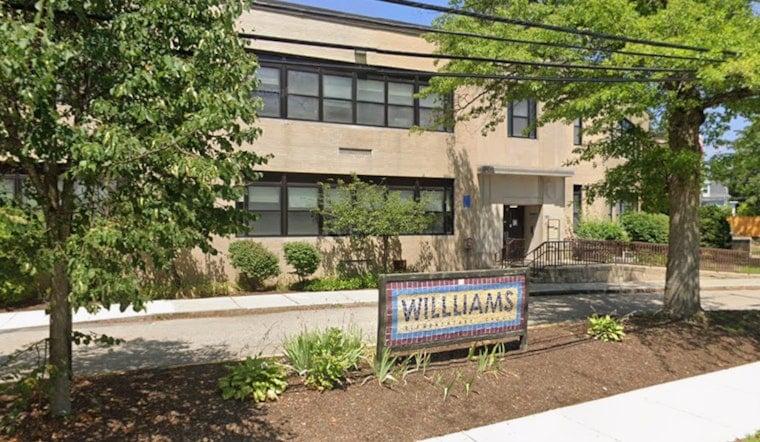
At Williams Elementary in Newton, the city’s Reflections program, which serves children with the most significant disabilities, is anchored at a school where many of those students cannot fully use the playground that is right outside their classroom. The main play structure has no ramps or accessible routes, so children who use wheelchairs or other mobility supports are often left on the sidelines while classmates climb and run. Parents say stopgap measures like mats over wood chips and two accessible swings are a token effort that still leaves kids out of everyday recess and play-based learning.
Families and caretakers have been organizing for years, pressing the district to either build a universally accessible playground at Williams or move Reflections to a campus where students can actually get to the equipment. According to the Boston Globe, the Reflections program launched in the 2021–22 school year and serves about 11 elementary-age students. Families brought their concerns directly to the School Committee in public testimony in February 2025. In a November 2024 letter shared with reporters, parent Toby Merrill wrote, “No one’s taken ownership of fixing this problem.”
Those frustrations spilled into the School Committee’s public comment period on Feb. 10, 2025, where multiple parents, staff and students spoke about playground accessibility at Williams. As reported by Fig City News, commenters described a play yard whose layout and a parking lot between the building and the play space limit safe, usable green space, especially for children who need more room to move. The meeting record and community coverage show just how long families have been pushing for something more than temporary fixes.
City meeting documents show that the district and municipal staff have been talking about the problem for years, but they differ over who should foot the bill and what the plan ought to be. Materials from the City of Newton note that roughly $100,000 has already been spent to bring the site up to minimum ADA standards, and estimate that a full, modern overhaul of the Williams play yard would be about a million-dollar project, made trickier by tight site geometry and existing parking, according to the City of Newton. Those constraints help explain why Williams sits on a long list of capital priorities with no firm timeline for upgrades.
Parents Press For A Fix
Families say the district’s options are straightforward: spend the money to build a fully accessible playground at Williams or move the Reflections classroom to a school where those children can play with their peers. The superintendent and the city’s chief operating officer told reporters that the needed work would cost about $1.2 million, and one parent, attorney David Mahlowitz, said he is weighing legal action under federal civil-rights laws, according to the Boston Globe. Parents and advocates argue that whichever route the city takes, the outcome should make it clear that Newton treats inclusive play as a core part of public education, not an optional add-on for when there is extra cash.
Legal Questions
Federal civil-rights and education laws give parents formal tools to challenge situations where students with disabilities are effectively shut out of school activities, even if academic services are provided. The U.S. Department of Education’s Office for Civil Rights enforces Section 504 and Title II protections and has explained how inaccessible facilities or policies can amount to discrimination, according to the U.S. Department of Education. The Department of Justice also enforces Title II of the ADA for state and local governments, and technical standards from the Access Board spell out how playgrounds must provide accessible routes, appropriate surfacing and usable play components for children with mobility limitations.
For now, Williams remains home to the Reflections program and the center of a drawn-out local fight over how Newton budgets for inclusion. Parents say the city’s next round of capital-planning decisions will reveal whether the district intends to make playtime equally available to all students, and whether officials really want to sort out the question of recess access in a courtroom.


