

























































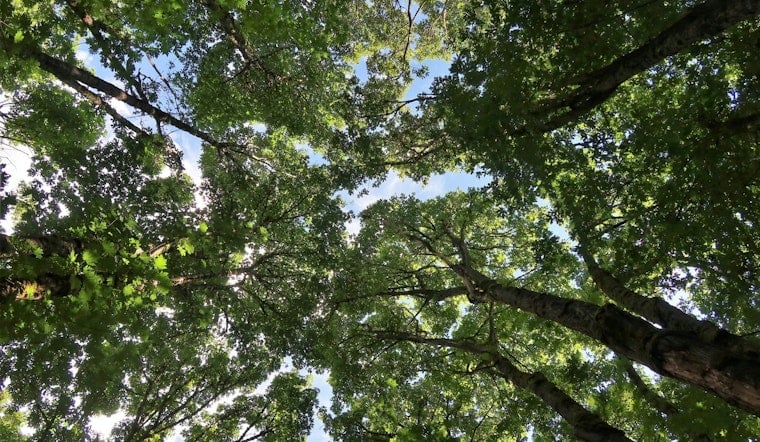
Tampa’s leafy reputation took a serious blow during the 2024 hurricane season, with storm damage wiping out more than three years of growth and knocking the city’s tree cover back to 2021 levels. Researchers estimate roughly 1,200 acres of canopy vanished, leaving once-cool corridors in South Tampa, East Tampa and beyond suddenly exposed to blazing sun and months of piled-up debris. City officials say restoring that shade will be a long, costly climb.
A post-storm analysis led by the University of South Florida used a dot-based review of more than 13,000 randomly distributed points and found that canopy coverage dropped to 29.9% in 2025 from 31.4% in 2024. That works out to a relative decline of about 4.8%, or roughly 1,200 acres. Researchers say the dot method improves accuracy because each point was checked by multiple analysts to confirm whether it landed on tree canopy.
USF’s team took those findings to Tampa City Council on April 16, where councilmembers pushed for follow-up work to separate losses from storms versus those caused by redevelopment and permitted removals, according to the Tampa City Council transcript. Speakers at the meeting urged the city to match any big replanting push with tougher protections and clearer rules on how tree money gets spent, and councilmembers asked staff to go deeper than the usual five-year canopy review.
Where Losses Hit Hardest
The damage did not fall evenly across town. Central Tampa, which includes downtown, Davis Islands and Ybor City, saw the steepest drop at about 8.2%, while South Tampa and the USF area lost roughly 6.2% and 6.9% respectively, according to the University of South Florida. Westshore and New Tampa experienced smaller declines.
Back-to-back storms saturated the ground before strong winds arrived, which made even mature trees more vulnerable and helped generate an estimated nearly one million cubic yards of vegetative debris. Many of those fallen giants were the very trees that had defined neighborhood character and kept streets livable during summer heat.
Money And The Debate Over Who Pays
Tampa’s Tree Trust Fund currently holds about $6 million, but how to use that pot of cash has become its own kind of political storm, as reporting from Creative Loafing details. The city’s mitigation fee, about $300 per removed tree, has critics arguing that it does not come close to covering real-world planting and long-term maintenance costs.
Advocates are also split on strategy. Some want limited funds aimed squarely at planting large, shade-heavy “type 1” trees to quickly cool streets and sidewalks. Others are pushing for more species diversity and a mix of sizes to build resilience so the next big storm does not take out the same uniform canopy all at once.
Rebuilding Won’t Look The Same
Researchers and city staff are leaning hard on the “right tree, right place” mantra. That means choosing wind-resistant species, planting them where they have space to grow, and then actually funding the pruning and watering needed to keep them alive. Utility officials are warning against tucking big trees under power lines again, while scientists recommend a blend of fast-growing and long-lived species to bring back shade and broader ecological benefits.
“When you think about replenishing the urban canopy, it’s a multi-generational project,” USF’s Rebecca Zarger told FOX 13 Tampa Bay, underscoring that residents today are really planting for people decades down the line.
The city has been sharing the analysis and trying to pull residents into the conversation, including hosting a January “Rooted in Tampa” tree town hall and posting resources on planting programs and tree giveaways for homeowners, according to the City of Tampa. Officials say the new canopy data will guide where and what to plant next.
Neighborhood advocates, though, warn that unless the city revisits fees, enforcement and spending priorities, Tampa could end up losing more canopy than it manages to grow back, no matter how many saplings go into the ground.





