

























































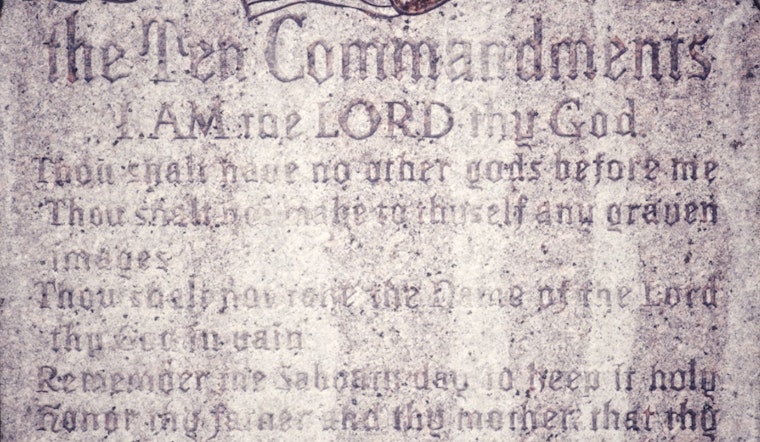
The U.S. Court of Appeals for the Fifth Circuit ruled Tuesday that Texas' S.B. 10, the law requiring the Ten Commandments to be posted in public school classrooms, can stay in effect while the legal fight continues. The decision lifts earlier blocks for some school districts, letting them move ahead with classroom displays as the case keeps moving through the courts. Families and civil-liberties groups that sued to stop the law say they are not backing down.
The appeals court rejected arguments that the statute violates the First Amendment’s Establishment and Free Exercise Clauses and allowed Ten Commandments displays to continue, according to WOAI. That outlet reports that the court reached the merits of the challenge and declined to treat the Supreme Court’s 1980 decision in Stone v. Graham as an automatic bar to enforcing the law.
The ruling follows months of dueling orders and partial injunctions that left enforcement uneven across Texas. A federal judge in August blocked the displays in a number of districts, and other judges later granted related relief, prompting a round of appeals to the Fifth Circuit. Earlier injunctions found parts of the law to be "plainly unconstitutional," according to The Associated Press.
What the court said
The Fifth Circuit’s opinion leaned on precedent that treats the Ten Commandments as both religious and historical, and said the constitutional analysis depends on context and how the text is used in schools. As the Houston Chronicle summarized it, the decision concluded that "S.B. 10 looks nothing like a historical religious establishment" and emphasized that school districts retain discretion over how the displays are presented. That approach mirrors the Supreme Court’s fact-specific handling of earlier Ten Commandments cases.
Lawmakers and supporters react
Supporters of S.B. 10 quickly claimed victory. In a statement to WOAI, Jonathan Saenz of Texas Values called the ruling "one of the most important religious liberty victories for Texas." Senator Phil King, who authored the bill in the Senate, said the court’s move "confirms that the Constitution does not require erasing our history." Representative Candy Noble, one of the House sponsors, said the decision affirms "the historical relevance of the Ten Commandments" in classrooms. Backers argue the statute simply acknowledges a document they see as part of the state’s legal heritage.
Legal implications and what's next
Civil-liberties groups representing the families say they will press on in court and explore every available legal option, with the ACLU calling the fight "a matter of religious liberty and church-state separation" in a press release. The Fifth Circuit has already weighed in on a similar Louisiana law, previously vacating a lower-court injunction there after finding some challenges premature because of unresolved factual questions; the court’s en banc opinion is publicly available.
Legal observers told the Texas Tribune that the mix of rulings from trial courts and the appeals court increases the odds that the U.S. Supreme Court could eventually be asked to step in.
For now, the practical impact depends on where students go to school. Some districts are still covered by local court orders that bar postings, while others have already complied with S.B. 10. Attorney General Ken Paxton has urged districts that are not under a court block to implement the law and has issued a legal advisory defending it, according to the Texas Attorney General’s office. The legal battle is expected to continue with more filings and appeals in the months ahead.




