

























































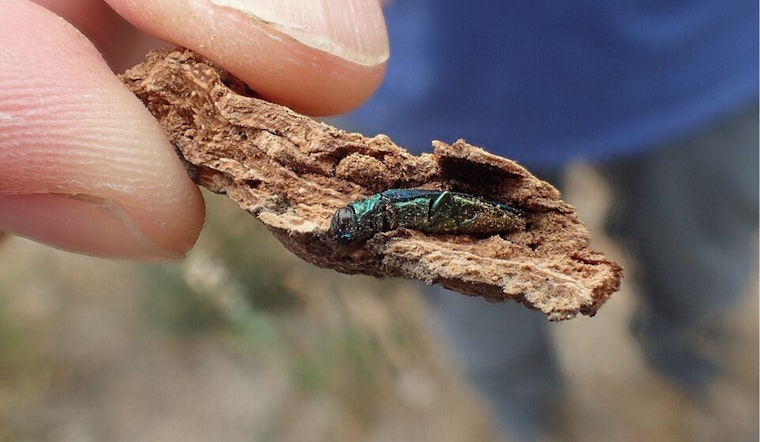
The tiny emerald ash borer that has already killed tens of millions of ash trees nationwide is now confirmed in Wagoner County, putting the county's lakefronts, roadways, and state-park woodlands on notice. Federal and state forestry officials say the invasive beetle is active this spring and into summer, and that homeowners, parks crews, and rural landowners should be paying close attention.
The USDA's Animal and Plant Health Inspection Service confirmed the Wagoner County finding, as reported by KTUL. Officials say the insect has already been recorded in Carter, Choctaw, Delaware, Love, McCurtain, Murray, and Pushmataha counties, continuing a run of detections across southeastern and eastern Oklahoma.
What to watch for
Residents are being asked to watch ash trees for a handful of telltale red flags. These include thinning crowns and dieback that begin at the top of the tree, vertical splits in the bark, patches of bark chipped away by woodpeckers, and the small D-shaped exit holes left by adult beetles.
According to Oklahoma State University Extension, emerald ash borer eggs are laid in bark crevices. After hatching, larvae tunnel in S-shaped galleries beneath the bark, cutting off water and nutrient flow. Adults are most often active from mid-May through early July. The Extension service offers photos and step-by-step guidance for identifying affected ash trees.
How it spreads
While adult beetles can disperse on their own for several kilometers, officials say the big jumps on the map are usually helped along by people moving infested material, especially firewood and nursery stock. Lab flight studies summarized in a USDA Forest Service review show some adults are capable of flying the equivalent of several kilometers over a few days, which helps explain the insect's steady range expansion.
Dieter Rudolph, a forest health specialist with Oklahoma Forestry Services, urged residents to "buy and burn local firewood" to help slow the spread, as reported by KOCO News 5.
What to do now
Homeowners with ash trees they want to keep are being told not to panic, but not to wait, either. Oklahoma State University Extension advises that treatment makes sense only for trees you truly want to save and when the emerald ash borer is known to be within about 25 miles of your location.
Residents who suspect an infestation are asked to take clear photos and email them to [email protected]. State officials have requested that the address be used for reports, according to KTUL. For federal resources and state plant health contacts, officials direct the public to the USDA APHIS pest page for Oklahoma.
Local costs and next steps
State forestry leaders are looking at the national track record and hoping to avoid a repeat. Across the United States, emerald ash borer has killed tens of millions of ash trees and has cost municipalities, property owners, and the forest products sector millions of dollars. Oklahoma officials say they want to keep those losses as low as possible within the state.
The Oklahoma Department of Agriculture, Food and Forestry, and federal partners plan to continue targeted surveys this season to map infestations and decide where to focus limited resources. Guidance from ODAFF and federal research highlights the ecological and economic stakes of losing ash across local forests and neighborhoods.
Officials say monitoring will continue and that early detection remains the best chance to save high-value trees and slow the beetle's advance. For more identification tips and management options, residents can turn to Oklahoma State University Extension and the Oklahoma pest information provided by USDA APHIS.





.jpg)