

























































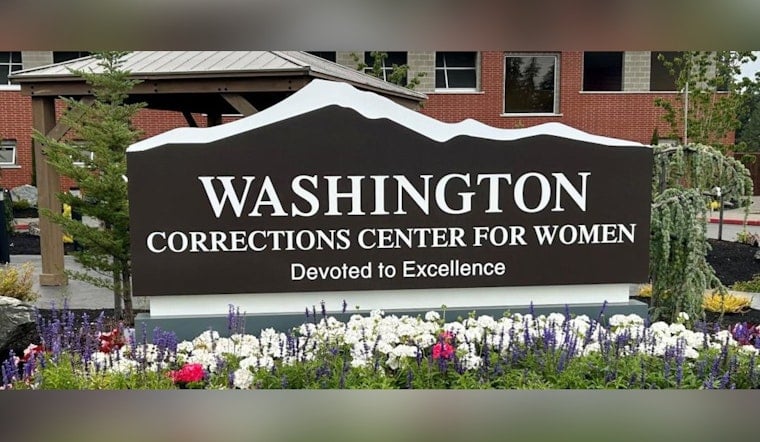
The women’s prison outside Gig Harbor is now under a federal microscope. The U.S. Department of Justice has launched a civil rights investigation into the Washington Corrections Center for Women in Pierce County after allegations that the facility failed to protect incarcerated women from sexual and physical violence by male prisoners who identify as female. Federal officials notified Gov. Bob Ferguson on Tuesday, May 19, 2026, and said investigators will review the prison’s housing and safety practices, along with any formal complaints tied to reported assaults. The probe centers on whether women at the Gig Harbor facility were denied Eighth Amendment protections against cruel and unusual punishment.
In a May 19 press release, the U.S. Department of Justice said its Civil Rights Division will investigate whether the state “engages in a pattern or practice of violating the constitutional rights of female prisoners” at WCCW and will examine allegations of sexual assault, rape, voyeurism and sexual intimidation. Assistant Attorney General Harmeet K. Dhillon said the division “will not allow women incarcerated in jails or prisons to be subject to unconstitutional risks of harm,” and Interim U.S. Attorney Neil Floyd for the Western District of Washington also urged the state to protect women inmates. The agency said the review will be conducted under the Civil Rights of Institutionalized Persons Act and stressed that it has not reached any conclusions.
The investigation follows at least three civil suits by women who say they were attacked at WCCW, according to The News Tribune. In court filings and local reporting, plaintiffs describe the alleged assailant as a “biologically intact” male and convicted child sex offender who was transferred to the women’s facility after self-identifying as a woman. The same reporting notes that the Department of Corrections told local media in 2024 that roughly 2 percent of the department’s population identified as transgender.
The Washington Corrections Center for Women, near Gig Harbor, is the state’s primary women’s facility and lists an operating capacity of about 738 beds, according to the Washington Department of Corrections. DOC materials describe a formal transgender housing policy that requires mental health and medical assessments and a multidisciplinary review of transfer requests. The department says the case-by-case system is designed to prioritize the safety of all residents, and DOC publications also reference routine PREA screening and periodic housing reviews at WCCW.
Part of a Broader Federal Review
The Washington inquiry is part of a wider effort by the Justice Department to scrutinize where and how transgender prisoners are housed. In March, the agency notified California and Maine that it was investigating whether housing biological men in women’s prisons violated inmates’ constitutional rights, as outlined in a March notice from the Justice Department. That move, along with the new Washington probe, has pushed prison placement policies into the national spotlight as states and the federal government wrestle with safety, privacy and equal-protection concerns.
Legal Authority and Possible Outcomes
Under the Civil Rights of Institutionalized Persons Act, the Attorney General may investigate conditions in state and local institutions when there is reasonable cause to believe a pattern or practice of constitutional violations exists. The Justice Department can then seek injunctive relief or negotiate remedies such as consent decrees or monitoring agreements. According to the Legal Information Institute, CRIPA is aimed at systemic problems rather than isolated incidents, and past CRIPA inquiries have led to long-term reforms in some correctional systems.
Gov. Bob Ferguson’s office did not immediately issue a public statement, and a DOC spokesperson told local reporters the agency was reviewing the notification and that it takes allegations of assault seriously, The News Tribune reported. The Justice Department said it is encouraging people with relevant information to come forward as it collects documents and examines the state’s policies and practices.
As part of the review, investigators are expected to request records, interview staff and residents, and tour the facility. For now, the department is in fact-gathering mode. The inquiry could ultimately close with no finding, prompt voluntary corrective steps by the state, or, if DOJ concludes there is a systemic violation, result in litigation or a negotiated remediation plan.





