

























































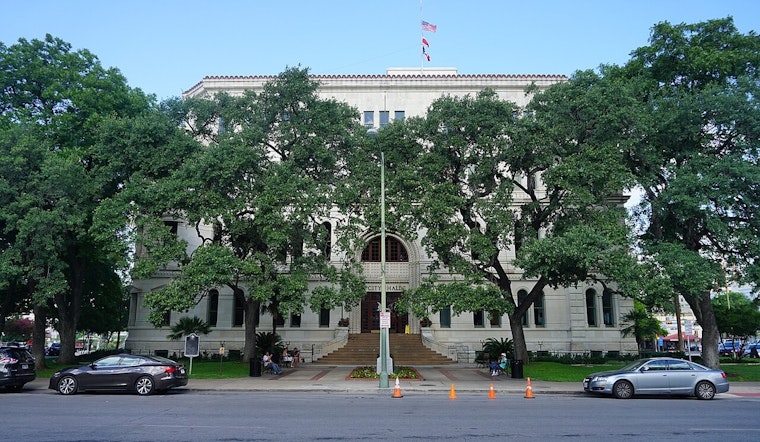
San Antonio could soon put some legal muscle behind the idea of looking out for your neighbors, if a new policy push at City Hall survives a tangle of state rules.
Councilmember Jalen McKee-Rodriguez has filed a Council Consideration Request (CCR) for a package called the LOVIN policy, short for Looking Out for Vulnerable Impacted Neighbors. The proposal asks city staff to study ways to guarantee access to public restrooms, shield personal health information, expand single-occupancy restrooms and refine how identification is issued and recorded. The plan lands at a time when recent state actions around restroom access and ID rules have raised fresh legal and enforcement questions for local governments.
McKee-Rodriguez framed the measure as a response to what he called "hateful rhetoric and legislation" and said San Antonio has "a responsibility as a city to demonstrate our commitment to the dignity, safety, and well-being of all of our residents," according to the City of San Antonio. The CCR was filed April 13, and the release notes that the request was developed with local advocates and carries supporting signatures from multiple councilmembers. City materials say the next step is a staff recommendation and a Governance Committee hearing, with a date still to be determined.
Local reporting says the CCR would direct staff to study concrete changes, including making single-user restrooms more widely available and examining whether city-issued credentials such as library cards should reflect a user’s gender identity, as reported by KENS5. Supporters on the council include Sukh Kaur, Phyllis Viagran, Edward Mungia and Teri Castillo, who signed on to the CCR, according to the San Antonio Report. Local advocates have praised the measure as a practical, city-level attempt to shore up safety for immigrants, people experiencing homelessness and queer residents.
How state law could complicate the plan
Hovering over the whole conversation is the Texas Women’s Privacy Act (Senate Bill 8), which requires multiple-occupancy restrooms in government-owned facilities to be designated by biological sex and authorizes civil penalties of $25,000 for a first violation and $125,000 for a second or subsequent violation in its enrolled text. The Texas Legislature also lays out a complaint-and-notice process that can lead the Attorney General to seek penalties if a political subdivision does not cure an alleged violation.
City officials have published guidance saying San Antonio will comply with applicable state law while staff reviews the CCR and its recommendations, which means any local changes will have to be carefully threaded through that legal needle.
Next steps and political stakes
The CCR is set to be reviewed by city staff and routed to the Governance Committee for a recommendation before the full council would consider any ordinance or policy changes. McKee-Rodriguez has said he hopes the measure will clear committee and reach the full council, as reported by KENS5.
Advocates are pushing for quicker local protections, while city attorneys and officials will be tasked with designing any changes in a way that minimizes exposure to state enforcement and civil penalties. Expect the Governance Committee debate to hinge on how far San Antonio can go in boosting safety and dignity for vulnerable neighbors without triggering the legal and financial tripwires built into state law.





