

























































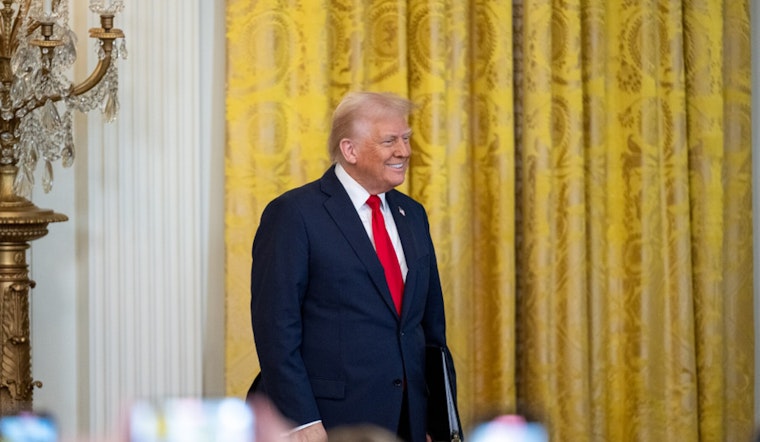
President Donald Trump used his Sunday to send a blunt message to the federal bureaucracy: stop signing off on foreign-made goods and start buying American, period. He ordered federal agencies to stop granting exceptions that let the government purchase foreign-made products, declaring, “All federal agencies must buy American, no excuses!” and blasting what he called “waiver loopholes” and the days of “handing out waivers like candy.”
What the order does
The move builds on Executive Order 14392, a March directive aimed at tightening enforcement around “Made in America” claims and federal procurement. According to the White House, the order directs the Federal Trade Commission to prioritize enforcement and instructs agencies to review and verify American-origin claims across government-wide contracts.
Stronger procurement checks
Under the order, agencies that manage government-wide acquisition contracts must periodically verify “Buy American” and similar American-origin claims. Products that are found to be misrepresented can be removed from procurement availability. The Federal Register version of the executive order specifies that contractors who misrepresent origin can be referred to the Department of Justice for potential action under the False Claims Act. The full text and implementation language appear in The Federal Register.
Waivers and the "candy" line
Trump framed the push as a direct rebuke to what he describes as “rubber-stamping” exceptions for foreign products, insisting there should be “no more handing out waivers like candy.” That line, and the administration’s new emphasis on cracking down, were reported by the Tampa Free Press on May 10, 2026, which reproduced the president’s Truth Social post.
Why waivers matter
Waivers to Buy America and Buy American requirements exist for cases where sourcing domestically is impractical or would substantially increase costs. Tweaking those rules can shift where federal dollars flow and which firms ultimately win contracts. Analysts note that procurement preferences are a powerful lever for reshaping supply chains, and that tightening waivers can boost some domestic industries while driving up costs or causing delays for projects that rely on specialized foreign inputs. The Center for Strategic and International Studies has outlined how waiver rules interact with existing Buy America statutes and grant programs, and CSIS has tracked those tradeoffs.
What lawyers and businesses are saying
Legal advisers point out that EO 14392 heightens enforcement risk for companies that advertise U.S. origin without strong support, even though it does not change the FTC’s “all or virtually all” substantive standard for Made in USA claims. Law firm guidance warns that the FTC may press online marketplaces to create verification procedures for country-of-origin claims, which could ripple through e-commerce compliance programs. In a client update, Holland & Knight recommends firms audit their Made in USA claims and prepare for deeper agency scrutiny.
What to watch next
Implementation will unfold through agency rulemaking, contract reviews, and enforcement referrals. The White House has made clear that the order must be executed “consistent with applicable law and subject to the availability of appropriations.” Companies are watching the FTC for prioritized enforcement actions and any proposed rules on marketplace verification, and they can look to the agency’s business guidance on Made in USA claims as a baseline for compliance. For background on that standard, see the FTC’s “Complying with the Made in USA Standard” guidance in the FTC resources.




