

























































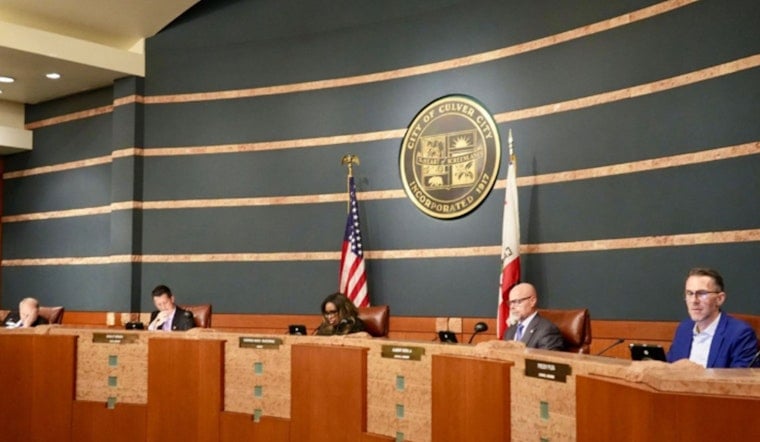
Culver City’s fight over a new In-N-Out got so tangled that the City Council broke out a die. After a tense public hearing and some procedural gymnastics, the council voted to impose a 45-day moratorium on new drive-through building permits, filling a vacant seat on the vote by literally rolling for it. The motion passed 4-0 and sends the issue back to city staff and the Planning Commission for follow-up work.
The moratorium, framed as an "interim urgency ordinance" that temporarily halts the issuance of any new building permits or entitlements for drive-through uses, appeared on the council’s June 8 agenda and was adopted by motion. According to the City of Culver City agenda, the council directed staff either to draft a regular ordinance for direct council consideration or to route proposed zoning changes to the Planning Commission for a recommendation. The meeting packet also highlights the four-fifths vote requirement for urgency ordinances under state and local rules.
Council members Dan O’Brien and Albert Vera recused themselves because of potential conflicts of interest. O’Brien stepped aside because of his work with the Chamber of Commerce, and Vera did so because one of his businesses sits near the proposed site. That temporarily left the council without enough members to meet the supermajority threshold. To solve the problem, the council used a random selection process, rolling a single die under a Political Reform Act exception to determine which recused member could participate. Vera rolled the higher number and took the seat for the vote, as reported by Culver Crescent. City attorneys said the move allowed the council to comply with ethics rules while still addressing what staff described as an urgent public safety issue.
Residents filled the chamber to oppose a planned In-N-Out at Jefferson and Sawtelle, and local reporting said a petition against the project had gathered more than 900 signatures. Assistant City Manager Christina Burrows told the council that any urgency ordinance would need to be linked to "current and immediate threats to public safety, health or welfare," citing vehicle idling, smog, and pedestrian danger, according to Culver City Crossroads. Supporters of the moratorium stressed that it would not affect existing drive-throughs but would give the city time to create consistent rules for future proposals.
What the Proposed In-N-Out Would Include
The company’s pre-application materials on the city’s project page describe a one-story restaurant of roughly 3,887 square feet at the northeast corner of Sawtelle and Sepulveda, generally addressed as 11046 Jefferson Blvd. The plans outline about 84 indoor seats, 44 outdoor seats, a 26-car drive-through queue, and 61 parking spaces, according to the City of Culver City. Those figures were presented at a February community meeting and appear in the city’s project materials. Neighbors pointed to queuing, traffic, and the site’s proximity to El Rincon Elementary as central concerns.
Next Steps and the Legal Path
The 45-day moratorium gives staff a window to draft a permanent ordinance or prepare a zoning amendment for Planning Commission review, in line with the council motion and meeting packet direction. The city can extend an urgency moratorium only if it makes specific findings about an immediate threat to public safety, health, or welfare; Culver Crescent notes that state law allows such measures to be extended for up to two years in narrow circumstances. Officials said they want a consistent policy that balances safety, environmental goals, and economic development, but any long-term ban would require additional hearings and formal findings.
Part of a Bigger Trend?
Culver City is not alone in rethinking drive-throughs. Municipalities around the country have moved in recent years to restrict or closely review new facilities as they weigh traffic, pedestrian safety, and greenhouse gas reduction goals. Minneapolis, for example, enacted a citywide ban on new drive-throughs in 2019 as part of its comprehensive planning effort, according to the Star Tribune, while other cities have leaned on moratoria or zoning changes to deal with queue-related congestion. That wider trend helps explain why Culver City leaders signaled they prefer a clear city policy instead of case-by-case approvals.
For now, the moratorium pauses new drive-through projects while the council and Planning Commission study traffic, health, and neighborhood impacts. Residents on both sides of the issue will get another chance to weigh in when staff returns with proposed code language and public hearings are scheduled in the coming weeks.





