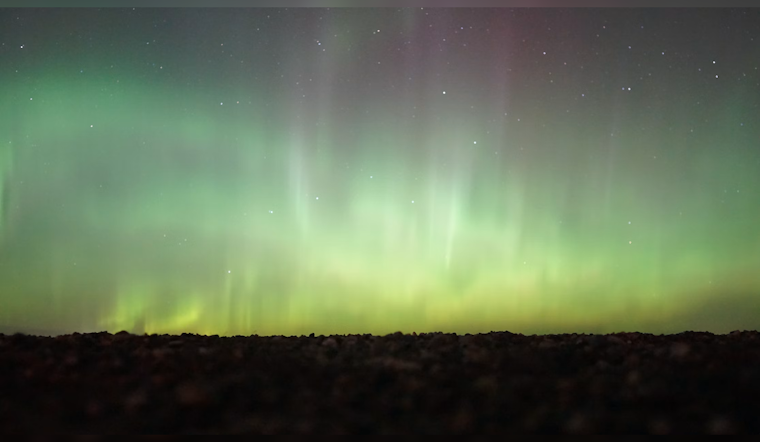
When the sky over southeastern Minnesota lit up with aurora in May, the real shock hit at ground level: GPS-guided planters suddenly lost lock, forcing farmers to park equipment during one of the tightest planting windows of the year. Growers who depend on satellite steering watched machines veer off course or stop cold, and one recent estimate ties those outages to roughly $1 billion in lost corn revenue across the Midwest. The disruption piled on top of spring weather delays and left operators weighing a lousy choice between risky manual passes or missed planting days.
As reported by MPR News, Blooming Prairie farmer Patrick O'Connor said his GPS-guided tractor was effectively grounded after the geomagnetic "Gannon" storm, leaving parts of his fields unplanted as the planting window closed. A now-viral image of a tractor under the northern lights, captured by photographer Tiffany Graham, became shorthand for how a spectacular sky show lined up with a very practical breakdown on the farm.
Study Puts Price Tag On Planting Delays
According to a Kansas State University analysis, GNSS outages during the May 10–11, 2024 "Gannon" storm triggered planting delays that translated into an estimated 17.4 million to 424 million bushels of foregone corn. Depending on the scenario, that corn would have been worth between about $69.6 million and $1.7 billion. The paper spells out its assumptions in detail, including planter capacity, field efficiency, and late-planting yield penalties, so the final dollar figure depends entirely on which set of assumptions you pick.
Why GPS Guidance Failed In The Heartland
Scientists say the Mother's Day storm briefly hit the highest G-scale severity and supercharged the ionosphere, creating the total electron content spikes and scintillation that can knock out RTK and other GNSS receivers for hours at a time. NASA detailed how the "Gannon" event scrambled signals, cataloging its ripple effects across satellites, flights and power systems, along with the guidance failures on the ground.
What It Meant For Farmers
The same Kansas State University report models a representative Illinois corn farm losing roughly $12,000 to $17,000 in revenue because of the outage. From there, the authors scale up across farms exposed to similar conditions to arrive at the headline regional totals. Behind the spreadsheet is a real-world fork in the road: keep planting without precision guidance and risk crooked rows, skips and overlaps, or sit out the outage and accept yield penalties for late planting. The study walks through those tradeoffs in its methodology and sensitivity checks.
How Farmers And Markets Could Hedge Risk
Researchers and economists say short-term, localized forecasts of GNSS trouble known as nowcasts could blunt some of that risk. If farmers knew a regional RTK outage was coming, they could make more informed calls about whether to hustle and finish a field, pause and wait it out, or switch tactics. A peer-reviewed valuation of RTK outage nowcasts found that timely warnings can deliver measurable economic benefits for operators dealing with brief disruptions, strengthening the argument for better space-weather monitoring and redundant navigation systems, according to ScienceDirect.
"It's not catastrophic, but they'll miss it," Terry Griffin told NASA, summing up what a high-tech failure delivered from the Sun can mean on the farm. For growers who count on centimeter-level steering, the Gannon storm was a vivid reminder that stunning auroras can arrive with a very real, very expensive sting.