

























































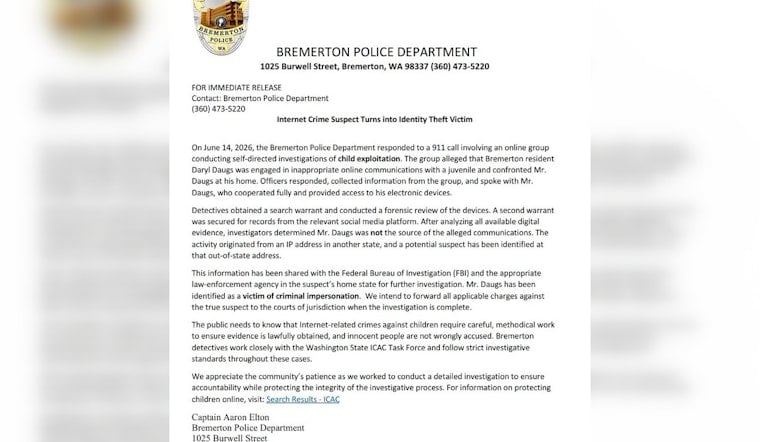
A Bremerton homeowner wrongly accused in a doorfront confrontation by an online investigator group has been cleared by police, who say digital forensics point to someone else entirely. Detectives now consider the local man a victim of criminal impersonation while they chase a potential suspect in another state.
Police: Digital Trail Leads Across State Lines
According to Bremerton police, the case kicked off on June 14, when officers responded to a 911 call after members of an independent online group showed up at a homeowner’s door. The group claimed he had exchanged inappropriate messages with a minor.
Detectives obtained search warrants and conducted forensic reviews of the man’s devices and social media accounts. Investigators say the evidence cleared the homeowner, showing he was not the person behind the offending messages. Instead, police report that the communications traced back to an IP address in another state, where they say a potential suspect has been identified. Bremerton police have shared their findings with the FBI and out of state law enforcement partners, according to FOX 13 Seattle.
Vigilante Stings Can Miss the Mark
So called “predator catcher” operations have become a social media genre of their own, turning confrontations into viral content. Law enforcement officials, though, have repeatedly warned that these amateur stings can muddy legitimate investigations and sometimes point fingers at the wrong person.
Deputies and longform reporting have documented instances where homegrown sting videos complicated prosecutions or dragged in innocent bystanders, as reported by News4JAX and examined in depth by The New Yorker.
Identity Theft Cases Often Jump Borders
Cases involving online impersonation and hijacked accounts frequently cross state lines, which often pulls federal agencies into the mix when digital trails lead outside local jurisdictions. The FBI’s 2025 Internet Crime Report notes rising complaint numbers and increasingly sophisticated schemes, according to the FBI IC3.
Closer to home, a separate federal case this summer saw two Bremerton residents plead guilty to mail based identity theft and bank fraud. Prosecutors say the case shows how stolen mail and personal data can be used to drive broader fraud networks, according to the U.S. Department of Justice.
What To Do If You Are Targeted or Falsely Accused
For anyone who discovers suspicious accounts in their name or finds themselves suddenly accused online, police and consumer advocates stress documentation and restraint. Save everything you can: screenshots, timestamps, message histories and device logs. Avoid in person confrontations that can spiral or contaminate evidence for investigators.
Report the issue to your local department, such as the Bremerton Police Department, and follow its victim fraud and identity theft guidance. Federal tools, including IdentityTheft.gov, can help you build a step by step recovery plan and notify the appropriate agencies about the crime.
Legal Status of the Case
Bremerton police say the homeowner is being treated as a victim of criminal impersonation. The department has not released the name of the potential suspect or the state where that person is located, and it is not yet clear whether any charges have been filed.
Investigators say they have turned over their findings to the FBI and out of state law enforcement partners while the case continues, according to FOX 13 Seattle.





