

























































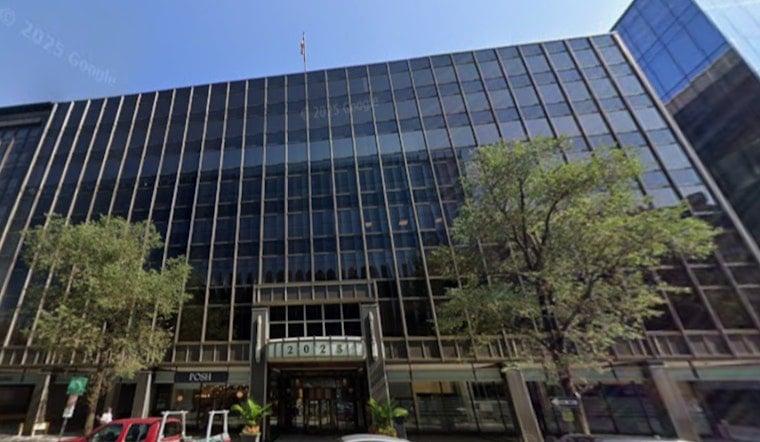
The eight-story West End office building at 2025 M St. NW, roughly 191,000 square feet, is taking a hard turn away from the cubicle life and is now being marketed to investors as an office-to-residential conversion that could deliver about 260 apartments. Brokers say the property, which went into receivership late last year, is expected to march toward full vacancy by the end of January 2027 as the last office tenants wind down their leases.
Marketing materials pitch the building squarely as a conversion play, and the listing agent told the Washington Business Journal the site could accommodate roughly 260 apartments. Local reporting shows the asset was placed into receivership after issues with its CMBS loan, and its biggest remaining tenant is Radio Free Asia, which occupies about 89,000 square feet. Commercial Observer has detailed the loan distress and the shift of the debt into special servicing.
Conversion math: zoning, parking and tax breaks
An offering packet from Avison Young pegs the property at about 191,248 rentable square feet and highlights three levels of below-grade parking with roughly 240 spaces, a combo that brokers say helps make an apartment reuse more realistic. The same materials note that the building sits in a D-5 zone, which allows multifamily use by right, a key zoning box checked for would-be apartment developers. The listing brochure lays out those physical and zoning basics.
The proposed project would also be eligible for the District’s Housing in Downtown program, a 20-year tax abatement targeted at residential conversions in the core. DMPED describes how the HID abatement works, who qualifies and what the application process looks like, details that will factor heavily into any buyer’s pro forma.
Loan trouble and ownership
The building was purchased in 2015 by an affiliate of Brazilian retail magnate Michael Klein for about $106 million, a deal financed with a CMBS loan that later ran into trouble as payments were missed. Commercial Observer reports that the loan’s move into special servicing and its maturity issues set the stage for the appointment of a receiver and the current sales push.
What it means for downtown housing
Washington’s current incentive stack and a recent wave of downtown conversion approvals mean any buyer circling 2025 M will be running numbers not just on construction costs, but on how much the city’s tax abatement, zoning relief and permitting pathways can soften the blow. The Housing in Downtown program has helped create a growing pipeline of office-to-residential projects across the city, giving developers a clearer playbook for conversions of this size. A development map tracks dozens of active and proposed adaptive reuse projects, including several large downtown conversions that offer a preview of what 2025 M could become.
Legal status and next steps
For now, 2025 M remains under court control while brokers shop the asset, and the sale is being handled through a receivership process rather than a traditional marketed sale. In an email to Bisnow, Avison Young vice president Joe French said his team had evaluated dozens of potential conversion candidates and that only a handful met today’s underwriting bar, adding that 2025 M showed the “strongest” opportunity in the bunch. Bisnow also reports that court-appointed receiver Trigild IVL is overseeing the marketing effort.
Any buyer that steps up will still have to wrestle with the big-ticket questions that come with office-to-residential deals in downtown D.C., including construction and financing costs, permitting timelines and the availability and scale of HID tax support before committing to a full residential overhaul.





