

























































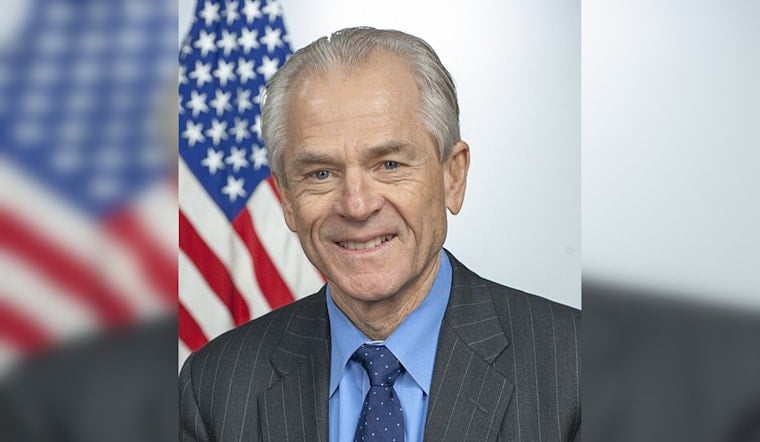
An 11-state coalition led by Oklahoma Attorney General Gentner Drummond has filed a friend-of-the-court brief asking the full U.S. Court of Appeals for the D.C. Circuit to rehear former White House adviser Peter Navarro's contempt of Congress case, arguing a three-judge panel misread the word “willfully” in the federal contempt statute in a way that could ripple far beyond Washington.
Navarro was convicted of refusing to comply with a subpoena from the U.S. House committee investigating the Jan. 6, 2021 Capitol riot, and a D.C. Circuit panel unanimously upheld that conviction on July 21, 2026, according to Courthouse News. The panel — Judges Patricia Millett, Cornelia Pillard, and J. Michelle Childs — ruled that executive privilege must be formally asserted by the president, and that a witness's subjective belief in privilege does not excuse deliberate defiance of a subpoena. Judge Millett noted that Navarro asserted executive privilege within three minutes of learning about the subpoena, without ever communicating with Donald Trump, per that same account.
Navarro's attorney, Abhishek Kambli, filed the petition for en banc rehearing on August 4, as reported by the Washington Examiner. The petition argues the panel leaned on outdated precedent in interpreting what it means to “willfully” default under 2 U.S.C. § 192, the federal contempt of Congress statute. That statute, enacted in 1857 to enforce legislative oversight powers, makes it a federal misdemeanor for any witness summoned by Congress to willfully make default, carrying penalties of up to one year in prison and $100,000 in fines, according to the U.S. Department of Justice.
A 65-Year-Old Precedent Under Fire
The D.C. Circuit panel based its ruling on its own 1961 decision in *Licavoli v. United States*, which held that “willfully” under the statute requires only a deliberate refusal to comply with a subpoena — not proof of an evil motive or knowledge that the conduct was unlawful, as reported by KOKH. Coalition court documents argue that standard clashes with modern U.S. Supreme Court jurisprudence, which conservative legal groups say requires prosecutors to prove a defendant knew their conduct was unlawful.
Drummond framed the stakes in blunt terms. “No American should face prison because a court, rather than a legislature, decided what willfully means,” Drummond said, per the outlet's report. He added that the ruling “will have a trickle-down effect on how Oklahoma courts read Oklahoma laws.”
Why State Attorneys General Are Watching Closely
The coalition brief — joined by Oklahoma, Alabama, Florida, Iowa, Kansas, Missouri, Montana, Nebraska, South Carolina, Texas and West Virginia — contends that federal appellate interpretations of statutory willfulness matter well beyond Navarro's individual case. Drummond's office says state courts routinely consult federal appellate rulings when interpreting their own legislative-contempt and administrative subpoena laws, meaning the D.C. Circuit's reading could reshape how states punish witnesses who defy state legislative subpoenas.
Navarro's case is not the only one to hinge on the *Licavoli* standard. In May 2024, the D.C. Circuit cited the same precedent to affirm the contempt conviction of former Trump strategist Steve Bannon, whose parallel legal saga Hoodline previously chronicled in February. Bannon also served a four-month federal prison sentence before the Department of Justice moved in February 2026 to dismiss his indictment with prejudice.
Navarro has already completed his own four-month sentence at the low-security Federal Correctional Institution in Miami, serving from March 19 to July 17, 2024, after the U.S. Supreme Court declined to stay his sentence pending appeal, according to PBS. He was the first former White House official imprisoned for contempt of Congress. Even so, the legal fight continues, since en banc review — or eventual Supreme Court intervention — could set new limits on executive privilege claims and congressional oversight power nationwide.
The Underlying Subpoena Fight
The House Select Committee investigating the Jan. 6 attack subpoenaed Navarro in February 2022 to probe his role in the so-called “Green Bay Sweep,” a strategy aimed at delaying congressional certification of the 2020 presidential election results — a scheme Navarro had already detailed in his 2021 memoir, according to Courthouse News' reporting.
Drummond's push comes as he campaigns for Oklahoma governor ahead of the state's June 2026 Republican primary, a race Hoodline has covered as part of a crowded field of contenders. It is also not the first time Drummond has organized a multistate legal coalition to press federal policy, having led a similar effort involving 50 attorneys general last year targeting illegal offshore gaming. For now, the D.C. Circuit has not indicated whether it will grant the rehearing request.





