

























































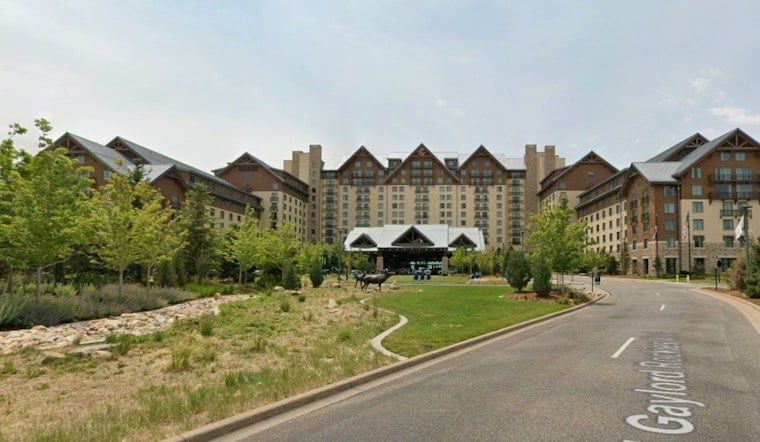
Gaylord Rockies Resort & Convention Center in Aurora is drawing fresh scrutiny over whether it needs more taxpayer help to expand, even as the property posts record revenues and dominates its Denver-area competitive set. The Colorado Economic Development Commission went into executive session on August 20 to discuss the resort's existing Regional Tourism Act award, with the matter expected to return for a public vote at a likely September meeting.
The timing is notable. As reported by the Denver Gazette, no formal incentive proposal had been submitted as of the report, but a state commission source said Gaylord Rockies is expected to submit one. The resort's owner, Ryman Hospitality Properties, has separately said it is contemplating an expansion and has reportedly discussed investing more than $300 million in an additional hotel tower and water-park addition, according to the same report.
Those plans track closely with municipal filings submitted to the City of Aurora back in August 2024, which outlined a two-phase project adding 450 guest rooms — bringing the resort's total to more than 1,950 rooms — alongside a 47,000-square-foot indoor water park called Soundwaves, as reported by The Real Deal. The water park is designed to mirror a similar feature at Ryman's Gaylord Opryland property in Nashville, which recently drew its own headlines for major capital reinvestment and holiday programming, as Hoodline reported.
A Legal Roadblock Finally Clears
One major obstacle to that expansion appears to have fallen away. In July, Ryman dropped a long-running property tax lawsuit against Adams County after the Colorado Court of Appeals upheld a $676.5 million valuation of the resort — far above the $270 million figure Ryman had argued for, according to 9News. Resolving that fight removed a local roadblock that had stalled the physical buildout and, per the Denver Gazette's reporting, appears to have cleared the way for state-level incentive talks to resume.
Gaylord Rockies is now also the largest single taxpayer in Adams County. Ryman told investors during its August 2026 earnings call that the resort achieved record performance in 2026 and maintained a trailing 12-month RevPAR index near 130% of its competitive set, a strong profitability signal even as the company weighs asking for more public support.
The Numbers Behind the Original Deal
The scale of public money already flowing to the property is not small. The city of Aurora and the Aurora Economic Development Council awarded roughly $300 million in tax-related incentives to Gaylord Rockies, and Aurora has agreed to refund 96.3% of sales tax collected there, 96.25% of its lodger's tax, and 93.3% of its use tax, per the Denver Gazette's review of the agreements. The resort began receiving tax rebates in 2015, took in $30.4 million when it opened in 2019, and collected $33.2 million in tax revenue rebates during the pandemic shutdown in 2020. Reported figures show the resort receiving between $2.4 million and $4.5 million annually in tax rebates.
Combined state and local incentives for Gaylord Rockies could exceed $1 billion by 2043, by one estimate cited in the Denver Gazette's reporting, and an earlier 2021 Denver Gazette report put the total closer to $1.3 billion over the next two decades. A separate projection based on quarterly pandemic-era revenues suggested Ryman could benefit well over $1 billion through the full agreement period. The original $81.4 million Regional Tourism Act award dates back to 2012, when the Colorado Economic Development Commission approved Gaylord Rockies as a unique and extraordinary RTA project — but commissioners split on the vote, with opponents, including former Denver Mayor Wellington Webb, warning the project would cannibalize existing Denver-area hotels rather than draw new visitors, according to Sentinel Colorado's contemporaneous coverage.
Competing Hotels Already Tried and Failed to Stop It
Rival hotels have challenged the arrangement in court before and lost. Eleven regional hotels filed a 2013 lawsuit challenging the incentives, and a Denver District Court judge ruled against them in April 2014, finding that private hotel competitors lack taxpayer standing under the Regional Tourism Act to challenge state funding decisions — a legal precedent noted by the Bond Buyer that effectively closed off the courtroom as a venue for competitors' objections. The Regional Tourism Act itself, established in 2009 to offer state sales tax increment financing for large projects, was revised in 2014 to cap state contributions at 50% of project costs, and Westword has reported that state officials consider the program unlikely to be renewed for new applicants.
Supporters of the original deal point to compliance with the program's core goal. Data from the Colorado Office of Economic Development and International Trade shows 81% of room nights booked at Gaylord Rockies come from convention groups that had never previously hosted an event in Colorado, and the resort has booked more than 1.2 million room nights since opening — including approximately 1.1 million rooms booked through 2028, according to the Denver Gazette. The project was intended from the outset to generate new jobs, spur business growth, and attract net-new out-of-state visitors, and Ryman has reported that the resort spurred additional development in Aurora's Aerotropolis site.
Record Revenues Complicate the Ask
Financially, the resort is thriving. Gaylord Rockies generated $313.2 million in revenues last year, an 8% increase over 2024, and generated roughly $26 million per month in revenues, according to SEC filings cited by the Denver Gazette. The resort booked 80% of its rooms last year per those same filings, and Ryman Hospitality Properties' share value has climbed 71% over five years. The company also completed a separate $22 million upgrade to dining and outdoor attractions and acquired 130 acres of undeveloped adjacent land, and in 2021 purchased the remaining 35% ownership interest in Gaylord Rockies for $210 million.
The original $800 million resort was built under a $530 million general contract awarded to a Mortenson/Welbro joint venture, generating 10,000 construction jobs and 2,500 permanent positions across the property's 85 acres, according to Construction Dive. The complex spans 1.9 million square feet, including 485,000 square feet of meeting space, and currently holds 1,501 rooms — a figure that could grow past 1,950 rooms if the expansion moves forward, with backers arguing it would draw additional and larger convention groups to the area.
Safety Litigation Still Looms
The resort has also faced separate legal exposure unrelated to its tax status. Gaylord Rockies and its mechanical contractors were named in civil lawsuits filed in Adams County District Court after a May 2023 HVAC equipment collapse in the indoor pool area injured six guests, as reported by the Denver Gazette. The city of Aurora has said it is up to the property owner to conduct any third-party investigation into that incident.
What Happens Next
Under RTA program rules, approved projects must undergo quarterly monitoring, submit independent annual CPA audits, and present semi-annual progress reports to the Colorado Economic Development Commission, which holds authority to set conditions and approve any modifications. The commission has not yet taken formal action on Gaylord Rockies; the August 20 session amounted to an update briefing and annual planning discussion, not a vote. Any future proposal to modify or extend the RTA award would still need to clear a public commission meeting, where — as with the Stanley Hotel's own RTA-backed horror museum project recently covered by Hoodline — scrutiny over whether a profitable, expanding property still needs public dollars is all but guaranteed.



