

























































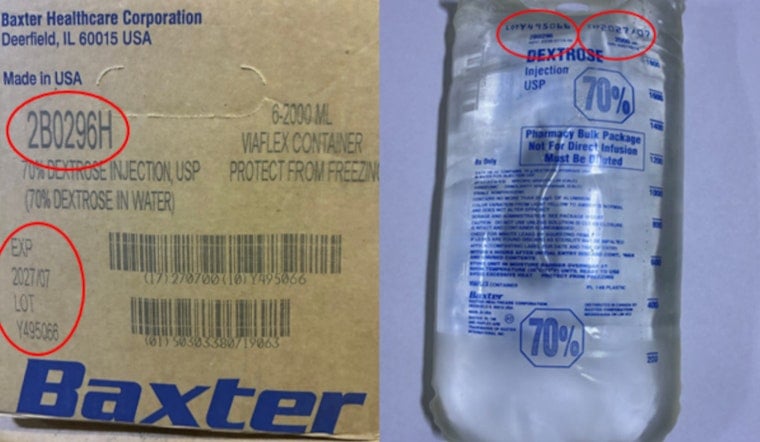
Baxter International has recalled two more intravenous solutions after inspectors found potential steel and fiberglass particles inside Viaflex bags distributed to hospitals and home-care patients across the country, adding to a string of quality problems the company has disclosed since late July. The company is telling affected customers by email how to identify and return the impacted products, and the recalls span products used for everything from home nutrition therapy to blood donation machines.
According to the FDA, Baxter voluntarily recalled one lot of 70% Dextrose Injection, numbered Y4950663, after quality testing turned up potential steel particles inside the 2000 mL Viaflex containers. The lot was distributed to healthcare providers and distributors in Alabama, Georgia and Tennessee between July 25 and July 28, and as reported by DC News Now, the solution provides the body with extra water and carbohydrates when a patient cannot drink enough liquids or needs additional fluids. Per Medical Daily, the recall most likely impacts patients receiving IV nutrition at home.
Steel Particles Carry Serious Clinical Risk
The FDA's health hazard evaluation warned that intravenous infusion of stainless steel particulate matter can cause vascular blockage and blood clotting, potentially resulting in life-threatening pulmonary embolisms, permanent organ damage, vein irritation and severe allergic reactions. Steel particles in the dextrose injection can cause potentially life-threatening health consequences, per the FDA. The agency reported no adverse effects tied to the recalled products as of the week of Thursday, though the physiological stakes remain high given how parenteral nutrition solutions bypass the body's standard gastrointestinal filtering mechanisms.
On the same day, the FDA announced a second recall tied to Baxter's Anticoagulant Sodium Citrate Solution, this time over potential fiberglass contamination. That product was distributed from July 2 through July 11 to a single U.S. customer, and it slows blood clotting during apheresis procedures, the automated process by which centrifuges collect donor blood components such as platelets or plasma. The FDA's recall documentation notes the solution is manufactured exclusively for use in those blood-collection devices rather than direct IV infusion, though foreign fiberglass particles still present risks of local phlebitis or systemic embolization if introduced without in-line filters. The FDA has said any potential harm from particulate matter in the solution depends on the size, number, morphology and composition of the foreign material. Both the dextrose injection and the anticoagulant solution were packaged in Viaflex plastic containers.
A Third Recall Landed the Same Day
Baxter did not stop at two products. As reported by Fierce Pharma, the company also filed notice with the FDA on the same day for two lots of 0.9% Sodium Chloride Injection in 500 mL Viaflex containers, citing potential fiberglass contamination in bags distributed across 14 states between July 31 and August 3. That saline solution is widely used for intravenous hydration and for priming hemodialysis machines, meaning the recall stretches across a broad swath of everyday hospital operations.
The wave of recalls did not start in August. Baxter had already pulled one lot of Cefazolin in Dextrose Injection in July, per the FDA, after quality testing detected cardboard particulate matter inside the antibiotic solution bag, a lot set to expire in February 2027. That recall was documented by AHA News, which noted cefazolin is a widely prescribed antibiotic used to prevent and treat bacterial infections. Between steel, fiberglass and cardboard turning up in different product lines within roughly a month, the pattern points to broader packaging or filling-line issues rather than an isolated one-off defect.
Particulate Contamination Is the Industry's Leading Recall Driver
Baxter's troubles fit into a much larger industry pattern. Analysis of FDA enforcement records from August 2017 through February 2024 found that foreign particulate matter contamination was responsible for roughly 31% of all sterile injectable drug recalls in the United States, according to World Pharma Today. Federal Current Good Manufacturing Practice guidelines require manufacturers to maintain contamination controls over filling machinery and packaging materials, since meeting end-product particulate tests alone does not satisfy regulators' expectations for preventing visible contamination — a gap that often traces back to worn filling-machine components or packaging line wear, the outlet notes.
Updated federal standards took effect just weeks before this recall wave began. The United States Pharmacopeia's USP <788> standard, covering subvisible particulate matter in injections, became compulsory on August 1, setting light-obscuration thresholds and microscopic assay requirements for parenteral formulations nationwide, per Vision Analytical. Baxter's recalls this summer are not an isolated case in the broader injectable-drug space either; earlier in August, pharmaceutical maker American Regent issued a nationwide recall of arthritis shots for dogs and horses after routine inspections found glass microfibers floating inside the vials.
What Consumers and Providers Should Do
Baxter is contacting customers by email with instructions on how to identify and return the impacted products, according to DC News Now's report. Consumers with questions can call Baxter at 888-229-0001 during standard business hours. The recalls arrive just weeks after Baxter, headquartered in Deerfield, Illinois, raised its 2026 outlook and touted ongoing manufacturing and supply-chain restructuring, a turnaround narrative now complicated by a summer of overlapping quality-control actions across its IV solution portfolio.
It remains unclear which specific manufacturing facilities or filling lines are responsible for shedding steel, fiberglass and cardboard particulates into Baxter's Viaflex containers, and whether federal regulators will pursue formal warning letters over Current Good Manufacturing Practice compliance. For now, the FDA says it has not received reports of adverse health events tied to any of the recalled lots, even as the agency continues to warn that foreign particulates in IV solutions carry the potential for serious, sometimes life-threatening harm.





