

























































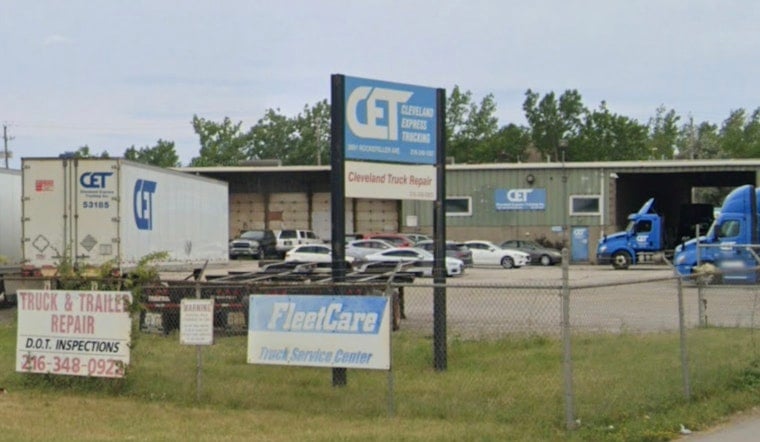
A Bedford Heights scrap metal company says a $239,000 shipment of copper it sent from its Solon Road facility never reached its destination, after a driver allegedly told the trucking company hauling it that he had hijacked the cargo near Oklahoma City. The copper has never been found.
Joseph Krash Metal Co. filed the lawsuit against Cleveland Express Trucking and Cleveland Express Transportation, which was recently transferred from Cuyahoga County Common Pleas Court to federal court in Cleveland, according to cleveland.com. The company, which operates a scrap metal processing facility at 25600 Solon Road in Bedford Heights, hired Cleveland Express on February 5 to ship copper to Aurubis Richmond, a copper-recycling plant in Augusta, Georgia. That relocation to federal court is a routine outcome under the Carmack Amendment, the 1906 federal statute that governs interstate carrier liability and preempts state-level breach-of-contract or negligence claims in shipping disputes, according to the State Bar of Texas.
How the Load Went Missing
According to the lawsuit, a driver loaded the copper at the Solon Road facility and set off on the roughly 1,100-mile route toward Georgia. But rather than handling the shipment itself, Cleveland Express allegedly subcontracted the job to TransMac Freight, a Las Vegas-based shipping company, without Joseph Krash Metals' knowledge — even though the scrap company expected Cleveland Express to ship the copper directly rather than farm it out to subcontractors, per the same account.
The load eventually reached a United Van Lines transfer station in Oklahoma City, where a driver attempted to unload the copper and reload it into a new trailer on February 6. Cleveland Express lost the shipment's GPS tracking signal during the drive despite having tracked the cargo by GPS monitoring, the suit states. It was United Van Lines employees who ultimately alerted both Cleveland Express and Oklahoma City police about the shipment, though Oklahoma City police did not respond to questions about the incident, per the report.
A Driver's Alleged Confession
The copper cargo was detained at the Oklahoma City transfer station until Cleveland Express could find another carrier, and it was there, according to the lawsuit, that the driver told Cleveland Express he had hijacked the cargo. Three days after the cargo was detained, Cleveland Express hired Voyager 1 Transportation, a North Carolina-based shipping company, to take over — but the copper was never delivered and has not been found. Voyager 1 lists an apartment building as its address in U.S. Department of Transportation records, the lawsuit notes, and the company did not return a message seeking comment.
Angelo Dees, who appears to be affiliated with TransMac, said TransMac never contracted with Cleveland Express at all. Dees said none of TransMac's trucks were even close to Ohio when the shipment was taken, and he noted that TransMac specializes in food delivery and has a policy of not taking shipments worth more than $100,000 because of insurance restrictions. Dees also reported that his personal email had been hacked, with hackers setting up or attempting several other transactions using his account — and he said the FBI contacted him in April but has not followed up since.
Insurance Denial and Legal Fallout
Joseph Krash Metals accused Cleveland Express of negligence in hiring TransMac and Voyager 1, and the lawsuit also names Cincinnati Insurance Co. as a defendant after the insurer denied a claim for the stolen copper. Lauryn Robinson, an attorney for Cleveland Express, declined to comment on the lawsuit. Dees, for his part, said he wants to learn how the theft happened so it does not happen again.
The scheme described in the lawsuit — a hacked email account, a subcontracted load, and a shipment that vanishes at a transfer point hundreds of miles from where it started — mirrors a warning the FBI's Internet Crime Complaint Center issued in April, cautioning that cybercriminals are hacking freight company email accounts, altering carrier details, and using double-brokering schemes to misdirect high-value shipments, per the Internet Crime Complaint Center. The FBI has reported that some cargo thefts specifically involve hackers infiltrating shipping companies' email accounts to arrange fraudulent shipments before reselling the stolen goods.
A Booming Criminal Trend
Nationally, cargo thefts caused an estimated $725 million in losses across the United States and Canada in 2025, a roughly 60 percent jump from 2024, according to the FBI. Separately, strategic cargo theft relying on fraud, identity theft, and account takeovers rather than physical break-ins surged 1,475 percent between 2022 and 2024 across North American supply chains, per Geotab. Double brokering alone, in which a contracted carrier illegally re-brokers freight to an unvetted subcontractor, is estimated to cause $500 million to $700 million in annual losses across the freight industry, according to Travelers Insurance.
Copper in particular has become a prime target because of tight domestic supply. The U.S. processing industry consumes roughly 1.8 million metric tons of copper annually but relies on foreign imports for about half of its processed supply, even as it exports around 960,000 tons of scrap each year, according to MINING.COM. Facilities like Aurubis Richmond, which held its first-melt ceremony in September and can process up to 180,000 metric tons of scrap annually, were built specifically to keep high-grade copper scrap circulating domestically rather than shipped overseas.
The Bedford Heights case fits a pattern Hoodline has tracked elsewhere, including a $1.3 million trailer yard bust in Illinois in June, where Cook County Sheriff's deputies recovered stolen trailers loaded with copper and data center equipment in a truck yard hundreds of miles from where the cargo was first taken. Whether investigators will ever trace the specific breach into TransMac's email, how Cincinnati Insurance's policy exclusions will apply to the claim, and whether the missing copper will ever surface remain open questions in the case.





