

























































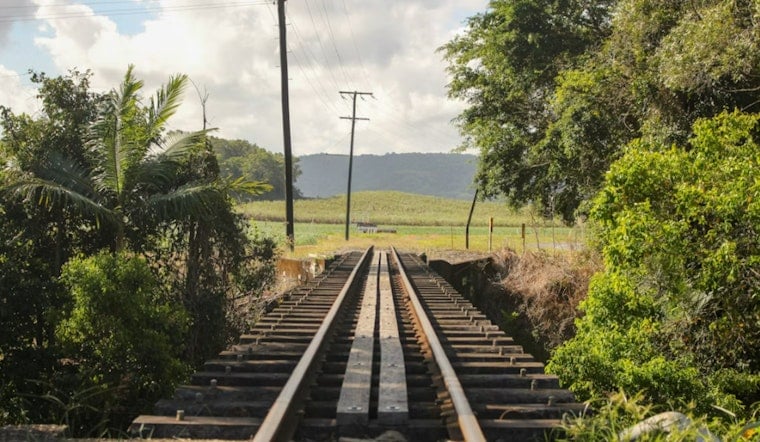
California's High-Speed Rail Authority owns a wide swath of land across the Central Valley, but it cannot legally say yes or no to the everyday requests piling up to cross it. A renewable-energy company wants to connect a generating facility to the electrical grid. A farmer needs to divert drainage water across the right-of-way during heavy rains. A water district wants to connect pipes across the alignment, and a city wants to run a sewer main through rail property. The authority currently has five such access requests it cannot accommodate, because it lacks the authority to issue ordinary permits for new crossings or construction on its own property.
That gap is the target of Senate Bill 1425, introduced by state Sen. Dave Cortese, which would create an encroachment permit program for certain work on the authority's operating right-of-way, according to the Sacramento Bee. Cortese has said the bill aims to make temporary installations on the right-of-way easier to track and to prevent the kind of miscommunications that lead to delays. The bill would give the rail authority authority similar to what Caltrans and the Department of Water Resources already hold over their own rights-of-way, a parallel laid out by the Senate Judiciary Committee, since Caltrans holds statutory permitting rights under existing streets and highways law and the State Water Project holds similar rights under state water law.
Millions Spent, Little Room For Error
The stakes are high because so much money is already on the line. California has spent $16 billion on high-speed rail construction so far, per the Sacramento Bee's reporting, with more than 170 miles of track between Merced and Bakersfield now under design and construction as of this past June. The rail authority still has not begun passenger service, and the project is not expected to start carrying riders before 2034.
Money troubles compound the pressure. The authority's inspector general has reported the agency could exhaust available funding as soon as December 2027, and the authority separately faces about $9.6 billion in funding gaps through 2031-32, according to the Sacramento Bee. The financial picture darkened further in 2025 when the Trump administration withdrew $4 billion from the rail authority, per the same reporting.
Utility Coordination Has Been A Persistent Sore Spot
Unresolved utility coordination has dogged the project for years. The authority needed 38 reimbursement agreements for planned extensions, and as of November 2024, 12 of those agreements remained unresolved, the Bee reports. Audits by the rail authority's Office of the Inspector General found that third-party delays, contract-term disagreements and slow authority reviews all contributed to utility-relocation delays that slowed design work for the Merced and Bakersfield extensions, according to the High-Speed Rail Authority Office of the Inspector General, which tied those delays to roughly $600 million in construction contract change orders. That inspector general recommended legislative changes to give the authority more leverage over unresponsive parties, though SB 1425 does not implement those specific recommendations, the Bee notes.
Those same findings drew federal attention. The Federal Railroad Administration opened a formal compliance review in July 2025 questioning whether the authority can achieve operational passenger service on the Merced-to-Bakersfield segment by 2033, warning that timeline slips could jeopardize federal grant compliance. Construction has remained concentrated mostly on that Merced-to-Bakersfield segment even though environmental clearances now cover 463 of the 494-mile Phase 1 alignment between San Francisco and Los Angeles, as Hoodline previously reported.
What The Permit Program Would Actually Do
Under SB 1425, the rail authority would have limited ability to issue access permits, per a 2025 project update report cited in the Sacramento Bee's reporting, and the authority requested this explicit permitting authority in its own 2026 business plan. The bill would apply to crossings, facilities or infrastructure installed beginning January 1, 2027, and it would cover certain repair, maintenance, expansion or relocation work. Emergency responses would be excluded from the permit requirement, though emergency situations would still require prior express consent.
Permit holders could be required to restore affected property and, at their own expense, to relocate or remove infrastructure if it interferes with rail operations, safety, maintenance or future improvements, the authority has said. Unauthorized permitted work could constitute a misdemeanor, and the attorney general could seek $5,000-a-day civil penalties for unauthorized encroachments after required notice periods, according to LegiScan's bill text. Amendments to the bill establish the High-Speed Rail Property Fund, where collected fees and penalties would be deposited, with the authority expecting permit revenue to offset the program's administrative costs and saying it does not anticipate needing additional staff positions at this time.
Utilities Push Back On Emergency Access And Costs
Opposition has come chiefly from utilities and local governments. PG&E and the California Municipal Utilities Association both oppose the bill, arguing in bill analysis that the permit program could interfere with their operations and maintenance. The City of Burbank, Southern California Edison and the Los Angeles Department of Water and Power formally opposed the measure as well, according to the Assembly Utilities and Energy Committee, requesting explicit exemptions to access rights-of-way during power outages and emergencies without standard permit delays.
Mike Gazda has said legislation in this area should protect public safety, preserve utilities' existing rights and avoid unnecessary customer costs, warning that new permit requirements, penalties and utility-funded relocation obligations could increase costs and pressure customer bills. The Assembly Appropriations Committee estimated earlier this month that the permit program could cost hundreds of thousands to millions of dollars to establish and administer, and it placed SB 1425 on its suspense file. The bill will return to that committee and must win approval from the full Legislature before the session ends on August 31.
Part Of A Broader Legislative Push
SB 1425 is one piece of a three-bill 2026 package from Cortese aimed at tightening oversight of the rail project, according to the Office of Senator Dave Cortese. The package also includes SB 1177, which would mandate detailed reporting on project costs and timelines, and SB 1375, which would provide targeted CEQA exemptions for the San Jose Diridon Station program. Separately, SB 445 would require the rail authority to establish internal standards and binding timelines for resolving utility conflicts by July 1, 2026.
Advocacy group U.S. High Speed Rail sponsored SB 1425, arguing that explicit statutory permitting authority is necessary to prevent unauthorized land encroachments that create development barriers and cause construction delays. The debate over the bill lands amid wider scrutiny of the project's cost and pace, themes Hoodline has tracked in coverage of the 2026 business plan and in reporting on Central Valley political resistance to the project.




