

























































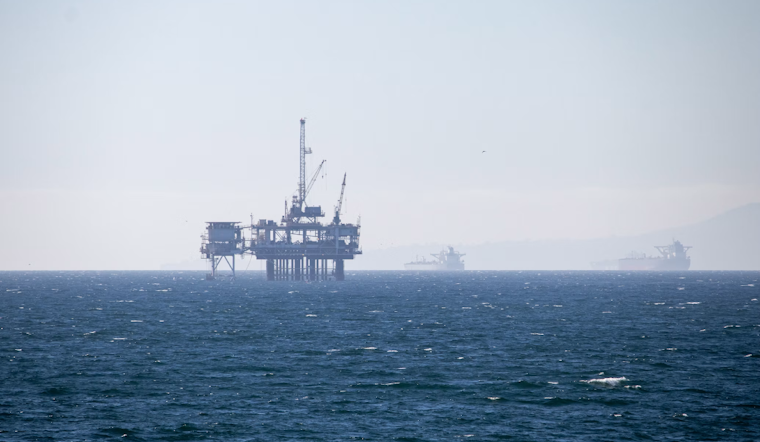
California's top coastal regulators unanimously rejected an oil company's bid to restart underwater fracking off the Ventura coast, a decision that could still be overturned by the Trump administration under an unusual federal review already underway. The California Coastal Commission's vote against Oxnard-based DCOR LLC's proposal came after the company sought to quadruple production at Platform Gilda, a 45-year-old rig sitting about nine miles offshore.
The rejection, reported by the Los Angeles Times, followed a commission meeting in Santa Cruz County where staff and lawyers laid out a detailed technical analysis of DCOR's proposal. Under the plan, well stimulation across 16 existing wells would have pushed Platform Gilda's output from 1,100 barrels per day to 4,000 barrels per day, according to the Times, the equivalent of roughly 168,000 gallons of oil pumped daily. DCOR said the fracking itself would happen for about 14 days per year over a five-year program, according to the Times' reporting on the company's application.
Technical analysis prepared for state regulators estimated the five-year well-stimulation program would ultimately recover roughly 14 million additional barrels of oil and 13 million additional cubic feet of natural gas through 2046, according to The Santa Barbara Independent. Without hydraulic fracturing, the paper reported, Platform Gilda's production was projected to keep declining from its current level. Coastal Commissioner Ray Jackson said the risks to oceans, beaches, wildlife and the coastal economy outweighed the benefits, per the Times.
A Platform Built to Last 18 Years, Now Pushing 45
Platform Gilda was installed in 1981 by Union Oil Company in 205 feet of water and was designed for an operating lifespan of roughly 18 years, according to the Bureau of Ocean Energy Management. It has instead run for 45 years, more than double what engineers originally expected, and has cumulatively produced over 42.6 million barrels of oil in that span, the federal agency's records show. The Times reported that the platform sits near several active earthquake faults and could reach the end of its run if fracking does not go forward.
DCOR's recent safety record loomed large in the commission's decision. California Coastal Commission staff reports cited a December 2021 internal corrosion pipeline leak off Huntington Beach and a gas release and platform fire on DCOR's Platform Habitat near Carpinteria earlier this year. The Times noted that a corroded pipeline in the Santa Barbara area had spilled more than 120,000 gallons of oil, and that DCOR was involved in two of the three most significant offshore oil spills in California over the past five years. DCOR owns and operates 20 of California's 27 remaining offshore oil platforms, according to the Times, making it the dominant operator in a shrinking industry; nearby Platform Grace, by contrast, is being decommissioned because of declining production.
Why Federal Waters Became the Only Path Left
California's statewide ban on new hydraulic fracturing permits on land and in state waters took effect on October 1, 2024, following a 2021 directive from Governor Gavin Newsom, according to the Center for Biological Diversity. That left federal waters beyond the three-mile state boundary as the only place operators like DCOR could still seek fracking approvals. Offshore fracking has occurred off the California coast for decades, the Times reported, but its future now hinges entirely on federal-state legal fights.
Those fights trace back to a 2022 ruling by the 9th U.S. Circuit Court of Appeals in Environmental Defense Center v. BOEM, which found that federal regulators had failed to comply with the National Environmental Policy Act and the Endangered Species Act. The court ruled that the Coastal Commission had to be included in the approval process under the Coastal Zone Management Act. That case emerged after the Environmental Defense Center filed a Freedom of Information Act request alongside the Center for Biological Diversity, Santa Barbara Channelkeeper and the Wishtoyo Chumash Foundation, revealing that federal officials had approved at least 51 permits for offshore hydraulic fracturing and acidizing without notifying California, the Times reported.
Maggie Hall, deputy chief counsel at the Environmental Defense Center, said the DCOR proposal illustrates the importance of state review of projects affecting coastal resources, according to the Times. This marked the first time the Coastal Commission had reviewed an offshore fracking proposal. Commission staff also noted that fracking fluid includes known carcinogens and hormone-disrupting chemicals, and that all chemical flowback fluids from the deep wells, which would target depths greater than 4,500 feet below the seafloor, would need to be retained on Platform Gilda and reinjected into subsea disposal wells, per federal environmental documents cited by WorkBoat.
The Stakes for the Santa Barbara Channel
Coastal Commission staff evaluations emphasized that Platform Gilda sits near critical marine habitats and the Channel Islands National Marine Sanctuary, where a major spill could impact up to 855 square miles of ocean surface and 134 miles of coastline, the Independent reported. Susan Jordan, a Santa Barbara resident and founder of the California Coastal Protection Network, said DCOR increases the risk of a spill off the California coast, according to the Times. More than 17,800 written comments were submitted by the public during the federal review period, the Times reported.
The Bureau of Ocean Energy Management initiated an expedited 28-day environmental review of DCOR's proposal in March under national energy emergency procedures established after President Trump's January 2025 emergency declaration, compressing timelines that normally allow for far more scrutiny. DCOR's Chief Operating Officer Dale Bradley said the proposed treatments would improve recovery and contribute to a responsibly produced domestic energy supply, according to the Times, and the company said its application would comply with the California Coastal Management Program and the Coastal Zone Management Act.
What Happens Next: A Possible Federal Override
The Trump administration has already launched proceedings that could limit California's ability to protect its shoreline, the Times reported, including a Coastal Zone Management Act performance evaluation ordered by Commerce Secretary Howard Lutnick. Under Section 307 appeal procedures, the Secretary of Commerce can override a state's consistency objection only if he determines a project is consistent with CZMA objectives or necessary in the interest of national security, according to NOAA's Office for Coastal Management. DCOR could appeal the commission's decision to Lutnick or challenge it in court, the Times noted, and Lutnick could ultimately overturn the decision on national-interest or national-security grounds, or even move to decertify the commission's review power altogether.
The Coastal Commission has generally had a smooth state-federal partnership under the Coastal Zone Management Act for five decades, aligning with 96% of the more than 3,700 federal actions in federal land and waters it has reviewed since the 1970s, according to the Times. But the current standoff echoes a fight Hoodline reported on in March, when federal officials invoked Defense Production Act authority to force the restart of dormant pipelines for Houston-based Sable Offshore Corp.'s Santa Ynez Unit, overriding state park permit denials. Sable, which acquired and restarted an operation that had gone dormant in 2015, is now entangled in more than ten lawsuits, the Times reported, a pattern of federal intervention that DCOR's case appears poised to follow.


