

























































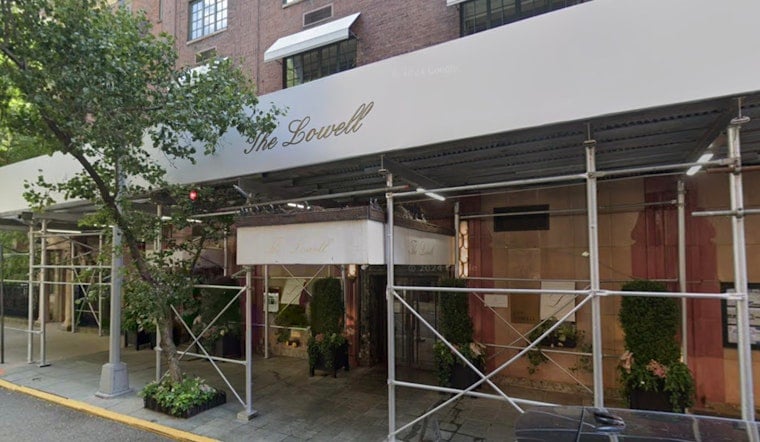
The Lowell Hotel, a 17-story fixture at 28 East 63rd Street since 1927, has landed a $106 million refinancing loan even as its owner pushes forward with a much larger bet a few blocks away: converting a Madison Avenue office tower into a brand-new luxury hotel. Kensico Properties, which has owned the 74-room Lowell since 1984, secured the new debt from Blue Owl Capital to replace previous financing on the property.
CBRE arranged the senior loan on behalf of Lowell Hotel ownership, according to The Real Deal. CBRE's Matthew Klauer, who arranged the loan, said the hotel's “unmatched reputation, superior market position, and experienced ownership group made this an exceptional lending opportunity.” The century-old property includes guest rooms and suites with private terraces, along with two notable gathering spaces, the Pembroke Room and the Club Room.
A Modern Sequel Rising on Madison Avenue
The refinancing lands as Kensico pushes forward on a far more ambitious project a short walk away. The developer plans to convert the 21-story office building at 509 Madison Avenue into a 30-story luxury hotel, branding the companion property The Lowell Modern, per the same account. The project, first detailed with renderings by New York YIMBY, would add nine stories to the existing 249-foot building and strip its original exterior down to the steel frame before wrapping it in a modern glass curtain wall, complete with landscaped setback terraces.
The proposed hotel would include 96 rooms, 3,300 square feet of ground-floor retail space, and amenities and a lobby spread across 139,000 square feet. Kensico began interior demolition on the building in late 2025 and started a seven-month Uniform Land Use Review Procedure that same month, with construction targeted to begin in 2026 and finish in early 2028. The original 1929 building was designed by architect Robert T. Lyons, who also designed the Gramercy Park Hotel and the Wellington Hotel.
Why an Office Tower Became a Hotel Bet
Kensico had actually tried to sell its leasehold at 509 Madison Avenue back in 2017, despite high occupancy at the time, but the property failed to find a buyer, according to The Real Deal's reporting on the ULURP filing. Shifting office market dynamics eventually pushed the firm toward the hotel conversion instead. Before demolition began, the building housed office tenants including Banyan Tree Capital Management, Yellowstone Capital Partners, and Kensico's own headquarters, all of whom vacated as leases expired.
Kensico Properties was co-founded by brothers Nabil and Fouad Chartouni, with Nabil serving as chair, and the firm has built and invested in more than $2 billion of global real estate assets across office, retail, and hospitality. The company's move to gut and rebuild a full office tower into hotel rooms sits at the intersection of two forces reshaping the city's lodging market: a nearly frozen construction pipeline and a resurgent lending environment for hospitality debt.
Regulation Has Frozen New Hotel Supply
New York City's hotel construction pipeline has been essentially frozen since the City Council mandated a special permit for new hotel developments in 2021, requiring discretionary ULURP review for any new project. The rule followed a boom in which the city added more than 21,000 hotel rooms between 2015 and 2019, and it has since combined with a crackdown on the short-term rental industry to squeeze new supply citywide, as detailed in Hoodline's earlier coverage of the looming World Cup room crunch.
That constrained pipeline has left only 24 hotel projects, yielding fewer than 6,000 total rooms combined, in active development citywide through 2028, according to the Manhattan Institute. Limited supply and the short-term rental crackdown have boosted occupancy and room rates at established properties like the Lowell. New York State Comptroller data show luxury hotel occupancy in the city reached 82.2 percent in 2025, while citywide revenue per available room grew 4.5 percent to $280.71 even as the metric declined nationwide.
Private Lenders Step Into a Financing Gap
The Blue Owl Capital loan also reflects a broader shift in how hotel projects get funded. Global real estate debt funds raised $51 billion in 2025, their highest total since 2021, as alternative private credit managers expanded commercial lending to fill gaps left by traditional banks. Blue Owl Capital and King Street Capital Management similarly originated a $510 million refinancing loan for Savanna's 5 Bryant Park office tower in December 2025, underscoring how far private credit has moved into major New York commercial real estate deals.
The Lowell's literary pedigree adds another layer to its Upper East Side profile: writer Dorothy Parker, a central figure of the Algonquin Round Table, regularly stayed at the hotel during the late 1920s and 1930s, seeking out its quiet rooms to write away from the bustle of Manhattan's literary scene. Whether Kensico can navigate the full seven-month ULURP process for 509 Madison Avenue, and how it will structure construction financing as work advances toward the 2028 target, remain open questions as the project moves forward.





