

























































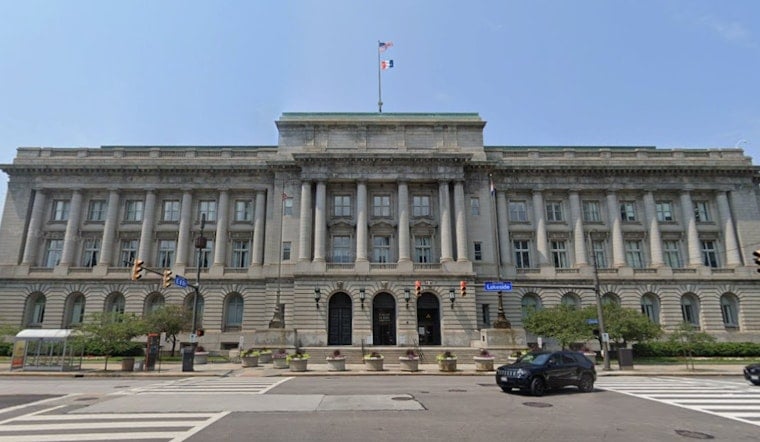
Cleveland City Council is weighing legislation that would fold 100 city land-bank parcels into 35 parks, four recreation centers and one trail, along with a new fire station and the city's animal kennel. The tradeoff: making that land permanently public would pull it off the tax rolls, costing the city an estimated $165,000 a year in forgone property taxes.
The proposal, introduced at council's summer session on Tuesday, touches neighborhoods across nearly every ward in the city, according to Signal Cleveland. Woodland Recreation Center in Ward 6 would receive eight parcels, the largest single addition alongside Harmody Park in Ward 4, which is also slated for eight parcels. New Fire Station 26, also in Ward 6, would gain eight land-bank parcels of its own, with an annual tax exemption pegged at $2,279.34.
Because Cleveland owns, manages and maintains its own land-bank properties, the parcels are already city-controlled, but formally converting them to park and recreation use requires sign-off from outside bodies. Signal Cleveland reports the land transfer needs approval from both the Cuyahoga County Council and the Cleveland Municipal School District, since removing the parcels from the tax rolls affects revenue those bodies rely on.
The Biggest Tax Exemptions on the List
The dollar amounts vary widely depending on parcel size and location. The former U.S. Coast Guard station in Ward 7, which would receive one land-bank parcel, carries the highest single exemption on the list at $20,376.81 annually. The City Kennel in Ward 11 would see an annual exemption of $58,851.07 for one parcel, and the Collinwood Athletic Complex in Ward 9 tops the list overall at $64,031.07 for two parcels — figures that reflect the assessed value of land already sitting outside private ownership.
Most additions are far smaller. Dozens of parks, including Hyacinth Park, Easton Park, Ambler-Holton Playground, R.J. Taylor Park and Humphrey Park, would each gain a single parcel carrying a modest $72.25 annual exemption. Carol McClendon Park in Ward 3 would pick up three parcels at $216.74, while Grant Park in Ward 5 would add three parcels worth $3,456.94 combined, per the same account from Signal Cleveland.
Ward-by-Ward Additions Span the City
The parcel additions cut across the city's geography rather than concentrating in one corridor. Ward 2 would see growth at Earle B. Turner Recreation Center, Dove Park, Mill Creek Falls Family Park and Oleatha Wilson Park. Ward 9 would gain parcels at Shirley Chisholm Park — formerly named Moulton/Scoutway Park — as well as Coit Park, MLK Jr. Park and Collinwood Athletic Complex. Ward 14 would see additions at Clark Recreation Center, Meyer Pool, Storer Park, Trent Park, WC Reed Playfield and Calgary Park.
Other wards see smaller but still notable additions: Abbey Park and Greenwood Park in Ward 7, Spencer & East 53rd Street Mini-Park and Carrie Cain Playground and Sam Miller Park in Ward 8, Thames Park in Ward 9, James M. Dunphy Park and the Booth Avenue Trail/Morgana Run extension spanning Wards 2 and 12, and Worthington Park in Ward 12. The full inventory reflects the scope of a municipal land bank that the city says contains thousands of properties across Cleveland.
How the Proposal Fits Into Cleveland's Broader Park Push
The parcel transfers align with a larger planning effort already underway. In April 2025, Mayor Justin Bibb's administration unveiled the Cleveland Parks and Recreation Plan, the city's first comprehensive park master plan in more than 40 years, laying out a 15-year framework for capital investment across 161 parks and 22 recreation facilities covering 1,600 acres.
The land-bank additions also touch territory tied to the mayor's Southeast Side Promise initiative, launched in 2023 with $15 million in American Rescue Plan Act funds to combat long-term disinvestment across Wards 1, 2, 4 and 6 — the same wards where several of the largest park expansions and the new fire station are slated. Separately, council introduced Emergency Ordinance File No. 918-2026 on August 13, authorizing up to $6,730,000 in general obligation bonds to retire notes previously issued for municipal park and recreation upgrades, showing capital financing for city parks moving on a parallel track. Council also introduced File No. 912-2026 the same day, allowing the parks department to negotiate up to three-year concession agreements for the city-owned Public Auditorium.
City and County Land Banks Are Not the Same Thing
The city's land-bank operation is distinct from the quasi-governmental Cuyahoga County Land Bank, a separate entity with its own history and mandate. Since forming after the subprime mortgage crisis in 2009, the county land bank has demolished more than 10,000 blighted structures and generated over $3.6 billion in total economic impact across Cuyahoga County through 2024. In August 2024, the State of Ohio awarded that county land bank $23 million to demolish more than 1,100 blighted structures concentrated in Cleveland and inner-ring suburbs, as Hoodline previously reported.
The city's own land bank, meanwhile, paused accepting new public applications in 2026 while it transitions to a Salesforce-based inventory system and updates its parcel pricing and disposition policies. Under its tiered pricing framework, land values run $10 per square foot in “Market Rate” neighborhoods, $3 per square foot in “Middle” neighborhoods, $0.70 per square foot in “Opportunity” neighborhoods, and a flat $200 for side-yard acquisitions under 5,000 square feet. Cleveland Neighborhood Progress also runs a Middle Neighborhoods Initiative in areas like Collinwood, Lee-Harvard, West Park and Old Brooklyn, working to acquire and rehabilitate 200 homes and support commercial corridors in working-class neighborhoods that fall outside emergency disinvestment subsidies — a reminder that land-bank lots are also competing for use as housing stock, not just park space.
Cleveland's finances give the city some room to absorb the tax tradeoff. In March 2026, City Council approved the 2026 annual operating budget, which included $17.5 million in reconciliation amendments for council priority projects in parks, recreation, housing and public safety, while still maintaining more than $70 million in rainy-day reserves. The land-bank parcel legislation is now before council following its introduction at the summer session.





