

























































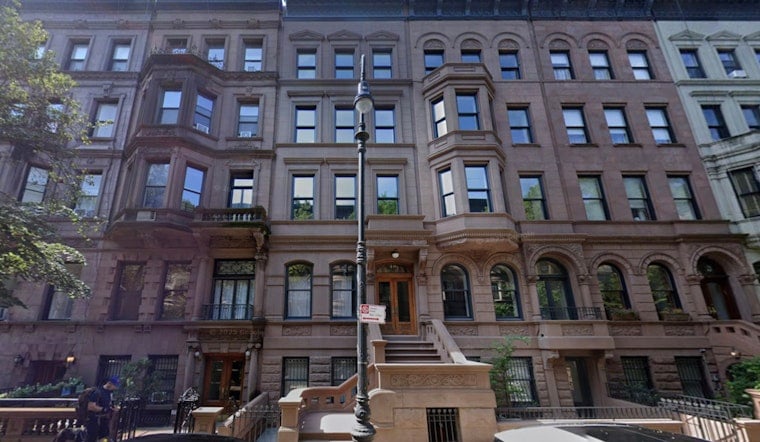
An eight-story mansion that spent years tormenting its Upper West Side neighbors with jackhammers and blasting has finally changed hands — for $45 million, a record for a townhouse in the neighborhood, and nearly 50 percent below its original $85 million asking price. Property records show the buyer is an entity called MI 8787, and a 2025 tax refund tied to a $45 million sale was issued to a Cayman Islands address connected to Block.one, the crypto company behind one of the largest token sales in history.
The sale of 48-50 West 69th Street was first reported by The Real Deal, which detailed how the purchasing LLC's paper trail connects back to Brendan Blumer, the chief executive of Block.one. The outlet's reporting is central to nearly every fact in this story, from the buyer's identity to the specifics of the mansion itself. Blumer built his fortune on Block.one's controversial $4 billion token issuance in 2017, and the company was later ordered by the U.S. Securities and Exchange Commission to pay a $24 million civil penalty to settle charges that its EOS coin offering was an unregistered securities sale, according to the SEC. The $24 million penalty amounted to roughly 0.58 percent of the $4.1 billion in Ether the EOS sale raised globally, per The Chain Bulletin.
Sellers Took a Steep Loss After a Notorious Renovation
The mansion was sold by French businessman Pierre Bastid and jazz singer Malou Beauvoir, who bought the two adjacent brownstones for a combined $24.5 million in separate deals closed in 2011 and 2012. The couple tore down the previous structures and undertook an expansive construction project that combined the properties into a single 19,600-square-foot residence spanning eight stories, five bedrooms, and 11 bathrooms, designed by Fradkin & McAlpin Architects with interiors by MDesign London, per Compass, which listed the property.
That renovation became a neighborhood flashpoint. The construction project drew more than 2,000 words in a 2019 New York Times article documenting noise and debris, and construction costs at the property could run as high as $100 million by the paper's estimate. As reported by Business Insider, residents on the block resorted to noise-canceling headphones, earplugs, and tranquilizers for their pets while crews excavated 38 feet into Manhattan schist to build a basement pool. Fed-up neighbors eventually posted protest petitions on the construction scaffolding and lobbied city officials to restrict so-called “iceberg home” developments.
A Record Price, But a Steep Discount
Bastid and Beauvoir listed the finished mansion for $85 million in March 2024, according to iLovetheUpperWestSide.com, but the home was taken off the public market a few months after listing. It ultimately closed for $45 million — a 47 percent, or $40 million, cut from the asking price. The couple never appears to have lived in the finished residence themselves. Listing agents on the property included Michael Maniawski, Trevor Stephens, and Jim St. Andre.
Even at a steep discount, the $45 million price still made 48-50 West 69th Street the most expensive townhouse sale in Upper West Side history, eclipsing the previous record set in March 2022, when 248 Central Park West sold for $22 million, according to FOX 5 New York. That 1887 Queen Anne mansion is one of only three single-family homes remaining on Central Park West. Still, the Upper West Side record pales next to Manhattan's overall townhouse benchmark: the Wildenstein mansion at 19 East 64th Street, which sold for $90 million in 2018.
What's Inside the Record-Setting Mansion
The finished home includes a parlor floor with 24-foot ceilings and a width of 38 feet, connected by a limestone floating staircase and served by a commercial-grade elevator. The garden level features a 55-foot indoor lap pool, while the primary suite spans more than 2,000 square feet and includes a south-facing terrace.
Buyer's Camp Offers a Different Story
Despite the paper trail connecting the purchase to Block.one, a representative for the buyer has pushed back publicly on the idea that Blumer himself is behind the deal. Maggie Wu said the property was purchased by an investor who plans to lightly renovate and re-list it later this fall, and Wu denied that Blumer was the buyer — leaving an open conflict between the tax-record trail reported by The Real Deal and the buyer representative's public account.
Blumer's Wider Real Estate Footprint
Whoever is ultimately behind MI 8787, the entity has been active elsewhere in high-end real estate. The same entity purchased 40 Palm Avenue in Miami Beach for $40 million in 2024, setting a Palm Island record, and in January 2026 it bought a 4,500-square-foot penthouse at 505 West 19th Street in New York for $21 million. That penthouse includes three bedrooms, three bathrooms, a deeded parking space, and a 3,400-square-foot rooftop, with a penthouse lounge featuring a skylight, a wraparound terrace, and a wet bar.
Blumer's name has also surfaced overseas. In March 2025, Italian media reported that Blumer paid $172 million for a 28-room seafront villa in Sardinia's Romazzino Bay, a deal an Italian newspaper attributed to him at the time, according to Elite Agent. The 5.7-acre estate has more than 1,000 feet of water frontage and access to two private beaches, and was previously owned by former Saudi oil minister Sheikh Ahmed Zaki Yamani, who played a large role in creating OPEC.
Blumer's path to that kind of wealth traces back to his teenage years: he launched his first virtual goods company, Gamecliff, at age 14 in 2004, later ran real estate data startup Okay.com in Hong Kong, and co-founded Block.one in 2016, which landed him on Forbes' list of cryptocurrency's richest people in February 2018, per Forbes. Block.one's legal troubles didn't end with the SEC settlement, either: in August 2022, a federal district court rejected a proposed $27.5 million class-action settlement between crypto investors and Block.one over the EOS token sale, finding that lead plaintiffs did not adequately represent foreign and domestic buyers, Forbes reported separately. The lawsuit had alleged that Block.one marketed tokens to U.S. residents despite claiming to exclude domestic buyers.





