

























































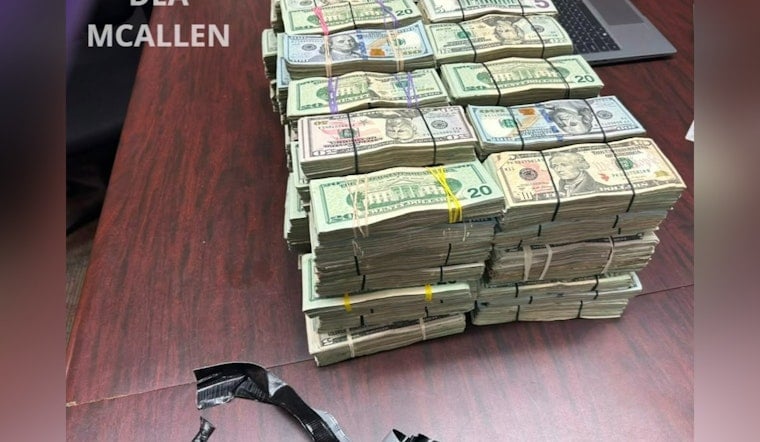
DEA agents in McAllen seized more than half a million dollars in cash during a traffic stop, an amount investigators say is likely linked to drug cartels operating in the area. The bulk currency was recovered with assistance from Texas state troopers as part of ongoing highway interdiction work across South Texas.
The seizure was announced in a post from DEAHouston, which described the haul as bulk cash pulled during a traffic stop and said DEA McAllen was assisted by the Texas Department of Public Safety's South Texas division. The post tagged DEA headquarters and the Justice Department and stated the money is likely connected to cartel activity in the region, though the exact highway, date, and any arrests tied to the stop were not detailed in the announcement.
A Familiar Pattern Along South Texas Highways
Traffic stops yielding six-figure cash hauls have become a near-routine occurrence in the Rio Grande Valley. In March, Texas DPS troopers seized $83,855 in cash hidden in plastic bags during a stop on US 281 in Hidalgo County, the same county that includes McAllen, according to the Texas Department of Public Safety. Just months later, in June, DPS troopers seized 30 plastic bundles of cocaine valued at $780,000 hidden in a false floor compartment during a traffic stop in neighboring Brooks County, the agency reported.
Cash moving in the opposite direction has also turned up in bulk. U.S. Border Patrol agents in the Rio Grande Valley Sector seized more than $570,000 in bulk cash in June as part of an interdiction targeting transnational smuggling networks, according to KFXV. Law enforcement officials in the region have said cartels routinely move cash south toward Mexico while moving contraband north, using major thoroughfares like US 281 and I-69C as primary corridors, per the Texas Department of Public Safety.
How Federal and State Charges Could Apply
Under federal law, knowingly concealing and transporting more than $10,000 in bulk currency to evade reporting requirements is a felony punishable by up to five years in prison and subject to mandatory asset forfeiture, according to guidance from FinCEN. Separately, Texas Penal Code § 34.02 makes knowingly transporting or possessing proceeds of criminal activity valued at $300,000 or more a first-degree felony under state law, carrying potential penalties ranging from five to 99 years or life imprisonment, according to Varghese Summersett. It remains unclear whether federal bulk cash smuggling charges or state money laundering charges will be filed in connection with the McAllen seizure, and bulk cash seizures often move forward through civil asset forfeiture proceedings independent of any criminal conviction.
DEA McAllen's Place in a Larger Enforcement Network
The DEA McAllen Resident Office operates under the DEA Houston Field Division, which covers 131 counties across South, Central, and Southeast Texas along the U.S.–Mexico border, according to the DEA. The office has a history of large cash seizures tied to cartel investigations; in June 2021, a multi-agency operation led by DEA McAllen across McAllen and Rio Grande City resulted in 19 arrests and the seizure of more than $500,000 in cash and property tied to a regional trafficking syndicate, KRGV reported at the time.
Forfeited cartel proceeds have also flowed back into local departments before. In January 2025, federal authorities distributed $29.5 million in forfeited drug proceeds seized from former Gulf Cartel leader Osiel Cardenas-Guillen to a dozen South Texas agencies, including $2.95 million each to the McAllen and Brownsville police departments, according to U.S. Immigration and Customs Enforcement.
The McAllen seizure also fits a broader pattern of joint interdiction operations across Texas highways. In January, a joint investigation involving the DEA, Houston Police Department, and U.S. Marshals ended in a pursuit on Loop 610 in Houston that netted more than 400 kilograms of cocaine, 13 firearms, and $100,000 in cash, as Hoodline previously reported. Since its 2021 launch, Texas's Operation Lone Star initiative has resulted in more than 535,000 migrant apprehensions, 57,000 criminal arrests, and 47,500 felony charges statewide, according to the Texas Department of Public Safety.





