

























































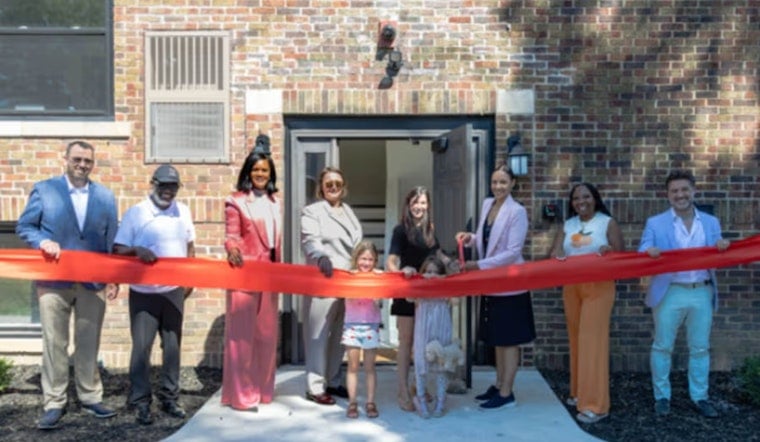
A brick apartment building that sat empty for years on Detroit's east side reopened this week with 17 new affordable homes, rents starting at just $900 a month, and a mayor eager to point to it as proof her housing strategy is working. Mayor Mary Sheffield joined developers and community leaders on Monday to celebrate the grand opening of Rohns Apartments at 4735 Rohns St. in the Gratiot Woods neighborhood, calling the project a benchmark of her administration's Rise Higher Community Framework.
Built in 1927 in the Pingree Park section of the east side, the Rohns Apartments building had been completely vacant before its conversion into a 17-unit apartment complex, according to Berkshire Hathaway HomeServices. The renovated building now includes two one-bedroom apartments and 15 two-bedroom units, with rent starting at $900 a month for the smaller units and $1,100 for the two-bedroom units, as reported by WDIV ClickOnDetroit. Tenants get stainless steel appliances, all-in-one washers and dryers, central air conditioning, secure parking, and access to green space.
The project was redeveloped by WIZE Detroit, led by owner and managing director Sophie Zembra, who moved from France to New York City roughly a decade before relocating to Detroit in 2024, per the station's report. Zembra, who had previously worked as a sustainable fashion entrepreneur in Miami and New York before pivoting into historic real estate redevelopment, according to Garmentory, said she became interested in renovating historic buildings and that Detroit's history and community resilience drew her to the city.
How the City's Tax Break Made the Math Work
Rohns Apartments is one of the more visible results of Detroit's Fast Track PILOT — Payment In Lieu Of Taxes — program, which lets qualifying affordable developments pay a percentage of rental revenue instead of standard property taxes based on assessed value. Detroit City Council adopted a revised version of the PILOT ordinance in October 2024, and the same account notes the change was designed to simplify and speed up approval for qualifying affordable housing projects.
City financial analyses show that without the PILOT tax reduction, developers would need to charge an average of $433 more per month per apartment to offset standard property taxes, according to the City of Detroit. The city says the PILOT structure gives developers more predictable costs and can help projects secure financing while maintaining affordability. Under the framework, developers must maintain rent restrictions for at least 15 years and invest at least $15,000 per unit in capital repairs for long-vacant rehabilitations, per city training documents.
The tax break scales with how deeply affordable a project is: developments averaging up to 60% of Area Median Income pay just 0.5% to 1.0% of rental revenue in lieu of property taxes, while workforce housing reaching up to 120% AMI pays 3.5% or more, according to a KEANDREWS. Community advocacy coalition Detroit People's Platform criticized the draft ordinance in October 2024, warning that tax breaks for units up to 120% AMI fail to guarantee deeply affordable housing for the more than half of Detroiters earning under $37,000 annually, per the Detroit People's Platform.
What Gratiot Woods Looks Like Right Now
Gratiot Woods encompasses 1,247 residential homes and one school, and mid-2026 listings showed median asking prices around $32,000 to $39,000 for unrenovated single-family properties in the area, according to The Neighborhoods. Those figures underscore how much a restored, move-in-ready building like Rohns Apartments stands out from the surrounding housing stock. Detroit's Housing and Revitalization Department administers the PILOT program and reviews developments for compliance with city affordability requirements, the station's report notes.
Since the revised ordinance took effect, Detroit has approved more than 7,000 new or preserved affordable housing units, and city figures cited by ClickOnDetroit show the program has unlocked more than $1.2 billion in total planned investment across more than 8,000 affordable housing units citywide. The city also says it has cut affordable housing approval timelines from as long as a year down to an average of less than 60 days, with a stated goal of completing PILOT reviews within 30 days.
More Projects Already in the Pipeline
WIZE Detroit is also using the PILOT program for another adaptive reuse project at 3045 Cortland in the Dexter-Linwood neighborhood, expected to include 34 residential units — a mix of one-bedroom and two-bedroom apartments and one studio — with completion targeted for 2028. That project plans to offer affordable housing to households earning up to 80% of area median income.
Other projects moving through the pipeline include Gesu Senior Housing, which will redevelop the former Gesu Parish Center into 36 affordable units for seniors; The Claire, which will redevelop a building originally known as the Clairwood into 40 affordable units; and The Booth Community, which will redevelop the former St. Mary of Redford parish school into 61 units of permanent supportive housing. The city currently has 6,142 units in its pipeline awaiting approval and expects additional projects to further expand the affordable housing supply.
The city frames all of this activity under its Thriving Neighborhoods Strategy, part of the broader Rise Higher Community Framework, which calls for preserving existing housing, expanding access to affordable housing, supporting neighborhood revitalization, and helping residents remain in their communities. Mayor Sheffield has also moved to bolster funding on the public side: in March, she issued Executive Order 2026-05, directing 100% of proceeds from city-owned commercial property sales into the Affordable Housing Trust Fund, doubling annual municipal contributions to roughly $4 million, according to the City of Detroit. That move echoes Detroit's Greystone groundbreaking earlier this year, another project built on the same expanded PILOT foundation now anchoring Rohns Apartments, as reported by Hoodline.



