

























































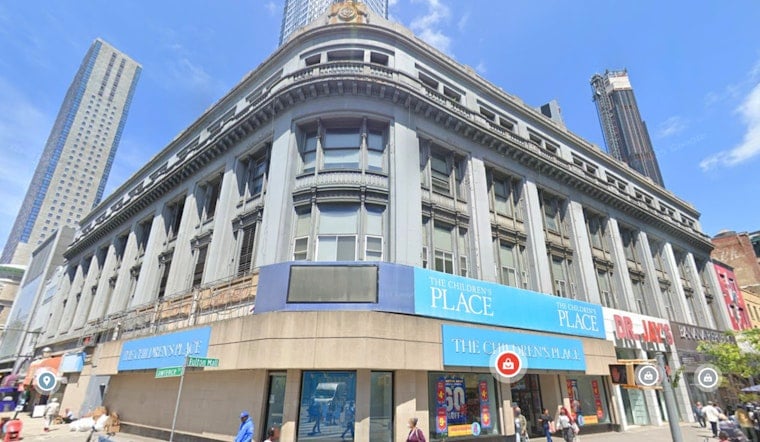
A developer has filed plans to build 297 apartments on Fulton Street in Downtown Brooklyn — but not in one tower. Shimon Klein's project, spanning 485 Fulton Street and 147 and 149 Lawrence Street, is carved into three separate residential buildings, each capped at exactly 99 units, according to New York City Department of Buildings filings.
The split is not a coincidence of design. As reported by The Real Deal, developers across the city are dividing large residential projects into buildings of 99 units or less specifically to avoid triggering the $40-an-hour construction wage floor that kicks in once a project hits 100 units. Klein could not be reached for comment on the filings, per the outlet's report.
The largest of the three structures, the 27-story tower at 485 Fulton Street, is designed to hold four to eight apartments per floor from the third floor up to the 27th, according to a Department of Buildings filing reported by Commercial Observer. Beyond the residential floors, the building is slated to include ground-floor commercial space, community facilities, and nearly 3,000 square feet of tenant outdoor rooftop space. The project as a whole, per The Real Deal, is expected to bring roughly 200 condos, 299 rental units, and 20,000 square feet of commercial space, and the design comes from Kao Hwa Lee Architects. No construction timeline has been disclosed.
A $40 Wage Floor Built Into the Site Lines
The wage rule at the center of the project's design comes from the state's 485-x Affordable Neighborhoods for New Yorkers program, which New York State lawmakers created in April 2024 to replace the expired 421-a tax break, according to guidelines from the New York City Department of Housing Preservation and Development. That older program had served as the city's primary multi-family housing tax incentive for more than 50 years before lapsing in June 2022.
Under 485-x, residential projects with 100 or more units must pay construction workers a wage floor starting at $40 an hour, while developments capped at 99 units or fewer carry no such minimum, per regulations from the Office of the New York City Comptroller. Land-use attorney Daniel Bernstein told Construction Owner Club that the 100-unit threshold adds an estimated 15 to 20 percent to construction costs on larger buildings compared with the old 421-a program, where wage rules only applied to projects of 300 units or more.
That math has reshaped how developers draw their plans. Real Estate Board of New York data reported by CRE Daily found that developers filed 28 building permit applications capped at exactly 99 units during the first four quarters after 485-x took effect — more than double the total number of 99-unit filings recorded over the preceding 16 years combined. In exchange for staying under the cap, projects with 6 to 99 units under the program's Option B can receive up to three years of construction tax exemption and a 35-year post-construction property tax abatement, provided at least 20 percent of the rental units are set aside as affordable housing, according to city housing officials.
Rabsky Group and Spencer Equity Group's Broader Fulton Street Push
Klein's filings are not the only sign of this strategy taking hold in Downtown Brooklyn. Rabsky Group and Spencer Equity Group, led respectively by Simon Dushinsky and Joel Gluck, are separately planning a residential project of about 200 condos and 299 rental units with 20,000 square feet of commercial space, and the two firms took over a long-term ground lease at 356 Fulton Street from Extell Development, founded by Gary Barnett, in a deal valued at $39 million, per The Real Deal's reporting.
Hoodline has documented this same 99-unit split elsewhere in Brooklyn, where a Rabsky Group affiliate filed plans for two towers on Broadway in Bed-Stuy divided into 99-unit and 98-unit structures to stay under the wage threshold. Rabsky Group has also been active on a larger scale nearby: J.P. Morgan provided a $765 million refinancing loan for the firm's 35-story, 1,102-unit tower at 625 Fulton Street in Downtown Brooklyn as that project shifted from construction debt into operations, Hoodline previously reported.
Elsewhere on the same stretch, Steven Shi's FBL Development filed plans last year for a 30-story, 158-unit project at 245 Duffield Street, on the site of a former Planet Fitness gym — marking Shi's first venture into the borough. That project includes 4,600 square feet of ground-floor retail space across a roughly 100,000-square-foot building, with amenities that include a golf simulator, swimming pool, sauna, and fitness center.
Fulton Street's Redevelopment Wave
Klein's proposed site sits directly across Fulton Street from 422 Fulton Street, where United American Land and partners are turning the historic former Macy's building into BKX, a 440,000-square-foot, five-story retail, dining, and entertainment complex, according to Commercial Observer. Hoodline has covered that mega-makeover in detail, underscoring how much investment is converging on this single Downtown Brooklyn block.
That construction wave arrives against a backdrop of severe housing scarcity citywide. The 2023 NYC Housing and Vacancy Survey found the city's net rental vacancy rate had fallen to 1.41 percent — the lowest level recorded since 1968 — with available units renting for under $1,100 a month dropping to just 0.39 percent, according to a report from City Limits. Whether regulators or state legislators eventually move to close the 99-unit workaround, or whether parcel-splitting becomes the standard path for non-union developers chasing affordable-rate units amid that scarcity, remains an open question.



