

























































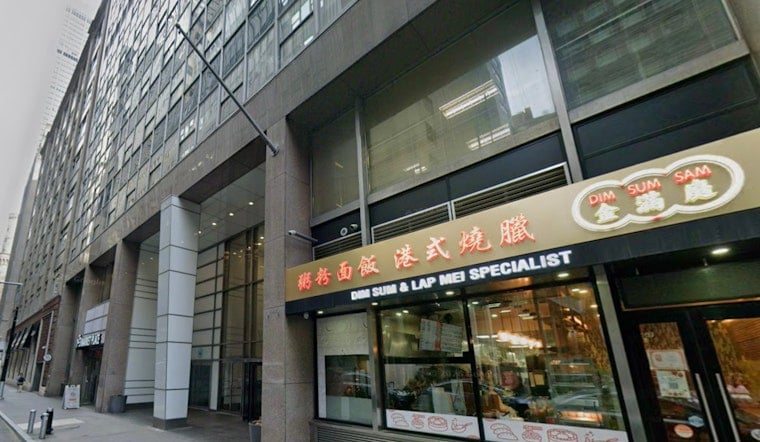
A Manhattan office landlord has told investors it may not survive the next 12 months, as a $140 million mortgage on its last major Financial District tower barrels toward a March maturity it cannot pay off. American Strategic Investment Co. lost $16 million in the first six months of 2026, even as its external manager continued collecting $500,000 a month in fees regardless of the company's performance.
The real estate investment trust, formerly known as New York City REIT before it changed its name in 2023, disclosed in SEC filings that it has substantial doubt about its ability to continue as a going concern. As reported by Bisnow, the company owes $249 million in total debt and has found no buyers for 123 William St., the 27-story, 545,000-square-foot Class-B office skyscraper it bought for $253 million in 2015. It announced plans to sell the building back in April 2024, without success.
The tower, now valued at $137.7 million as of the end of the second quarter, carries an underwater mortgage of $140 million that matures in March. Occupancy at the building has slipped to 72% as of June, down from 84% a year earlier. Ratings agency KBRA downgraded three classes of the property's commercial mortgage-backed securities loan in May and has estimated that bondholders could face a 54.6% loss.
A Portfolio in Free Fall
ASIC's troubles at 123 William St. are only the latest in a string of losses. The company sold 9 Times Square in 2024 for a $100 million loss, after acquiring the property for $162.3 million in November 2014 and unloading it for just $63.5 million, according to The Real Deal. It also defaulted on a $99 million loan at 1140 Sixth Ave. and agreed to a consensual foreclosure on that building at the end of 2025, a move the company says cost it rental revenue that helped drive second-quarter 2026 total revenue down 40% year-over-year, from $12.2 million to $7.3 million, per a company earnings release. On the accounting side, ASIC recorded a $110.9 million contract asset in early 2026 to reflect the debt relief expected once that foreclosure is finalized.
In June 2026, the company also agreed to allow foreclosure on properties at the Laurel condominium and 200 Riverside Drive, part of a 120,000-square-foot portfolio it had acquired for $88 million in September 2014. The Laurel property includes 33,000 square feet of vacant office and retail space at 400 E. 67th St. The 200 Riverside foreclosure has stalled amid a rent dispute: Rialto Capital Advisors filed suit in January seeking receivership and foreclosure, the 200 Riverside condo board sued the CMBS trustee in February over parking-garage rents, and city parking attorneys have filed an interpleader complaint over who should receive the garage rent, after ASIC defaulted on the parking garage debt last year. A judge, Dakota Ramseur, has not yet ruled on the motion in that case.
Following these surrenders and sales, the company's active property portfolio has shrunk to five assets totaling roughly 700,000 square feet with 74.8% occupancy, down from nine properties at its peak, according to the same earnings release. Among what remains, ASIC still owns an 18,000-square-foot Brooklyn preschool and 60,000 square feet of retail and office space at 196 Orchard St. — both fully leased — though the preschool building is in breach of a debt covenant.
Cash Crunch and Fee Questions
ASIC's unrestricted cash fell from $5.3 million in June 2025 to just $2.4 million as of June 30, 2026. Under mortgage debt covenants disclosed in its SEC filings, the company is required to maintain at least $5.0 million in liquid assets and a net worth above $100 million — thresholds that its shrinking cash position now threatens to breach. The company generated $14.7 million in revenue over the first six months of 2026 but still posted a $16 million loss for the period.
Despite the losses, AR Global affiliates — the company's external manager and majority owner — collected roughly $6 million in advisory and management fees over that same six-month stretch, accepting $4 million of those fees in new stock instead of cash. The management agreement requires monthly $500,000 payments to AR Global affiliates regardless of performance. Jonathan Morris, an industry observer cited by Bisnow, said most REIT managers are paid based on performance, implicitly contrasting that norm with ASIC's flat-fee arrangement, though he also expressed skepticism that the company would actually go bankrupt.
ASIC founder Nicholas S. Schorsch, who owns a majority stake in the company through Bellevue Capital Partners and founded the company in 2013, has a documented regulatory history that adds context to scrutiny of the fee structure. In July 2019, Schorsch and his firm AR Capital agreed to pay over $60 million in disgorgement and civil penalties to settle SEC charges alleging they improperly inflated incentive fees and collected unsupported charges during REIT mergers, according to InvestmentNews.
Leadership Says Turnaround Efforts Continue
Nicholas Schorsch Jr. became ASIC's CEO in 2025 and chairman of its board in July 2026. He said the company remains focused on completing asset dispositions and directing capital toward opportunities that create durable shareholder value, adding that efforts to identify additional profitable investment opportunities are ongoing. AR Global has said asset sales and lending would alleviate doubt about the company's ability to stay in business, a position it took before the 2025 annual report — but that report ultimately stated that substantial doubt about the company's ability to continue as a going concern had not been alleviated.
ASIC's shares have lost more than 90% of their market value since 2022, and the company stopped paying dividends in April 2022. It has not indicated that it would hold a call with investors regarding its latest disclosures. In July 2026, the New York Stock Exchange notified the company that it had regained compliance with Section 802.01B listing standards on minimum market capitalization and stockholders' equity, though ASIC remains under a 12-month monitoring period during which the exchange can accelerate delisting procedures if noncompliance recurs.
A Wider Office Market Squeeze
ASIC's predicament reflects broader strain across the commercial office sector. The national CMBS delinquency rate for office properties hit an all-time peak of 12.34% in early 2026, driven substantially by defaulted loans on large office towers in major markets including New York City, according to Trepp. In Manhattan specifically, leasing activity during the second quarter of 2026 shifted toward discounted space, with Class B and C buildings accounting for 39% of total leased square footage compared to 21% in 2025, even as Class B asking rents ran roughly 27% below prime trophy towers, per Avison Young. For a Class-B building like 123 William St., that shift offers little comfort — tenants are chasing bargains, but ASIC still owes far more than the property is worth.



