

























































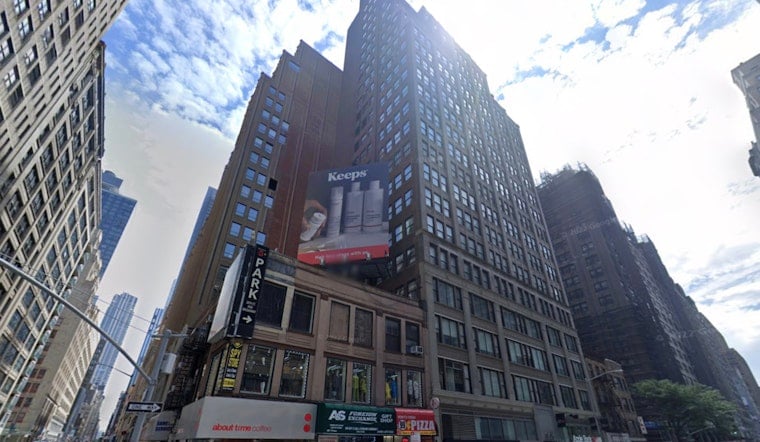
A Boston-based lender has filed to foreclose on a cluster of Garment District office buildings owned by Great Neck investor Mike Kohan, accusing him of defaulting on a $73 million mortgage and falling nearly $72 million behind on payments, interest, and back taxes. The pre-foreclosure complaint, filed August 14 in New York State Supreme Court in Manhattan, targets 345 Seventh Avenue along with three adjacent Chelsea parcels at 341 Seventh Avenue, 343 Seventh Avenue and 167 West 29th Street.
The Davis Companies, which acquired the mortgage note from Benefit Street Partners in July, alleges Kohan and partner Yael Kohansieh missed the previous month's debt payment, fell behind on building bills, and failed to resolve outstanding building violations, according to The Real Deal. The lender is seeking appointment of a third-party receiver to take over the 25-story, 190,000-square-foot property while the case proceeds. Kohan told the outlet he is working on a deal with his borrower to avoid losing the properties, though no resolution has been announced.
A Steep Fall From a $107 Million Deal
The property's slide has been dramatic. Namdar Realty Group and Empire Capital Holdings bought 345 Seventh Avenue and the three adjacent parcels for $107 million in September 2021 from Clemons Management Corporation, which had held the asset for 75 years, as reported by Commercial Observer. That 2021 purchase was financed with a $78 million mortgage from Benefit Street Partners.
By January 2025, with building occupancy down to 43 percent, Namdar and Empire Capital sold the property to Kohan, Katan Realty Group's Isaac Katan, and Ilya Mikhailov for just $85 million — a $22 million loss, or nearly a 21 percent discount, according to Bisnow. The property was reportedly facing a Uniform Commercial Code foreclosure auction before that discounted deal was structured. CoStar now puts the building's vacancy rate at 39 percent, and the sale worked out to roughly $447 per square foot.
Conversion Plans Fell Apart
When Kohan's group took over 345 Seventh Avenue, the pitch centered on New York City's newly passed “City of Yes for Housing Opportunity” zoning package, which opened the door to office-to-residential conversions for buildings constructed before 1990. Katan said at the time that the Garment District area was primed for bringing thousands of residential units online, adding that the building's residential potential complemented the city's broader zoning approach, per the same account from The Real Deal.
But the plan never got off the ground. Kohan has confirmed the ownership group is no longer pursuing conversion of the building, and former co-owner Igal Namdar has claimed the city's zoning-law changes ultimately prohibited the developers from converting the property to residential use. The building's physical layout and the cost of servicing its debt reportedly compounded the barrier, leaving the office tower stuck in its original use even as its finances deteriorated.
Trouble Piles Up in Chicago
The Manhattan foreclosure filing lands amid a broader unraveling of Kohan's holdings. In Chicago, nonprofit Baptist Theological Union has moved to evict Kohan from his portion of jointly owned ground beneath 33 West Monroe Street over $126,035 in unpaid tax-equivalent rent. Kohan has claimed the nonprofit returned his wire payments and rejected his offer to prepay six months of rent, though the eviction proceeding remains active.
Kohan took control of the 28-story Loop skyscraper earlier this year through a deed-in-lieu of foreclosure, after acquiring a $60 million loan note tied to the building at a discount from its face value — a deal Hoodline first detailed in its report on Kohan's bargain Loop tower debt buy. Kohan Retail Investment Group, which he leads, owned 28 commercial properties across 19 states as of September 2025, primarily distressed regional shopping malls acquired at steep discounts.
Overseas Regulators Take Notice
Kohan's financial troubles now extend across the Atlantic. Regulatory filings submitted to the Tel Aviv Stock Exchange in July revealed that the Israel Securities Authority is scrutinizing him over allegations that he diverted millions in Israeli bond proceeds — raised using equity stakes in Chicago real estate as collateral — to settle private, noncompany debts. Per those filings, Kohan now owes his own company $3.8 million as a result. Kohan told The Real Deal he faces regulatory scrutiny overseas but plans to resolve the Israeli bond balance shortly.
The pattern of leveraged distress is not new for Kohan's portfolio. Hoodline previously reported that lender Ardent Cos. repossessed his Town Center at Cobb mall in Kennesaw, Georgia, at a foreclosure auction in July for $51.8 million — a 27 percent loss on the $71 million he paid for the property in 2023, following earlier utility cutoffs at the mall. In Dearborn, Michigan, lender Peachtree Group sued a Kohan affiliate in late 2023 seeking receivership over the Fairlane Town Center, alleging a $28 million loan default, $2.96 million in delinquent property taxes, and $400,000 in diverted tenant rents, according to Platinum Management Holdings.
A Business Model Under Pressure
Kohan built his reputation buying troubled suburban malls at steep discounts before expanding into urban office towers in Chicago and New York. That expansion has coincided with sustained office vacancy rates above 25 percent in both markets through 2025 and 2026, a slump that has enabled opportunistic buyers to scoop up Class B office buildings for a fraction of prior valuations, per The Real Deal's reporting on the broader trend. But the same forces that made those acquisitions cheap have also made the debt service nearly impossible to sustain, and the Garment District foreclosure filing suggests Kohan's leveraged strategy is now colliding with its limits in one of the country's most competitive office markets.



