

























































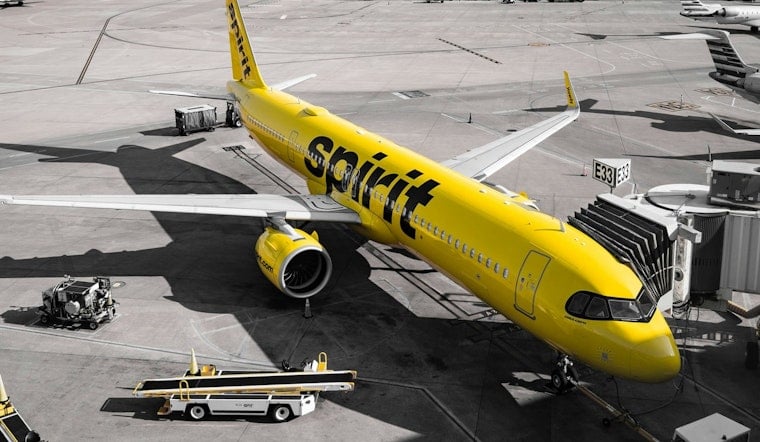
Spirit Airlines is already gone from the skies, its jets sold off and its Dania Beach headquarters picked over by would-be buyers. Now the airline's final asset up for grabs isn't a plane or a terminal gate — it's data. Google has placed the winning $10 million bid in bankruptcy court for a massive trove of Spirit's internal company records, including more than 100 million emails, over 3 million payroll records and more than 1 million employee time cards, and the deal has triggered a fight over whether workers' digital lives should be sold off to train artificial intelligence.
The sale, first reported by the Miami Herald, stems from an August 14 auction held as part of Spirit's ongoing liquidation proceedings in New York bankruptcy court. According to the Herald's reporting, the dataset Google is seeking includes decades of payroll, timekeeping, training, travel and recruiting files, along with 148,000 employee tax forms, 20,577,677 SharePoint items, 17,082,644 OneDrive items and 500,000,000 Microsoft Teams items — a digital record of the airline's internal operations stretching back decades, according to figures reported by PPC Land, which put the corporate archive at 30 million lines of software source code, 667,563 IT tickets, 763,000 flight records and 5 million crew pairings dating back to 1986.
Notably absent from the sale are Spirit's 97.5 million passenger profiles and 50 million loyalty records. Under Section 332 of the U.S. Bankruptcy Code, sales of consumer personal data require review by a court-appointed Consumer Privacy Ombudsman, a legal safeguard that led liquidators to carve customer records out of the auction entirely, per a framework detailed by legal publication Servola. No equivalent federal statute protects employee workplace communications, which is why decades of internal emails, chats and personnel files remain on the table even as customer data does not.
Flight Attendants Say Their Data Was Never Theirs to Sell
The Association of Flight Attendants-CWA, AFL-CIO, which represents Spirit's former flight attendants, filed an objection with the New York bankruptcy court arguing the sale would expose thousands of workers to re-identification risk. Per the Herald's account of the union's filing, the objection contends that de-identifying 500 million Teams messages and employee files does not adequately protect workers, since relational links across 5,500 flight attendants' schedules and records could allow individuals to be re-identified through pattern reconstruction, according to a detailed breakdown from Alex Goryachev.
“The flight attendants' data is not for sale and was not consented to,” union president Sara Nelson said, according to the Herald. The union argues that employee data is receiving less protection under the bankruptcy process than customer data, even though the proposed sale would transfer substantially the entire employment and workplace record of Spirit Airlines, spanning payroll, timekeeping, training and recruiting files dating back decades. Adam Schwartz, cited in the Herald's reporting, said employees who trusted Spirit with their information are now at great risk.
The union's objection was significant enough that it forced the bankruptcy court to postpone its hearing on approving the sale from August 19 to September 9. Spirit's flight attendants have not been paid accrued vacation, sick leave and other overdue compensation, according to the Herald, a grievance that has fueled anger over the prospect of the same workers' internal communications being monetized for AI training.
Google Says Personal Data Will Be Scrubbed First
Google has said it will not intentionally associate de-identified data with any person or household, and has agreed that the data will first pass through a third-party de-identification agent before Google receives it. Gareth Evans, speaking for Google, said the company will not receive personal information from the Spirit dataset and that a third party will rigorously scrub personally identifiable characteristics before the data is handed over, according to the Herald. Google has committed, per its court filing cited by the Herald, to maintain and use the data only in de-identified form. Both Google and Spirit have said the awarded data does not include personal information of customers or consumers, and Spirit's representatives and interested bidders have said in bankruptcy filings that privacy and personal identity would be protected, and that the sale concerns internal company data rather than consumer information. What Google is acquiring, according to the Herald, is described as productivity and collaboration data — email, calendar, chat, collaboration, messaging, documents, presentations, spreadsheets, knowledge repositories and wikis — along with tens of millions of cloud-stored files, and the sale explicitly excludes privileged materials.
A $12.5 Million Late Bid Could Reopen the Docket
Google's win is not necessarily final. AI training startup Micro1 plans to bid $12.5 million for the same dataset, but the company missed the original court-imposed bid deadline, according to the Herald. Micro1's Ali Ansari said the company is moving quickly to prepare a bid for filing on the docket, and separate reporting from Forbes frames the late offer as an assertion that 34 years of real-world operational records are critical fuel for AI models as public internet data becomes depleted. Micro1 also plans to engage the Association of Flight Attendants to address its privacy concerns directly, the Herald reported.
Spirit's representatives had already selected Mercor as an alternate bidder at $7.5 million, positioning it as a backup should Google's winning offer fall through. Whether Micro1's late counter-offer will be allowed to reopen bidding remains an open question the bankruptcy court has not yet resolved.
A Third Company Says Its Own Software Is Caught in the Sale
Adding another wrinkle, workforce-software company Springshot filed its own objection to the sale on August 22, arguing that Spirit was never authorized to transfer Springshot's intellectual property as part of the deal. Springshot said Spirit had been its customer dating back to 2022, when the airline presented the partnership at Future Travel Experience Global in Las Vegas — the same event where Spirit executive Mike Byrom said the airline was deploying the Springshot platform at every airport, gate and departure. Spirit used Springshot's system, which analyzes and synthesizes operational data to help employees complete tasks and make quicker real-time decisions, through its final flights on May 2, 2026.
Springshot has claimed ownership of substantial intellectual property used by Spirit's aviation operations and is requesting that the court block the sale unless its property is expressly excluded. “Spirit was not authorized to transfer Springshot's intellectual property,” Springshot's Doug Kreuzkamp said, according to the Herald, adding that the company's intellectual property is not for sale. Springshot's customer agreement states that the company owns all rights and intellectual property in its software, service and generated data, per the filing cited by the Herald.
The Latest Chapter in Spirit's Piecemeal Collapse
The data sale is the newest entry in a liquidation that has already scattered Spirit's physical footprint across the country. The airline's second Chapter 11 filing, coming just five months after it exited its first bankruptcy, was triggered when aircraft lessor AerCap terminated leases on 73 planes and credit card processor Elavon began withholding $3 million in cash daily, according to ElevenFlo, culminating in the airline's complete shutdown on May 2, 2026, amid a spike in fuel prices. Spirit has since sold or returned its planes and auctioned landing rights to other carriers, including a $58.5 million sale of 22 LaGuardia takeoff and landing slots to JetBlue Airways approved in July, and its headquarters has been bought by another firm, with Hoodline previously reporting on Broward's bid for the Dania Beach HQ and Delta's pursuit of Spirit's former gates at Hartsfield-Jackson.
Meanwhile, former Spirit workers have separately filed a proposed WARN Act class action in New York federal bankruptcy court, alleging the airline illegally terminated roughly 17,000 employees on May 2, 2026, without the 60 days' notice or final wages required by federal law. That lawsuit has fueled additional anger toward the estate, since Spirit had sought court approval during its wind-down to pay $10.7 million in retention bonuses to 130 non-management personnel even as laid-off workers reported receiving no severance and losing health insurance the same day. Industry analysts describe the Spirit sale as part of a broader 2026 trend of bankrupt companies selling internal Slack, Teams, email and code archives to AI developers hungry for real-world operational data, a shift that leaves the September 9 hearing as a closely watched test of how far that trend can go before workplace privacy law catches up.





