

























































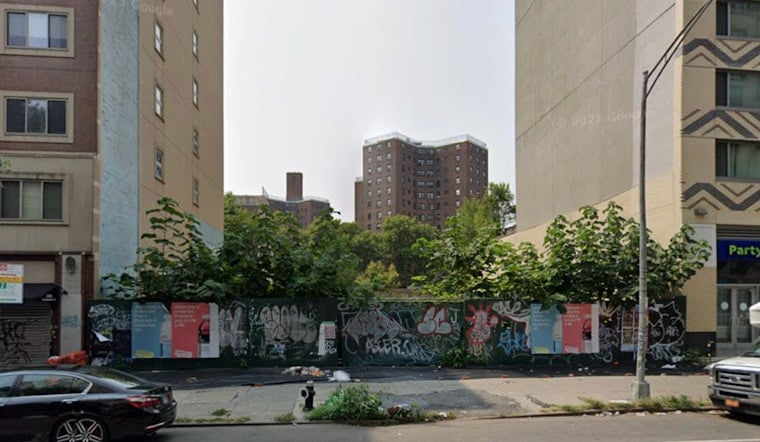
Construction is progressing on a 12-story, 55-unit mixed-use rental building at 18 West 116th Street in Harlem, rising on a site between Fifth and Lenox avenues that spent more than a century as a house of worship before falling into disrepair. The 125-foot building will include studio and one-bedroom units, a landscaped rooftop lounge, a residence lounge, a 24-hour concierge, and community facility space designed as a new sanctuary for Baptist Temple Church. Developer Carthage Real Estate Advisors expects the project, designed by Fischer + Makooi Architects, to wrap up by summer 2027.
According to New York YIMBY, the site's 60,702 square feet were occupied for more than a century by the former First Hungarian Congregation Ohab Zedek synagogue, a Neo-Tudor structure designed by Hedman & Schoen and completed in 1907. Baptist Temple Church purchased the building in 1939 and worshipped there for decades until a devastating 1965 fire damaged the structure. The same outlet reports that Baptist Temple Church sold the site to Carthage in 2018 for $6.7 million, with the sale agreement providing that the congregation would return to a new house of worship built into the redevelopment. The path to construction was anything but direct. Structural decline accelerated in 2009 when the Department of Buildings cited the aging synagogue-turned-church for instability, and partial demolition began that year but stalled, per the same outlet's reporting. The remainder of the church wasn't cleared until a 2019 demolition permit. Along the way, architecture firm GF55 Partners proposed an 11-story, 28-unit condominium scheme that was abandoned, and a ten-story, 46-room hotel proposal filed in 2022 was also dropped before the current plans advanced.
A Congregation's Long Financial Struggle
The church's decision to sell wasn't made lightly. In an October 2022 court filing seeking state approval for the sale, Baptist Temple Church disclosed that it lacked the financial resources to repair its decaying 116th Street sanctuary, as reported by Patch. The congregation was forced to rent temporary space on West 153rd Street from Harlem Congregations for Community Improvement while the redevelopment worked its way through the approval process. That process is not optional. Under Section 12 of the New York Religious Corporations Law, religious organizations must obtain formal approval from the State Supreme Court or the Attorney General's Charities Bureau before selling real estate or executing long-term leases, according to CBMS Law. That oversight exists specifically to ensure sale proceeds and replacement sanctuary terms protect a congregation's mission, which explains the years-long gap between the 2018 sale and today's active construction.
The building's decay wasn't limited to the 1965 fire. New York City Housing Preservation and Development previously conducted emergency work on the structure in 2009, removing its deteriorating roof after the Department of Buildings declared the facade and roof structurally unstable, according to New York YIMBY's 2016 reporting, and the agency billed the church for the repairs. Water damage and lingering effects from the 1965 fire had left the building unstable long before demolition finally began.
Deep Roots Predate the Decline
Long before its decades of disrepair, the original synagogue building carried real weight in Jewish civic life. In October 1920, the structure hosted a high-profile memorial service for philanthropist Jacob Schiff, who had personally laid the building's cornerstone in 1906, according to a historical account published by Jewish History.
A Developer With Harlem Roots
Carthage Nexus Canada LP is associated with the development, and the project is led by Edward Poteat, a Harlem native whose firm previously co-developed Marcus Garvey Village on West 124th Street in partnership with Rester Management, purchased in 2017. That 330-unit residential complex includes 117 income-restricted affordable apartments and community space, according to 6sqft. Rester Management is also behind the financing on 18 West 116th Street. In September 2025, the firm secured $19.62 million in construction financing backed by M&T Bank for the Harlem project, per NYC commercial financing data cited by PincusCo. That loan landed amid a broader rebound in New York City construction lending, with lenders issuing $23.3 billion across 344 construction and conversion loans in 2025, up from $17.1 billion across 275 deals in 2024, the outlet notes.
Part of a Wider Harlem Pattern
The arrangement at 18 West 116th Street fits a pattern playing out across Harlem, where historic congregations are trading land equity for new sanctuaries built into mixed-income housing projects. Bethel Gospel Assembly's 28-story redevelopment on West 120th Street follows a similar model, according to The Boland Team, which frames combining residential units with church space as a way for faith institutions to maintain a neighborhood presence even as they give up outright ownership of their land. The redevelopment also adds to a wave of new residential construction along the West 116th Street subway corridor. Hoodline permits filed nearby in March for a 13-story, 88-unit mixed-use building one block west at 2132 Frederick Douglass Boulevard would add roughly 64,900 square feet of residential and retail space to the same subway-adjacent stretch. For context on what new units in the area might eventually rent for, a 2018 rental market report found median studio rents in neighboring East Harlem averaging $2,000 per month, with entry-level studios starting around $1,600.



