

























































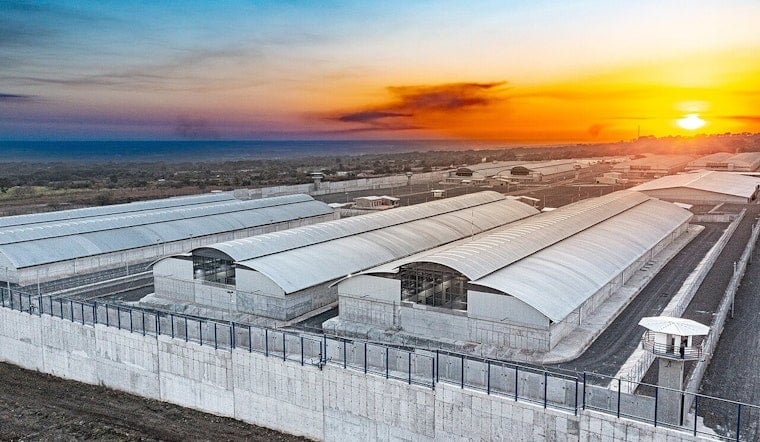
A federal judge has ordered that a $1.3 million lawsuit brought by a former Irving, Texas barber who says he was wrongfully deported to El Salvador's most notorious prison must be heard in Texas, not Washington, D.C. Neiyerver Adrián León Rengel says immigration officers mistook his tattoos — including one of a barbershop and another of a tiger — for gang symbols before shipping him off to the Center for Terrorism Confinement, known as CECOT, where he says he spent four months being beaten and denied medical care.
Rengel filed his civil suit under the Federal Tort Claims Act seeking at least $1.3 million in damages for false imprisonment and intentional infliction of emotional distress, according to CBS News. He is represented by the Democracy Defenders Fund and the law firm Mariziani, Stevens & Gonzalez PLLC, with backing from the League of United Latin American Citizens. The filing is believed to be the first known individual damages lawsuit brought by a former CECOT detainee against the U.S. government, per that same report.
Chief Judge James E. Boasberg of the U.S. District Court for the District of Columbia ruled that Rengel's case, Rengel v. United States, belongs in the Southern District of Texas, as reported by Tampa Free Press. Boasberg determined that the specific acts directly affecting Rengel occurred in Texas and wrote that the relevant conduct at issue was plainly aimed at Texas. The judge denied the government's request to dismiss the lawsuit outright but sided with federal attorneys on the question of venue, also denying Rengel's motion for venue-related discovery.
How an ICE Stop in Irving Turned Into a Flight to El Salvador
According to the lawsuit, immigration officers detained Rengel on March 13, 2025, at his apartment complex in Irving and inspected his tattoos, which also included his mother's and daughter's names. Officers alleged the tattoos indicated membership in Tren de Aragua, despite Venezuelan criminal organizations generally not using tattoos for identification, the Tampa Free Press report notes. Rengel denied any gang affiliation and requested a hearing before an immigration judge.
Rengel had entered the United States legally in 2023 through a port of entry in El Paso after using a Customs and Border Protection mobile app to schedule his appointment, and he had applied for Temporary Protected Status with a court date set for April 2028. Before his arrest, his only law enforcement contact in the U.S. was a Class C misdemeanor drug paraphernalia charge in Irving after he was a passenger in a co-worker's stopped vehicle, according to the civil rights group LULAC. Class C misdemeanors in Texas carry a maximum fine of $500 with no jail time, the same account notes.
Rengel was transferred to a detention center in South Texas on March 14, 2025, the day the president issued a secret proclamation under the 1798 Alien Enemies Act directing the summary removal of suspected Tren de Aragua members. He was placed on a flight out of Harlingen, Texas, on March 15, 2025, and the aircraft landed in San Salvador that same day. The lawsuit alleges that high-ranking federal officials in Washington directed the planes to proceed despite a temporary restraining order that had been issued to block the removals, and that those officials orchestrated the broader deportation scheme.
Four Months Inside CECOT
Once in El Salvador, Rengel alleges he was imprisoned by Salvadoran officials alongside other detainees and subjected to beatings, poor conditions, and a denial of medical care. He was held incommunicado for four months, reporting that he was forced to drink contaminated wash water and was told he would serve 90 years, before his release came as part of a July 2025 U.S.-Venezuela prisoner exchange that returned more than 200 Venezuelan men to Venezuela, per CBS News. Rengel now resides back in Venezuela.
A report from Human Rights Watch, cited in the same CBS News account, concluded that the incommunicado detention of Venezuelan deportees at CECOT amounted to arbitrary detention and torture under international law, documenting physical beatings, psychological abuse, and sexual assault based on post-release interviews with former detainees. Rengel's lawsuit alleges negligence, abuse of process, false imprisonment, and intentional infliction of emotional distress, and seeks both money damages and a declaratory judgment.
Why the Case Landed in Texas
The federal government had moved to dismiss the case for improper venue, arguing that under 28 U.S.C. § 1402(b), FTCA claims must be brought either where the plaintiff resides or where the alleged acts or omissions occurred, a standard detailed by Law & Crime. Because Rengel was detained in Irving and processed through South Texas before his flight out of Harlingen, the government argued the core operative facts occurred in Texas judicial districts — an argument Boasberg ultimately accepted.
The transfer sends Rengel's case into a district where judges have already pushed back hard against the government's use of the Alien Enemies Act. In May 2025, U.S. District Judge Fernando Rodriguez Jr. of the Southern District of Texas issued a permanent injunction ruling that the 1798 law does not authorize the executive branch to deport alleged Tren de Aragua members without due process, holding that transnational gang activity does not meet the statute's requirement of an organized armed attack or invasion, according to The Guardian. That ruling followed an April 2025 U.S. Supreme Court decision establishing that noncitizens targeted under the Alien Enemies Act must be given constitutional due process, including a meaningful opportunity to challenge gang allegations through habeas corpus before removal.
Part of a Wider Wave of Litigation
Rengel's case is not the only one testing accountability for the March 2025 deportation flights. In July 2026, three Venezuelan deportees filed a separate class-action lawsuit in D.C. federal court on behalf of more than 230 men against private charter contractors CSI Aviation and GlobalX, alleging the companies executed the CECOT deportation flights in defiance of judicial stay orders, according to Common Dreams. That suit alleges charter staff deceptively told passengers they were being flown to Venezuela rather than El Salvador.
Rengel's case also follows a $56 million claim from Utah filed in March by attorneys representing another migrant, identified as Johnny Hernandez, who was similarly deported to CECOT under the Alien Enemies Act. Administrative tort claims like that one serve as a mandatory statutory prerequisite that must be filed six months before an FTCA lawsuit can proceed in federal court. It remains an open question how the Southern District of Texas will handle discovery involving federal officials based in Washington, and whether the government will settle or continue litigating the individual damages claims stemming from the four-month CECOT detentions.




.jpg)