

























































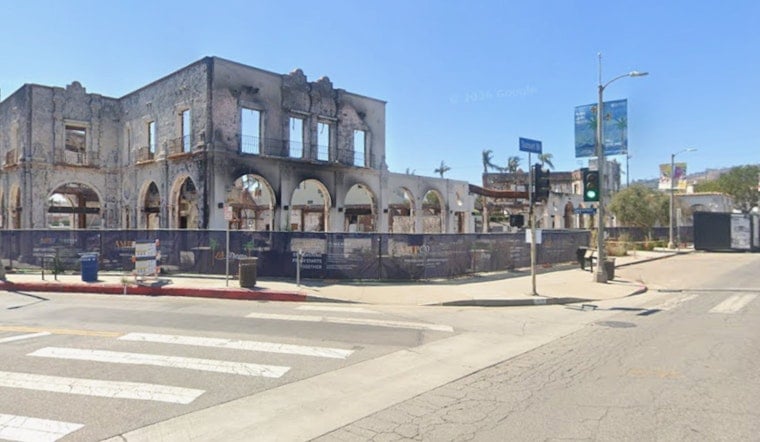
Johnny Buss, the eldest son of late Lakers owner Dr. Jerry Buss, has purchased a vacant 15,000-square-foot lot at 860 Vía de la Paz in Pacific Palisades for more than $7 million, closing out a fire-scarred property that once housed a bustling office and retail building before the January 2025 wildfire reduced it to rubble. The deal lands just two days after the Lakers themselves changed hands again in a record-breaking $12.5 billion sale.
The purchase, first reported by The Real Deal, was made through Olliitoco Real Estate Holdings LLC, an entity controlled by Buss, in an all-cash transaction, according to RENTV.com. The sale was brokered by Janet Neman of Kidder Mathews. The lot is now cleared, though its subterranean parking structure survived the fire intact, and under Los Angeles rebuild guidelines and C2-1VL zoning, the parcel qualifies for an expedited city review path that would allow a replacement development of up to 38,000 square feet, per Kidder Mathews.
From the Atrium Building to a Cleared Lot
Before the fire, the site was home to what was known as the Atrium Building, a roughly 34,500-square-foot office and retail complex built in 1980. Seller Optimus Properties bought the building out of foreclosure in November 2014 for $11.35 million, at a time when the property sat about 16 percent vacant, according to Optimus Properties' own account, though other reporting on the seed story put that vacancy figure at 50 percent at the time of purchase. By the time the Palisades Fire tore through the neighborhood in January 2025, the building was said to be 98 percent occupied, per the seed reporting from The Real Deal — a stark before-and-after that underscores how much was lost in a single blaze.
The development site sits close to Rick Caruso's Palisades Village, the 125,000-square-foot shopping center that serves as the commercial anchor of Pacific Palisades and is set to reopen Aug. 15 after a remediation effort estimated between $50 million and $100 million-plus. That timing places Buss's purchase squarely alongside one of the neighborhood's most visible recovery milestones, as shoppers prepare to return to a commercial corridor that was largely dark for a year and a half.
A Lakers Fortune Meets a Burn-Zone Bargain
The land deal comes just two days after Josh Kushner and Bob Iger agreed to buy controlling interest in the Los Angeles Lakers from Mark Walter for a record $12.5 billion, a sale Hoodline detailed earlier this week. Walter had purchased majority control from the Buss family only ten months earlier for $10 billion, and the Buss family retains a 15 percent minority stake in the franchise even after this latest sale.
Buss, 69, has a long history around Los Angeles sports and civic life beyond his family's basketball legacy. He previously managed the L.A. Lazers indoor soccer team and the L.A. Sparks women's basketball team, and he ran an independent campaign for President of the United States in 2024, according to the Los Angeles Times. The Vía de la Paz purchase marks a comparatively modest but notable real estate move for a family whose wealth has just been reshaped by two mega-valuations of the Lakers in less than a year.
Why Optimus Is Leaving Los Angeles
For Optimus Properties, the sale is part of a broader retreat from Los Angeles real estate. Optimus co-founder Kamyar Shabani said the broader business and regulatory climate in Los Angeles made long-term investment increasingly difficult, and that the environment led the firm to redeploy capital elsewhere, according to the seed reporting. The company sold two Koreatown apartment buildings for $13 million in 2025 and has been shifting capital toward San Carlos and Orange County retail assets, per RENTV.com. Optimus still owns retail holdings in Echo Park at 1501 Sunset Boulevard and 1487-1489 Sunset Boulevard, a property at 301-343 Glendale Boulevard, and a retail property in Hollywood at 5214-5232 Sunset Boulevard.
Part of that regulatory friction traces to Measure ULA, which imposes a 4.0 percent transfer tax on Los Angeles commercial property sales above $5.4 million. Real estate research cited by the California Apartment Association indicates the levy has reduced commercial transaction volume across the city by 30 to 50 percent, with ULA rates adjusted upward as of July 1, 2026.
Public Money Is Trying to Counter the Exodus
City and county officials have been working to offset that drag with a series of rebuild incentives across the burn zone. California executive orders temporarily waived key CEQA and Coastal Act environmental review requirements for fire-damaged properties, according to CoStar, while Los Angeles officials weighed waiving roughly $90 million in rebuilding permit fees — an effort Hoodline covered in permit fee relief for fire survivors. In July, Los Angeles County also established a disaster recovery financing authority projected to generate $245 million in present-value tax-increment funding for infrastructure and fire-resilience projects across the Palisades burn area, using fiscal year 2025-26 property tax values as its base, as Hoodline reported in its coverage of the county's $245 million rebuild plan.
The Vía de la Paz parcel is zoned for commercial and mixed-use development, giving Buss flexibility on what eventually rises there. Whether he intends to build a signature project himself or simply hold the shovel-ready lot as a long-term investment while Palisades Village reopens and the surrounding blocks rebuild remains an open question, one likely to draw attention as the neighborhood's recovery continues to take shape.




