

























































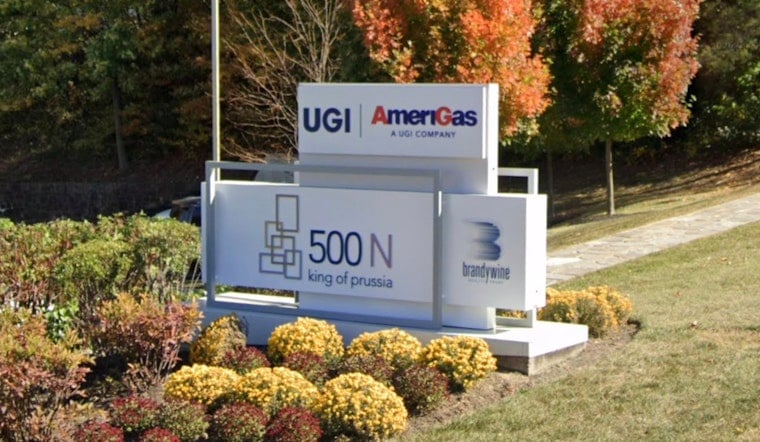
Shares of King of Prussia-based UGI Corporation spiked more than 12% in early trading Tuesday after word broke that private equity giant KKR had floated a $9 billion takeover bid for the natural gas and electricity distributor. The stock's swing was steep enough that it triggered a temporary volatility halt on the New York Stock Exchange at $37.20 before climbing further, a sharp jolt for a company that had been trading near $35 a share just days earlier.
The reported offer, first detailed by the Wall Street Journal and citing people familiar with the matter, would value UGI at $42.50 per share — a premium of about 21.1% over the company's closing price from the prior Monday, according to Reuters. Neither KKR nor UGI immediately responded to requests for comment from the wire service. KKR's own stock dipped roughly 1% in early trading, a modest move compared to the jump in UGI shares.
UGI is a familiar name to Pennsylvania ratepayers well beyond Wall Street. Founded in 1882 and headquartered in King of Prussia, the company operates across four business units — UGI Utilities, AmeriGas Propane, Midstream and Marketing, and UGI International — serving more than 2.5 million customers in 18 countries, according to UGI Corporation. It runs the second-largest regulated gas utility in Pennsylvania and the country's largest retail propane business.
Why Private Equity Wants a Piece of a Gas Utility
Reuters frames the interest in UGI as part of a broader reshaping of the U.S. energy market, driven by surging electricity demand from AI data centers and other large power users — a shift that has sharpened investor focus on reliable natural gas supplies. That dynamic isn't abstract for UGI. In May, UGI Energy Services partnered with Prime Data Centers to sell property and commit more than $100 million toward natural gas pipeline infrastructure supporting a proposed gas-fired power facility for an AI computing campus in Pennsylvania's northern tier, with Prime anticipating daily gas demand exceeding 100,000 dekatherms within three to five years.
KKR's timing lines up with its own war chest. The firm closed its flagship infrastructure vehicle, KKR Global Infrastructure Investors V, on August 3 after raising $19.2 billion in capital commitments aimed at core-plus real assets including digital infrastructure and regulated utility networks, according to Infrastructure Investor. The firm has already been active in pairing natural gas generation with AI infrastructure elsewhere: in July 2025, KKR and Energy Capital Partners announced the first project under their $50 billion AI infrastructure partnership, a $4 billion, 190-megawatt data center campus in Texas co-located with a Calpine natural gas power plant, per Energy Capital Partners.
A Company That Already Weighed Breaking Itself Up
UGI's board has recent experience wrestling with its own structure. In May 2024, the company wrapped up an eight-month strategic review of its propane operations — during which it had engaged Goldman Sachs and J.P. Morgan to evaluate options for the unit — and ultimately chose to retain ownership of AmeriGas Propane rather than pursue a sale, spinoff, or joint venture, opting instead for internal operational restructuring.
The company has also been shoring up its regulated revenue base at home. In August, administrative law judges recommended approval of a joint settlement granting UGI Utilities a two-phase $65 million natural gas distribution rate increase in Pennsylvania, with $40 million taking effect in October and a rate stay-out provision running through January 2029. UGI reported GAAP net income of $678 million, or $3.09 per diluted share, for the fiscal year ended September 30, 2025, along with roughly $530 million in free cash flow, as its operating margin improved from 10.7% to 15.2% year over year.
State Incentives Add to the Backdrop
Pennsylvania's state government has also been actively courting the kind of data center growth fueling investor interest in gas assets. The Pennsylvania Department of Community and Economic Development this month highlighted its Governor's Responsible Infrastructure Development, or GRID, Standards, which establish expedited permitting and tax incentives for AI data centers that meet state energy affordability guidelines — a notable policy lever in a state that is the nation's second-largest natural gas producer behind Texas.
For income-focused shareholders, UGI's appeal has long rested on its dividend track record rather than deal speculation. The company has paid common stock dividends for 141 consecutive years since 1885 and currently pays an annual dividend of $1.50 per share, yielding approximately 4.3%, with a 10-year dividend compound annual growth rate near 6%. Whether that legacy factors into how UGI's board evaluates KKR's offer remains an open question, as does any path the deal might take through regulatory review, including scrutiny from the Pennsylvania Public Utility Commission given UGI's status as a regulated in-state utility.





