

























































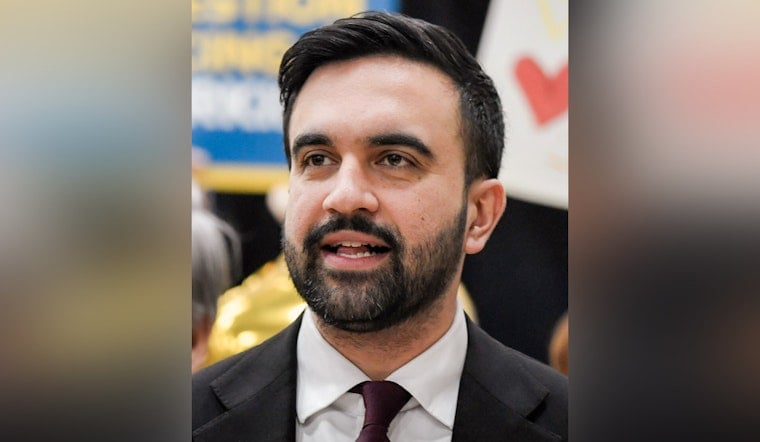
New York City's top fiscal watchdogs handed Mayor Zohran Mamdani a mixed report card this week: credit for finally putting real numbers on the books, but a stark warning that the city is heading toward budget gaps as high as $8.5 billion within a few years. Mamdani appeared before the New York State Financial Control Board on Wednesday, where officials praised his administration for ending years of underbudgeting while cautioning that New York City still relies heavily on one-time fixes to stay afloat.
The Financial Control Board, created in response to the city's fiscal crisis of the 1970s, exists to make sure New York City's budget stays balanced, and it reviewed the city's adopted $125.8 billion fiscal 2027 budget during the hearing. As amNewYork reported, State Comptroller Thomas DiNapoli and City Comptroller Mark Levine both credited the Mamdani administration with adding billions of dollars in previously underbudgeted expenses to the city's ledger, including Metropolitan Transportation Authority subsidies, rental assistance, overtime, and public assistance costs. Roughly $6.4 billion in those previously hidden costs were incorporated into the fiscal 2027 plan, addressing what the board had criticized as chronic underbudgeting under the prior administration led by Eric Adams in 2025.
A Deficit That Keeps Growing Despite Record Tax Revenue
Even with the more honest books, the numbers are not pretty. New York City had an underlying fiscal 2026 operating deficit of $1.8 billion after accounting for carried-forward prepayments, according to the board's review — its fourth consecutive year running a deficit, and the largest shortfall since fiscal 2020. The city projects a fiscal 2028 budget gap of $6.4 billion, with the board's own staff estimating it could reach $6.7 billion, followed by projected gaps of $8.2 billion in fiscal 2029 and $8.5 billion in fiscal 2030.
DiNapoli said that better-than-projected revenues were insufficient to close the gap once expenses were properly accounted for, even though city-fund revenue exceeded projections made when the fiscal 2026 budget was adopted by $5 billion, aided by strong Wall Street profits and tax collections. Mamdani himself pointed to those same bright spots during his remarks, highlighting high labor force participation, recovering transit ridership, declining office vacancies, and strong Wall Street profits as signs of underlying economic strength.
No Deposit Into the Rainy Day Fund
City Comptroller Mark Levine used his own address to the board on Wednesday to flag a missed opportunity: New York City made no deposit into its Rainy Day Fund during fiscal 2026 despite record tax revenues, according to Comptroller Levine's office. His office's recommended formula would have generated a deposit ranging from $1.4 billion to $1.7 billion. Levine also addressed recent increases in New York City bond yields during the same appearance, telling the board the movement reflected broader market dynamics rather than an eroding tax base or expectations of a credit rating downgrade.
Despite the missed deposit, Levine praised Mamdani for largely ending the practice of underbudgeting known costs. New York City ended fiscal 2026 with a $1.96 billion surplus that was used to prepay fiscal 2027 debt service, but the city also eliminated its capital reserve and reduced its general and labor reserves in the process. Former city Comptroller Bill Thompson praised Mamdani for ordering agencies to find savings early in the fiscal year, saying the 2.5% savings target — which Mamdani directed city agencies to hit annually through fiscal 2030 and which could save up to $1.5 billion annually depending on exemptions — provides comfort heading into a tighter fiscal stretch.
State Aid Fills Gaps, But Only Temporarily
Much of the near-term relief has come from Albany rather than City Hall's own revenue tools. State Comptroller Thomas DiNapoli's June analysis of the fiscal 2027 executive budget found New York City received over $2.7 billion in additional state aid for education, childcare, transit, and public health, according to the Office of the New York State Comptroller. Much of that aid must be renegotiated in future state budget cycles, leaving the city dependent on Albany's continued cooperation. Governor Kathy Hochul, who chairs the Financial Control Board, said the state would help City Hall close the budget gap and preserve access to capital markets, and pledged to continue investing in what she and Mamdani have called a shared affordability agenda.
That partnership has not been without friction. In April, Mamdani and City Council Speaker Julie Menin proposed cutting the city's Pass-Through Entity Tax credit from 100% to 75% for high-income business owners, a move projected to generate $1 billion annually, but Hochul rejected the change in May as an unacceptable personal income tax hike, according to reporting by FOX 5 New York. A spokesperson for Hochul said she would consider additional revenue when necessary to solve a real problem, but would not support policies making it harder for families, workers, or employers to remain and succeed in New York. The New York Post reported, citing City Hall sources, that Mamdani is preparing a post-Labor Day campaign to push for higher taxes on wealthy New Yorkers and corporations targeting the 2027 legislative session.
Short-Term Fixes, Long-Term Imbalance
New York City's budget plan currently relies on $6.1 billion in short-term and one-time measures, including state aid, pension reamortization, and accounting adjustments, none of which resolve the underlying imbalance between city spending and revenue. One targeted revenue tool that did survive Albany negotiations is the pied-à-terre tax, a surcharge on non-resident second homes valued above $5 million, though its rollout is currently being challenged in a Staten Island court.
Marjorie Henning called the declining surplus evidence of an ongoing and growing structural budget imbalance, noting that the surplus carried between fiscal years is the lowest in a decade. She has backed a proposed city charter change that would set a reserve target equal to 12% of prior-year city tax revenue and require the Mayor's Office of Management and Budget — now led by budget director Sherif Soliman, whom Mamdani appointed in December after Soliman's earlier stints under the Bloomberg, de Blasio, and Adams administrations, per City & State New York — to develop a reserve-deposit methodology together with the comptroller. The reserve reductions already made would limit the city's flexibility to respond to an economic slowdown or federal funding cuts without cutting services, board staff warned, even as roughly $10 billion in new agency needs were added to the fiscal 2027 budget over the past year.
No Formal Control Period, For Now
Despite the grim long-term math, Financial Control Board staff found that none of the statutory conditions requiring a new control period had occurred, and the board approved the determination that New York City was not experiencing fiscal stress warranting stricter state oversight. The board, which operates under state statutory authority set to terminate in 2035, was formed in response to the city's fiscal crisis of the 1970s specifically to provide state-level spending control and prevent a repeat of that era's near-insolvency.
Mamdani said he appreciated the comptrollers' and board members' assessments following the hearing. The scrutiny arrives as the mayor's public standing diverges sharply along geographic lines: a Siena University poll found Mamdani viewed favorably by 69% of likely New York City voters but unfavorably by 44% of likely voters statewide, with 47% viewing him favorably statewide and 24% unfavorably within the five boroughs. The same poll found Hochul leading Republican Bruce Blakeman 64% to 19% among city voters and 49% to 39% statewide.
New York's fiscal challenges are not confined to the five boroughs. State Comptroller Thomas DiNapoli reported in July that the state's own Division of the Budget projects cumulative out-year deficits totaling $31.8 billion through state fiscal year 2030, driven largely by rising Medicaid and school aid costs, according to the Office of the New York State Comptroller. For New York City, the structural gap between what it collects and what it has committed to spend remains the defining challenge for Mamdani's financial team, even with the books now more honest than they have been in years.





