

























































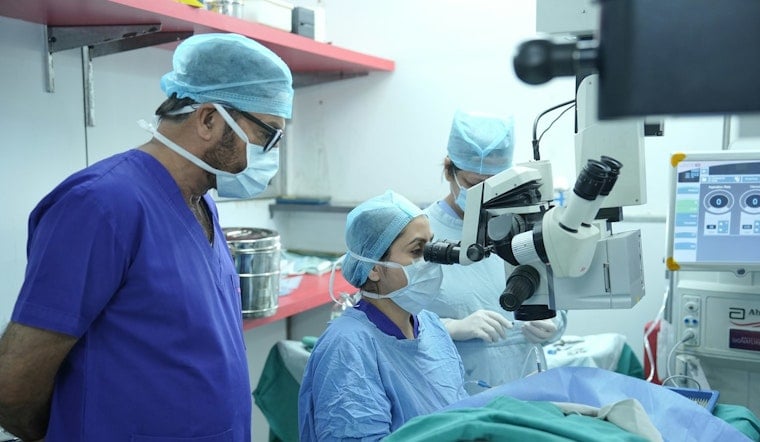
Medicare pays about $520 for a standard cataract procedure today, down roughly 20% over the past decade, and that steady squeeze on reimbursement is reshaping how eye surgeons talk to patients about their options. Cataracts affect more than half of Americans by age 80, causing blurred vision and poor night vision as proteins and fibers in the eye's lens break down and clump together with age. As the standard payment shrinks, a growing share of surgeons are steering patients toward laser-assisted procedures that carry out-of-pocket charges of $1,000 to $3,000 per eye.
Kevin Miller, a UCLA ophthalmology professor, put it bluntly: laser surgery gives doctors additional money on top of what Medicare reimburses, according to the Miami Herald. Cataract surgery itself involves removing the clouded lens and replacing it with a clear artificial one, and Medicare typically leaves enrollees owing a few hundred dollars for the standard version. Both the laser-assisted and traditional scalpel methods are considered safe and capable of significantly reducing or eliminating a patient's need for glasses, but the price gap between them has widened as federal payments have fallen.
A Decade of Shrinking Payments
The math behind that gap is stark. Under the 2026 Medicare Physician Fee Schedule finalized in November 2025, federal regulators applied a 2.5% practice efficiency cut to work relative value units, translating into an 11% reduction in surgeon reimbursement for simple cataract surgery — the largest single-year payment cut for the procedure in three decades, according to Review of Ophthalmology. It follows a 2020 cut that dropped payments nearly 15%, from $654.47 to $557.58 for the same procedure code, and a further 3% reduction set for 2025 that brought the rate down to $521.75, per the American Society of Cataract and Refractive Surgery.
That erosion matters because cataract surgery is one of the most common procedures in American medicine, with 3 million to 4 million performed annually on Medicare beneficiaries, according to UCLA eScholarship research. Nationally, laser-assisted surgery now accounts for nearly 12% of the roughly 5 million cataract surgeries performed each year in the U.S., according to Market Scope, a St. Louis-based ophthalmic market data company. That share varies widely by practice — Vance Thompson, an ophthalmologist and past president of the American Society of Cataract and Refractive Surgery, said laser choice among his Sioux Falls, South Dakota patients has climbed from about 10% a decade ago to roughly 50% today. Miller said 80% of patients at his Los Angeles practice choose the laser option.
What Patients Actually Pay
The financial reality lands directly on patients. Tammy Chalala, 69, paid nearly $4,000 out of pocket in New York for two laser-assisted cataract surgeries, telling the Herald the laser seemed like the better option. Premium lenses that patients often pair with laser procedures — designed to reduce dependence on reading glasses — cost an additional $1,000 to $4,000, since traditional Medicare does not cover most vision correction and private insurers typically follow Medicare's benefit rules.
Barbara Cobuzzi, 71, took the opposite path, opting for cataract surgery without a laser and paying nothing beyond her standard Medicare cost-sharing. She was quoted a price of $1,500 per eye for the laser option in New Jersey and told the Herald that doctors are using the laser as a moneymaker. Federal guidance issued by the Centers for Medicare & Medicaid Services in November 2012 explicitly bars doctors and surgery centers from charging patients extra simply for using a laser; out-of-pocket fees are permitted only when the laser is used to deliver a genuinely non-covered service, such as correcting astigmatism or implanting a premium lens, as detailed by Ophthalmology Management.
Does the Laser Actually Improve Vision?
The clinical evidence on whether laser surgery is worth the added cost is largely settled, and it does not favor the laser. A 2023 Cochrane Systematic Review analyzing 42 randomized controlled trials involving 5,831 patients found no clinically important differences in visual acuity, overall complications, or quality of life between laser-assisted surgery and standard ultrasound phacoemulsification — and noted that 16 of those trials were funded by laser equipment manufacturers. The American Academy of Ophthalmology similarly says studies do not show fewer complications or better outcomes with laser surgery, and Oliver Schein, an ophthalmologist at Johns Hopkins Medicine, said his colleagues have seen no benefit from laser surgery over the traditional approach — though he added that it does not cause harm and provides good results.
The landmark UK FACT trial, published in 2020, reached a similar verdict: femtosecond laser-assisted cataract surgery was clinically non-inferior to conventional surgery but delivered no additional health benefit at one year while significantly increasing costs. A separate 2023 review in PLOS ONE did find one real-world edge for the laser — lower corneal endothelial cell loss and faster recovery from corneal swelling in the first one to three days after surgery — but confirmed the laser does not improve ultimate visual acuity. Miller told the Herald that laser surgery offers precision and reproducibility but does not improve vision, and many doctors say the laser simply makes more precise cuts than a scalpel.
Why Doctors Are Buying the Technology Anyway
If the vision outcomes are essentially identical, the pressure to adopt laser technology comes down to money — on both sides of the ledger. Acquiring femtosecond laser equipment costs practices between $400,000 and $500,000 upfront, plus $25,000 to $50,000 in annual maintenance and a $150 to $400 per-eye disposable click fee owed to the manufacturer for every procedure, according to Cataract & Refractive Surgery Today. Barrett Eubanks, a U.S.-trained ophthalmologist now practicing in Toronto, has watched that dynamic from both sides of the border, while Miller noted the laser is also useful in specific clinical situations, making it easier to implant premium lenses or remove certain difficult cataracts. The laser is not suitable for every patient, either — it is not recommended for those with corneal scarring or an unusually small pupil.
Miller said his own practice does not pressure patients to choose the laser, even though it offers the option, underscoring that the upsell dynamic Cobuzzi described is not universal. As Medicare's per-procedure payment keeps falling, though, the financial logic pushing practices toward laser equipment and premium add-ons shows no sign of reversing, leaving patients like Chalala and Cobuzzi to weigh a choice that, by most clinical measures, comes down to price rather than outcome.





