

























































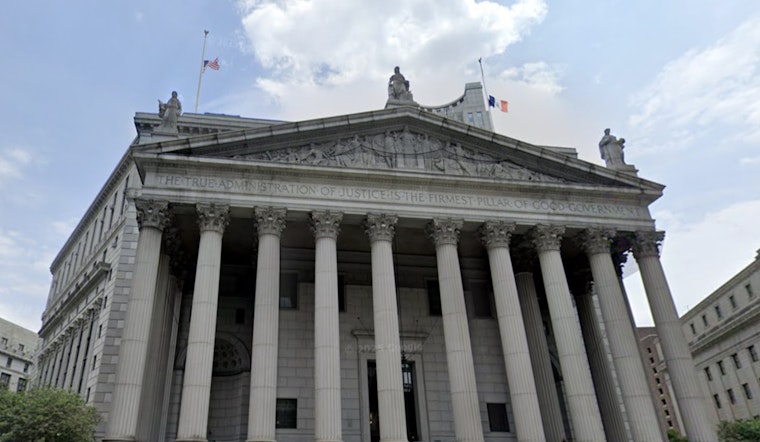
The man accused of pouring scalding hot liquid on four strangers across Midtown Manhattan in a two-hour rampage returned to a New York Supreme Court criminal courtroom Wednesday, appearing noticeably heavier and clean-shaven, as his attorney insisted he has made real progress since his 2024 arrest. Larry Martin, now facing eight felony counts tied to the March 2024 attacks, did not respond to questions from reporters outside the courtroom.
Martin's attorney, Rosemary Vassallo, told reporters her client has turned over a new leaf, saying he is compliant with his treatment plans and cooperating with staff at a rehabilitation facility, according to the Daily Mail. Vassallo declined to comment further outside the courtroom. Presiding Judge Juan Merchan praised Martin's progress during the hearing, according to the same account.
Manhattan District Attorney Alvin Bragg announced an eight-count indictment against Martin on March 28, 2024, charging him with four counts of attempted first-degree assault and four counts of second-degree assault, according to the Manhattan District Attorney's Office. Bragg said Martin, then 42, allegedly committed violent attacks against four randomly selected individuals walking in Midtown within less than two hours, and that the victims suffered extensive injuries.
A Two-Hour Rampage Across Midtown
According to the District Attorney's timeline, the attacks unfolded sequentially between 7:10 a.m. and 8:39 a.m. on March 6, 2024. Martin allegedly threw hot water down the back of a man at East 44th Street and Lexington Avenue, leaving the first victim with burns to his neck. He is then accused of throwing scalding water on the side of a second victim's face at West 56th Street and Sixth Avenue, an attack that left that victim with burns and hearing loss.
Prosecutors say Martin next tossed hot liquid from a cup onto the right side of a third victim's face at West 42nd Street and Seventh Avenue, causing facial burns. The fourth attack allegedly occurred at West 35th Street near Eighth Avenue, where Martin poured scalding hot liquid on a victim's chest and hand. The NYPD shared video of Martin walking the streets during the attacks and arrested him the day after, on March 7, 2024.
A History of Instability and a Prior Arrest
At the time of the attacks, Martin's last known address was a homeless shelter in Brooklyn, police told the New York Post. He also had a prior arrest in Queens in August 2021 in connection with an alleged assault on a 70-year-old man. That earlier case, unhoused housing instability, and now the Midtown attacks trace a pattern that has become familiar in New York's criminal courts, where individuals with severe untreated mental health needs often cycle repeatedly through shelters and the justice system without sustained intervention, per the New York City Bar Association.
Martin's case is being overseen in Manhattan Supreme Court under Judge Merchan, who has led the Manhattan Mental Health Court, known as Part 59M, since it was established in 2011, according to the New York County Supreme Court. Part 59M provides dedicated judicial monitoring for defendants with severe mental health needs who agree to court-supervised treatment as an alternative to straight incarceration.
What Diversion Would Require
To qualify for reduced charges through mental health court diversion, defendants must undergo clinical evaluations and follow personalized outpatient treatment plans supervised by dedicated case managers, per procedures outlined by NYC Health + Hospitals and the New York City Bar Association. Successful completion of that process typically requires 12 to 18 months of verified compliance with rehabilitation and mental health care before a court will consider dropping or reducing felony charges.
The stakes for Martin remain severe if that path fails. Attempted assault in the first degree is a Class C violent felony under New York Penal Law § 120.10, carrying a statutory state prison sentence ranging from 3.5 to 15 years per count upon conviction. Assault in the second degree, charged under Penal Law § 120.05, is a Class D violent felony punishable by a mandatory minimum of 2 years and up to 7 years in state prison per count, unless a formal diversion program or plea deal is negotiated.
Martin's demeanor in court this week stood in sharp contrast to his initial arraignment on March 28, 2024, when he appeared in a bright orange jumpsuit, smiled broadly, and was ordered held without bail given the unprovoked nature of the public attacks, according to news archives relayed by the Daily Mail's reporting partners at the time. Martin is expected to appear in court again on September 9.
Why Midtown Attacks Draw Outsized Scrutiny
Cases like Martin's land amid broader anxiety about random public violence in New York's densest commercial corridors. Midtown Manhattan has consistently recorded among the highest total major crime complaint volumes and property crime rates of any police precinct area in the city, according to data compiled by Vital City. The outlet notes that Midtown's dense commercial and transit corridors handle millions of daily visitors, amplifying the impact of any public-space violence.
Separately, Vital City's analysis of NYPD transit data found that while overall major subway crime fell 8.9% in 2025 compared to 2024, felony assaults on the transit system remained more than 100% higher than pre-pandemic levels recorded in 2019. That gap helps explain why unprovoked attacks on commuters, even isolated ones like the Midtown scalding spree, continue to generate intense public and media attention despite broader declines in robberies and homicides.




