

























































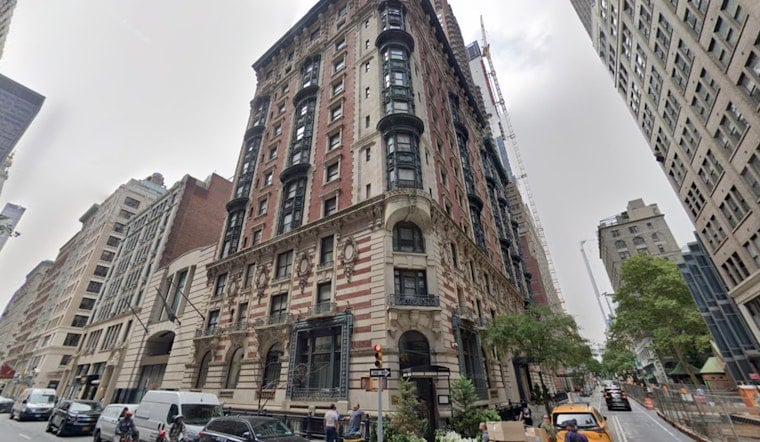
The company behind the Seville NoMad hotel says it may not be able to make its next payment on nearly $60 million in Israeli bonds unless it can restructure its debt, as the Manhattan property struggles with sinking occupancy and mounting losses. GFI Capital Resources Group, the New York City real estate firm led by Allen Gross, disclosed the situation in filings with the Tel Aviv Stock Exchange this month, warning that a British Virgin Islands affiliate tied to the bonds may lack sufficient funds for upcoming principal and interest payments.
According to The Real Deal, the GFI-related company has requested a three-year extension of the bonds' maturity date, which is currently set for December 1, 2026. In exchange for the extension, GFI has offered to raise the interest rate on the bonds from 8.75 percent to 9 percent, paid to bondholders semiannually. The company has also offered a lien on the historic Beekman Hotel as collateral to secure bondholder support for the deal.
The trouble centers on the Seville NoMad, formerly known as the James Hotel, at 88 Madison Avenue. The property's occupancy fell to 51.2 percent in the first quarter of 2026, down sharply from 64.6 percent in the same period a year earlier. The hotel posted an operating loss of $1.21 million in the first quarter of 2026, more than triple the $423,000 loss it recorded in the first quarter of 2025.
A History of Financial Maneuvering to Save the NoMad Property
This isn't the first time GFI has scrambled to shore up the Seville NoMad. The firm originally bought the 317-room property, then known as the Carlton Hotel, for $162.1 million in 2015 using a $153 million loan, as The Real Deal reported at the time. GFI then poured millions into redeveloping the landmark 1904 building.
In June 2020, with a partner facing foreclosure amid pandemic-era disruptions, GFI acquired an additional 61 percent stake in what was then called the James Hotel for $110.5 million in cash and debt assumption, raising its ownership to roughly 80 percent — a deal struck at a steep discount to the property's pre-pandemic appraisal of $296.5 million. More recently, GFI signed a non-binding term sheet in September 2025 to sell the hotel's ground rights for $60 million in a 99-year land sale-leaseback, according to CoStar, a structure that would have let GFI repurchase the land for $1 after 65 years and retire senior debt before bond talks escalated.
GFI now says it is engaged in positive talks with its senior lender, which is reportedly interested in extending the property's $136 million senior loan by three years. The company has also said it will repay 50 percent of the bond principal by December 1 if it can secure refinancing for the Seville NoMad, though whether that refinancing or a ground-lease deal will materialize in time remains an open question.
Beyond NoMad: A Sprawling Portfolio at Stake
GFI's holdings extend well beyond the struggling NoMad property. The firm also owns the Ace Hotel Brooklyn, the Ace Hotel New York, One11 Residences at Thompson Central Park, and 144 North 8th Street in Williamsburg. Its most prominent asset, however, may be the Beekman Hotel in Lower Manhattan, now offered up as bondholder collateral.
GFI developed the Beekman through a $350 million joint venture with hedge fund Elliott Management, backed by a $195 million construction loan from HSBC and M&T Bank in 2014, transforming a vacant 19th-century office building into a luxury hotel. The property's central nine-story Victorian atrium was officially designated a New York City interior landmark by the Landmarks Preservation Commission in June 2024, underscoring the architectural weight of the asset GFI is now leaning on to keep bondholders at the table.
Currency Swings and Tourism Headwinds
GFI attributes part of its financial strain to declining international tourism tied to the conflict with Iran. That explanation lines up with broader industry data: while Manhattan hotel RevPAR in 2025 rose 31 percent above 2019 levels thanks to elevated daily rates, per HVS, full recovery has been hampered by international visitor numbers that remain below pre-pandemic projections, a shortfall tied to geopolitical factors and extended visa processing times.
Compounding the pressure is a currency squeeze hitting American developers across the Tel Aviv exchange. U.S. developers raised a record $4 billion on the TASE in 2025, but a roughly 20 percent appreciation of the Israeli shekel against the dollar between 2025 and mid-2026 — from about 3.75 shekels per dollar to near 2.80 — has made servicing shekel-denominated debt substantially more expensive for dollar-earning U.S. borrowers, according to Roth&Co. GFI-related bonds have fallen 25 percent this month alone, and a GFI-related company reported negative working capital of $224 million in the first quarter of 2026.
GFI's Track Record — and How It Differs From Recent TASE Scandals
GFI has raised money on the Israeli bond market for more than a decade, completing six separate bond raises and, according to the company's own disclosures, previously repaying its Israeli bond offerings in full. Prior to this year's restructuring request, GFI Real Estate Limited had raised more than 900 million shekels across four bond series and successfully repaid over 550 million shekels. The firm did face regulatory friction in January 2019, when it was forced to restate its 2017 TASE filings, including revising its reported 2015 net operating income downward from $28 million to $8 million.
Notably, GFI does not face allegations that it diverted or misused bondholders' money — a distinction that separates its case from other recent troubles on the exchange. Israeli regulators and federal law enforcement are separately investigating other U.S. bond issuers on the TASE, including summer camp operator Simad Holdings, which defaulted on $200 million in bonds in mid-2026 following an alleged $34 million fund diversion that prompted a U.S. Department of Justice grand jury investigation, as The Real Deal reported separately.
GFI is described as the latest American developer to face trouble with Israeli bondholders, joining a growing list of U.S. real estate firms confronting bond market headwinds tied to currency swings and softening demand. Hoodline previously reported on a Brooklyn developer's ouster tied to a separate TASE bond collapse, and on Extell's use of Tel Aviv bond filings to confirm financing for its Times Square Torch Tower project. The GFI bond restructuring news was first reported by Globes, according to The Real Deal's account. What remains unresolved is whether bondholders will accept GFI's proposed extension and Beekman lien, whether the company can pull off a refinancing or ground-lease deal for the Seville NoMad in time, and how the senior lender negotiations over the $136 million loan ultimately play out.



