

























































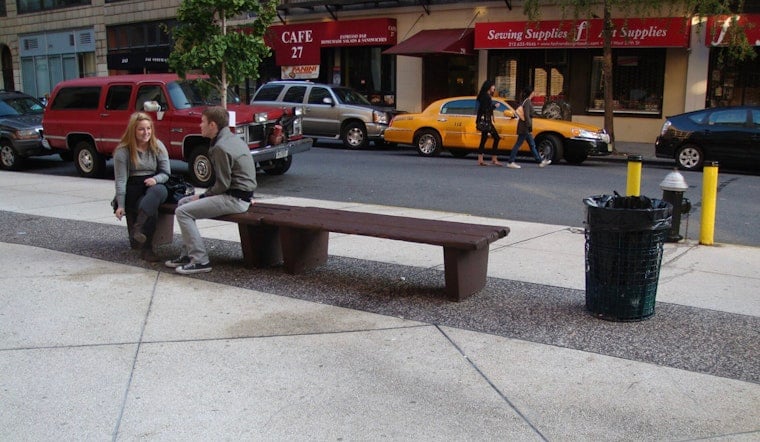
New York City building owners who lock the public out of the plazas, atriums, and seating areas they are legally required to keep open now face fines of up to $25,000, as city regulators ramp up enforcement following a viral confrontation at a Midtown Manhattan office tower. The Department of Buildings has spent the past several months reminding landlords that the roughly 590 privately owned public spaces scattered across the five boroughs come with binding legal obligations, not suggestions.
The renewed scrutiny traces back to a single Instagram account, @780_lord_of_bench, launched by a man named Wade after he said he was threatened with arrest simply for sitting in a public plaza. As reported by PIX11, Wade wants the city to create a dedicated POPS division to guarantee that residents and visitors can actually sit down in the spaces developers were required to build. The account's name refers to 780 Third Avenue, the Sovereign Partners-owned tower where building staff reportedly used water sprinklers and verbal confrontations to push people out of the public plaza, according to Our Town Downtown. Sovereign Partners acquired the property in 2024, and the fallout from the incident led to the termination of two building employees in May.
Department of Buildings spokesperson Ahmed Tigani said interest in public space has been growing on social media, according to the same PIX11 report. Tigani said the regulations require building owners to maintain amenities such as seating, plants, and tables in these spaces, which exist because of a decades-old bargain between the city and private developers.
A Half-Century-Old Trade-Off
New York City law dating to the 1960s allows developers to construct larger, bulkier buildings in exchange for creating and maintaining public space, per the PIX11 report. Under the city's 1961 Zoning Resolution, developers could build up to 10 square feet of bonus private floor area for every 1 square foot of public plaza they provided, a formula that produced more than 16 million square feet of bonus floor area — roughly equivalent to six Empire State Buildings — across 80 acres of privately owned public land, according to the Center for Art Law. Those early zoning rules contained minimal design guidelines for seating or greenery, the Center for Art Law notes, which helped set the stage for decades of disputes over what landlords actually owed the public in return.
Nearly 600 of these spaces now exist citywide, concentrated almost entirely in high-density Manhattan office and luxury residential corridors, with none located in the Bronx or Staten Island, per the Center for Art Law. The Department of Buildings regulates all of them and has run a proactive, three-year inspection cycle since 2017, inspecting every POPS on a rotating basis rather than waiting for complaints, PIX11 reports.
Compliance Numbers Have Climbed, But Gaps Remain
The improvement in compliance since that inspection cycle began has been dramatic. During the department's first cycle, from 2017 to 2019, 57 percent of POPS were found violating their conditions. That figure dropped to 20 percent during the 2020-2022 cycle, and fell further to 15 percent during the most recent 2023-2025 cycle, meaning 85 percent of spaces were compliant, according to the PIX11 report. The city's fourth proactive enforcement cycle, covering 2026 through 2028, began in January.
Even with those gains, 2025 alone generated 461 POPS complaints and 336 complaint and compliance inspections, the outlet reports. The department classified 125 of those complaints as duplicates, unrelated to POPS compliance, or referrals to other agencies. Inspectors issued 3 violations for unauthorized POPS closures, 2 violations for unpermitted sidewalk sheds inside POPS, and 21 total OATH/ECB violations related to POPS during the year.
Those violations move through the Office of Administrative Trials and Hearings, which found 9 POPS cases in violation or default in 2025, dismissed or cured 2 of the 21 violations, and still had 7 cases pending, per PIX11. Building owners found in violation face fines ranging from $5,000 to $25,000, per the Department of Buildings. Broader Department of Buildings penalty guidance shows initial POPS offenses typically start between $4,000 and $5,000 and escalate to $10,000 upon default, while the most severe Class 1 building code violations can reach $25,000 plus monthly non-compliance fees, according to the Office of the New York City Comptroller.
A History of Locked Gates and Hostile Design
This is not the first time the city has had to force a major landlord's hand. In August 2016, the city fined Trump Tower Commercial LLC $10,000 for replacing required public space inside its Fifth Avenue atrium with an unapproved commercial sales counter, a case the NYC Council cited as precedent when it passed Local Law 116 in November 2017. That law mandated standardized city signage at every POPS detailing public hours, amenities, and how to file a 311 complaint, along with annual enforcement reports and a public interactive map.
The push for that transparency law followed years of documented problems. A 2017 audit by the city comptroller's office inspected all 333 POPS that existed at the time and found that 182 of them — more than 54 percent — were violating their legal agreements by denying access or failing to provide required amenities. Many of those sites had gone uninspected by the Department of Buildings for years before that audit, the comptroller's office found.
A more recent investigation cited by The New York Groove put a dollar figure on the imbalance: POPS real estate across the city has been estimated at roughly $10 billion in value, while non-compliant owners had paid just over $1.4 million in total fines at the time of that reporting. That same investigation found roughly 20 percent of POPS landlords were actively violating their zoning agreements. Advocates for Privately Owned Public Space, founded in 2002 by Harvard professor Jerold S. Kayden alongside the Municipal Art Society of New York, has tracked and mapped the spaces independently for over two decades.
Last week, the Department of Buildings posted a public reminder that buildings with public plazas must follow their agreements with the city. Owners seeking to bring signage into compliance must follow rules under Title 62 of the Rules of the City of New York, submitting a design review package with a $500 fee and installing approved city-branded signage within 90 days of approval, according to the NYC Department of City Planning. For Wade and the growing audience following @780_lord_of_bench, the question now is whether that reminder — and the fines behind it — will be enough to keep plazas like the one at 780 Third Avenue open the next time someone tries to sit down.





