

























































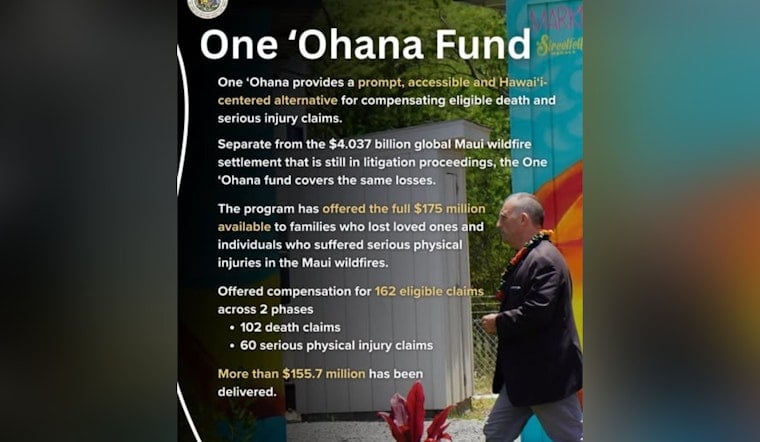
The One ʻOhana Fund has now offered the entire $175 million available through the program to families of all 102 people who died in the August 2023 Maui wildfires, along with dozens of survivors who suffered serious injuries. Gov. Josh Green announced the milestone this week, marking the conclusion of a two-phase compensation effort that began less than three months after the fires tore through Lahaina and Upcountry Maui.
As of August 4, 2026, the fund had delivered more than $155.7 million across 162 eligible claims, according to Maui Now. That total includes all 102 death claims and 60 serious physical injury claims. Green said the fund, formally known as the Maui Wildfires Compensation Program, was built to give families relief without forcing them into years of courtroom battles.
“The One ʻOhana Fund was created to provide meaningful help without forcing families to wait years for relief,” Green said, per the same report. He added that the program will continue until remaining injury payments are completed and affected ʻohana have the support they need to heal and rebuild.
How the Two Phases Broke Down
Phase One, overseen by retired judge Ronald Ibarra as trustee and administrator, provided more than $38.7 million through 30 eligible claims, covering 23 death claims and seven serious physical injury claims. Phase Two, led by trustee Keith Hunter and administrator Amy Gernon, received 226 claims and determined 132 of them eligible, ultimately paying all 79 eligible death claims and offering a combined $17.8 million to physical injury claimants across 53 serious injury cases. To date, Phase Two has distributed more than $117 million.
Eligible death claims receive $1.5 million each, while serious physical injury awards may total up to $1.5 million depending on severity. Under the program's rules, injury claimants had to have begun medical treatment by August 11, 2023, and endured at least one night of hospitalization or emergency outpatient care to qualify, according to the Maui Wildfires Compensation Program.
Money Comes From Seven Contributors
The $175 million fund, first announced on November 8, 2023, drew contributions from Hawaiian Electric Co., the State of Hawaiʻi, Kamehameha Schools, Maui County, Charter/Spectrum, Hawaiian Telcom and West Maui Land Co. According to Honolulu Civil Beat, Hawaiian Electric pledged $75 million, the state pledged $65 million, Kamehameha Schools pledged $17.5 million, Maui County pledged $10 million, and Charter Communications, Hawaiian Telcom and West Maui Land Co. each pledged $2.5 million.
The tradeoff for claimants accepting the $1.5 million payments has been well documented: in exchange, surviving family members agreed to sign legal waivers releasing all seven fund contributors from court litigation and wrongful death liability, Civil Beat has reported. That arrangement was designed to shield the utilities and government entities involved from prolonged trials while still getting money to families quickly.
A Separate, Much Larger Settlement Still Looms
The One ʻOhana Fund is legally distinct from the $4.037 billion global Maui wildfire settlement, which remains in litigation proceedings. Eligible claimants who accepted One ʻOhana money may still receive additional compensation through that broader settlement, though any such payout is subject to offsets for what they already received from the fund covering the same loss.
Hawaiian Electric's $75 million One ʻOhana pledge is folded into a far larger $1.99 billion commitment the utility made toward the global settlement, Civil Beat has reported, reflecting the severe financial strain and credit downgrades the company faced after the disaster. Kamehameha Schools, Hawaiʻi's largest private landowner and owner of more than 1,000 acres near Lahaina, separately pledged $872.5 million toward the same global settlement.
That larger settlement nearly hit a wall earlier this year when insurance companies attempted to intervene. In February, the Hawaiʻi Supreme Court unanimously ruled that insurers could not block or intervene in the $4.037 billion agreement, holding instead that subrogating insurers must pursue reimbursement through liens rather than independent lawsuits, as Hoodline reported in Maui Now's earlier coverage of the ruling. The decision cleared a major legal bottleneck that had stalled payouts for insurers who had already paid out billions in disaster claims.
The State of Hawaiʻi's involvement in Maui wildfire relief extends well beyond its $65 million One ʻOhana pledge. Under Act 301, enacted in July 2025, the state authorized an $807.5 million appropriation over four years to the Maui Wildfires Settlement Trust Fund to support the broader global settlement, according to the Department of the Attorney General - Hawaii.gov — a distinct legislative action separate from the earlier Act 10 that created the One ʻOhana Fund itself.
What Comes Next
The fund's work is not yet finished. Officials still plan to finalize agreements, resolve healthcare liens and complete remaining steps required to issue payments, with injury claimants required to accept their offers by August 15, 2026. Administrative costs for the One ʻOhana Bank Trust Account had reached approximately $2.36 million as of October 31, 2025, including $1.91 million in state and federal income taxes and $402,500 paid to PricewaterhouseCoopers for claims processing, per the Department of the Attorney General.
The August 8, 2023 fires killed 102 people and destroyed more than 2,200 structures, generating over $2.3 billion in paid insurance claims even before final global settlement approvals, according to Civil Beat's reporting. Three years on, the scale of both the One ʻOhana Fund and the still-unresolved global settlement underscore how long the financial reckoning from that single day in Lahaina and Upcountry Maui continues to stretch.



