

























































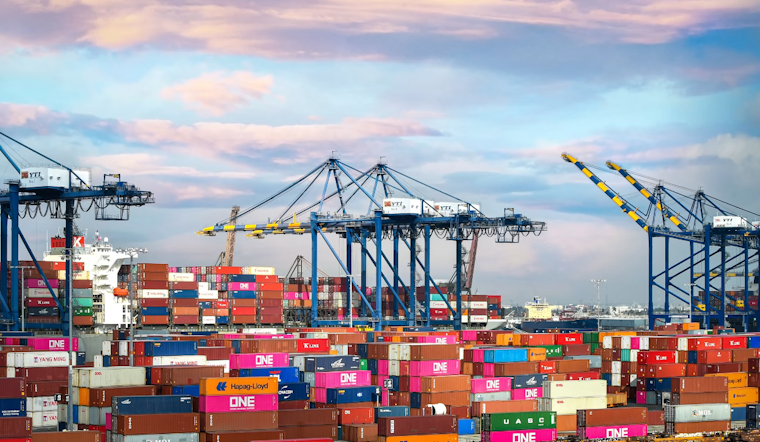
The Port of Los Angeles just wrapped up its second-busiest July on record, as importers scrambled to push cargo through San Pedro Bay before a federal tariff deadline reshaped the cost of doing business. The surge capped a summer stretch that already included the busiest June in the port's 118-year history, with shipping lines and terminal crews working through what has become a multi-month wave of front-loaded freight rather than a single seasonal peak.
The near-record July volume was driven largely by importers trying to beat the clock on a major shift in trade policy, according to Bloomberg. Temporary 10% global tariffs enacted under Section 122 expired on July 24, only to be immediately replaced by new Office of the U.S. Trade Representative Section 301 tariffs ranging from 10% to 12.5% across 60 trading partners, according to Baker Donelson. Those Section 122 tariffs were originally put in place in February 2026 for a statutory maximum of 150 days following Supreme Court action on IEEPA tariffs, giving importers a hard deadline to plan around.
Port of Los Angeles Executive Director Gene Seroka framed the surge as businesses seizing a narrow window rather than a permanent shift in trade patterns. Businesses continue to move cargo when they see windows of opportunity amid an evolving trade environment, Seroka said, per the Bloomberg report. Importers, the outlet notes, have spent the year navigating both volatile tariff policy and broader global supply chain disruptions.
June's Million-Container Month Set the Stage
July's numbers followed directly on the heels of a historic June, when the port processed 1,002,734 TEUs, making it the busiest June in the port's 118-year history and only the third time monthly volume has topped 1 million containers, according to gCaptain. Loaded imports that month reached 530,558 TEUs, up 13% year-over-year, the same report notes. Hoodline previously covered that record-breaking June surge, part of a run of strong months that also included a solid April and a March export bump despite shipping disruptions elsewhere.
The rush wasn't confined to Los Angeles. The neighboring Port of Long Beach handled 928,508 TEUs in July, its second-busiest July on record and fourth-busiest month in its 115-year history, per FreightWaves' coverage of the West Coast port surge. Together the two ports make up the San Pedro Bay complex, which handles roughly 30% of all U.S. containerized import freight, as Hoodline has previously reported.
Southern California Pulled Cargo Away From the Pacific Northwest
The front-loading rush didn't just boost Southern California, it also reshuffled where cargo landed nationally. During the second quarter of 2026, loaded imports jumped 13.8% at the Port of Los Angeles and 12.0% at Long Beach year-over-year, while Pacific Northwest ports saw steep declines, including a 9.2% drop at the Northwest Seaport Alliance, according to Global Maritime Hub's analysis of the trend. San Pedro Bay's ports offered faster turnarounds and greater logistics capacity during the rush, the outlet notes, which helped pull shippers away from Northwest gateways ahead of the mid-summer tariff deadline.
Ocean carriers have felt the ripple effects too. Maersk raised its full-year 2026 financial guidance for the second time in August as analysts projected the peak shipping season would extend through September, per the same FreightWaves report on the West Coast surge. Non-traditional shipping patterns, the outlet notes, have smoothed out the historical peak season into a broader multi-month wave rather than a single concentrated rush.
China's Share of Imports Keeps Shrinking
Behind the monthly volume swings sits a longer-running shift in where America's goods actually come from. China's share of containerized imports moving through the Port of Los Angeles has fallen from 61% in 2020 and 53.4% in 2025 to roughly 40% in 2026, according to FreightWaves' reporting on the port's fiscal year budget. Importers have increasingly sourced goods from Southeast Asia and other alternative trade routes, the outlet notes, as tariff policy continues to push manufacturing away from China.
That longer-term uncertainty is already showing up in the port's own books. In June, the Los Angeles Board of Harbor Commissioners approved a record $3.4 billion annual budget for fiscal year 2026-2027, even as port management projected a 7% drop in total container volume to 9.3 million TEUs due to trade policy uncertainty. The budget still included a 31% increase in capital spending despite those conservative volume projections, underscoring a bet on long-term growth even as near-term forecasts stay cautious.
Infrastructure Investment Continues Alongside the Surge
The port has also been shoring up the freight infrastructure needed to keep cargo moving inland. On July 30, the Port of Los Angeles signed a Memorandum of Understanding with the California State Transportation Agency and Caltrans to form a planning partnership for an overhaul of the Vincent Thomas Bridge freight corridor, according to the port's own announcement. The bridge serves as a primary arterial connection between port terminals and regional highways, making it a critical link for the drayage trucks that move containers out of San Pedro Bay.
The Port of Los Angeles has held the title of busiest container port in the Western Hemisphere for 26 consecutive years, from 2000 through 2025, handling 10.2 million TEUs in calendar year 2025, according to the port's own statistics. Whether that streak extends through the current fiscal year may hinge on how long the front-loading wave lasts, and whether the 7% volume decline port officials have projected materializes once the tariff-driven rush finally subsides.





