

























































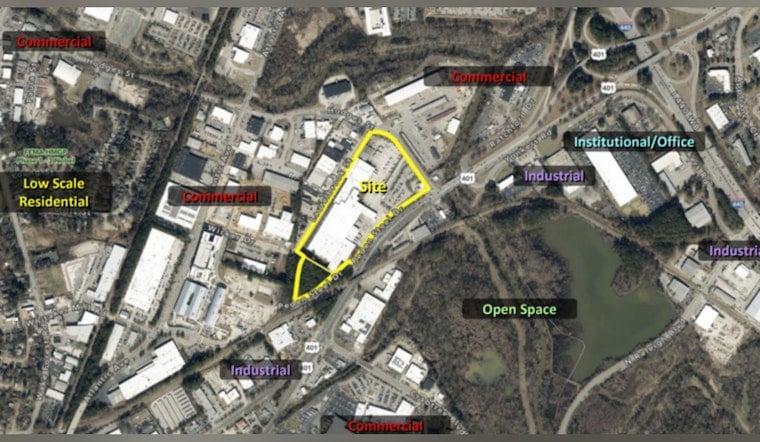
A stretch of industrial land just north of downtown Raleigh could soon give way to towers as tall as 20 stories, under a rezoning proposal that would allow more than 5,700 housing units, roughly 400,000 square feet of retail and over 5 million square feet of office space on about 20 acres along Capital Boulevard. The properties at 2233 and 2321 Capital Blvd are currently zoned primarily for industrial use, which caps buildings at three stories and allows only around 500 housing units on the site.
Charlotte-based developer Beacon Partners asked the city of Raleigh to rezone the parcels, according to The News & Observer. The formal application, designated Case Z-50-25, seeks to change the zoning from IX-3-PL to CX-20-CU across 19.74 acres, according to the City of Raleigh's public engagement portal. The developer's proposal includes conditions barring detention centers, jails, prisons and adult entertainment from the site, and calls for a mix of apartments and townhomes alongside the retail and office space.
The Raleigh Planning Commission voted unanimously on Tuesday to recommend the rezoning to the City Council, though the council has not yet scheduled a date to take up the matter, the paper's report noted. Exact numbers of housing units and new buildings remain unclear, and developers have not yet put forward formal site plans.
A Former Warehouse With Contamination Concerns
The site includes an approximately 300,000-square-foot building that previously operated as a Harris Teeter warehouse, according to N.C. Department of Environmental Quality records cited by the paper. County tax records and commercial listings put the larger parcel at 19.08 acres with a 296,209-square-foot industrial facility that had also housed beverage distributor Mutual Distributing Company, according to LoopNet.
The state suspects chlorinated solvents, petroleum and metals are present in the groundwater and soil at the site. Beacon Partners filed a brownfield application with the state in 2025 and has agreed to clean up the property. Brownfield agreements, per the Department of Environmental Quality, function in effect as a covenant not to sue over certain environmental actions or consequences, while also laying out a required list of cleanup steps for developers.
Under North Carolina's Brownfields Property Reuse Act, developers who sign such an agreement can receive a five-year property tax exclusion, with the tax break phased in and declining progressively over five years for a total savings of roughly 50% during that stretch, according to the North Carolina Department of Environmental Quality. Those tax breaks are contingent on the developer actually building on the brownfield site.
Traffic, Transit and Neighborhood Pushback
Site development would require improvements to Hodges Street, Peden Steel Drive and Capital Boulevard, along with new sidewalks and bike lanes. Public speakers opposed the rezoning at recent hearings, though the specific nature of their objections was not detailed in the paper's coverage.
The corridor already carries significant transit infrastructure that supporters point to as justification for the density. GoRaleigh's Route 1 runs along Capital Boulevard at high-frequency 10-minute intervals using articulated buses, and Wake County's transit plan designates the corridor as one of four key Bus Rapid Transit routes, according to GoRaleigh. Raleigh voters approved a half-cent transit sales tax in 2016 to help fund 20 miles of BRT infrastructure across the county.
Separately, the North Carolina Department of Transportation is converting more than 10 miles of Capital Boulevard north of I-540 into a 70 mph limited-access freeway, with grade-separated interchanges and parallel service roads replacing traffic signals and direct driveways, according to the state agency. The upgrade is meant to handle growing commuter traffic between Raleigh and Wake Forest.
Part of a Broader Corridor Transformation
Raleigh's City Council adopted the Capital North Corridor Plan in July 2022 as an amendment to the city's 2030 Comprehensive Plan, following a three-year study examining projected daily vehicle volumes exceeding 100,000. That plan called for multi-way boulevard upgrades, grade-separated interchanges, BRT infrastructure and new bike and pedestrian paths along Capital Boulevard, laying groundwork for the kind of dense redevelopment Beacon Partners is now proposing.
Beacon Partners has been building its footprint in the immediate submarket, acquiring the 215,000-square-foot Dock 1053 commercial complex for $35 million in October 2025 after buying an adjacent Atlantic Avenue industrial warehouse for $20.75 million that May. Hunter Winstead, speaking on behalf of the project, said it hopes to revitalize the area and make it a portion of the city people can be proud of.
Nearby, real estate firms Jamestown and Grubb Ventures previously completed a $150 million redevelopment of historic industrial land into Raleigh Iron Works, a mixed-use district with nearly 500,000 square feet of office space, 90,000 square feet of retail and 220 residential units, according to Dock 1053. That project helped establish the Whitaker Mill and Atlantic Avenue corridor as a destination, offering a template for what the Capital Boulevard site could become if the rezoning moves forward.
Attorney Jason Barron of Morningstar Law Group, representing Beacon Partners, hosted required neighborhood meetings on the proposal in November and again in mid-July at the Kiwanis Neighborhood Center, part of the city's mandated outreach process for major rezoning requests. With the Planning Commission's recommendation now in hand, the case heads next to the City Council for a binding public hearing, where residents can submit written comments or speak on the record before any final vote.





