

























































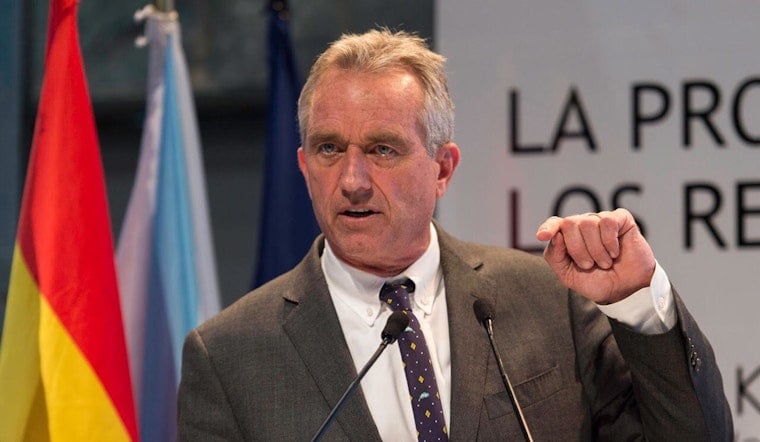
Health and Human Services Secretary Robert F. Kennedy Jr. stopped in Atwater on Thursday to announce that Castle Family Health Centers will receive $650,000 in federal grant funding and be upgraded to full Federally Qualified Health Center status, part of a nationwide $102 million push to expand primary care access. The visit put a spotlight on a Merced County clinic that has spent 16 years operating under a lesser federal designation, even as California lawmakers and hospital leaders warn that far larger federal health care cuts are squeezing the state's safety net.
Castle Family was one of just 66 so-called “look-alike” clinics selected nationwide out of roughly 600 applicants for the upgrade, according to KVPR. The station reported that California health center organizations received $17 million across 27 grant awards from the $102 million national allocation, the largest total funding amount awarded to any single state, with HRSA Administrator Thomas Engels confirming California's lead. Nationally, the New Access Points awards support 158 new and existing health centers to establish 415 new sites, according to HHS, which said the expansion would reach nearly 1 million additional Americans and represents the first major growth of HRSA's Health Center Program since 2019.
What the Look-Alike Upgrade Means for Atwater
Castle Family Health Centers had operated as an FQHC look-alike since 2010, meeting federal clinical and operational standards without qualifying for base federal operating grants or federal malpractice insurance protections, per the same KVPR report. Look-alikes were originally created for clinics that met federal standards when grant funding wasn't available, and they have historically leaned on community support to keep pace, according to Trillium Health. The Atwater upgrade means Castle Family will now draw on funding streams previously out of reach.
Kennedy, during his stop, highlighted new federal investments aimed at expanding access to primary care and said community health centers combine primary care, prevention, behavioral health, nutrition services and other essential care in one place, according to KATU. He said expanding community-based care can help patients avoid waiting until health problems become emergencies, and argued that community health centers succeed because they are rooted in the communities they serve. HHS officials said the Atwater stop was tied to a broader announcement of new funding opportunities for health centers nationwide.
Regional Investment and a Growing Physical Footprint
Castle Family was one of three San Joaquin Valley health center organizations selected under the federal program, joining United Health Centers of the San Joaquin Valley in Fresno and San Joaquin County Health Services Employees Guild in Stockton, KVPR reported. The Valley remains a focal point for federal rural care expansion efforts. In Merced County, roughly 51% of residents rely on Medi-Cal for health insurance, and the entire county carries HRSA's Health Professional Shortage Area designation, according to the USC Center for Health Journalism.
Castle Family, incorporated in 2006 to serve low-income and rural populations across Atwater and Winton, reported $37.7 million in total annual revenues in 2025, employed 256 staff members, and logged 178,865 patient visits, per Cause IQ. Environmental review filings show the organization has approved plans for a 14,800-square-foot medical facility on Third Street in Atwater, with 27 exam rooms, telehealth capabilities and x-ray imaging designed to serve 6,000 to 8,000 patients annually on a 1.63-acre redeveloped parcel, according to filings on CEQAnet.
Domestic Supply Push and Political Pushback
Alongside the grant announcements, HRSA said it is building a federal platform to help health centers identify, verify and purchase domestic, American-made medical supplies and equipment as part of what HHS described as President Trump's “America First” agenda. The initiative aims to establish a digital verification system encouraging domestic supply chain sourcing across the Health Center Program.
But the celebratory tone of Kennedy's visit collided with sharper criticism from state officials covered in KATU's report. The outlet, citing the article by Mayra Franco, noted that the One Big Beautiful Bill signed by President Trump stripped more than $1 trillion from the U.S. health care system, cutting an estimated $30 billion per year from California health care specifically. California Assemblymember Patrick Ahrens said the $100 million in primary care funding helps but is “much smaller” than the roughly $1 trillion in federal health care cuts, per KATU. The outlet also reported that H.R. 1 is projected to cause more than 2 million Californians to lose access to health care and puts 83 California hospitals at risk of closing, while federal health care cuts are estimated to cause 51,000 Americans to die needlessly each year.
State Lawmakers Warn of Hospital Losses
California lawmakers and hospital leaders in Silicon Valley warned last week that public hospital systems face nearly $4 billion in annual losses tied to federal funding reductions, according to the same KATU account. A hospital leader quoted in the report said there is a gap that no public hospital system can solve on its own. California has already provided more than $200 million specifically for distressed hospitals, according to officials cited by KATU, part of hundreds of millions of dollars in state funding the state has directed toward health care.
That state backstop dates to 2023, when California established a $300 million Distressed Hospital Loan Program that helped reopen closed facilities such as Madera Community Hospital, according to the Office of Assemblymember Esmeralda Soria. Soria introduced AB 1923 in February to authorize another $300 million in emergency state loans following federal Medicaid funding reductions. During Thursday's news conference, which took three questions, KATU reported that HHS had not yet responded to a question the outlet emailed the department about federal relief for distressed hospitals, and the outlet said its article would be updated if HHS responds.



