

























































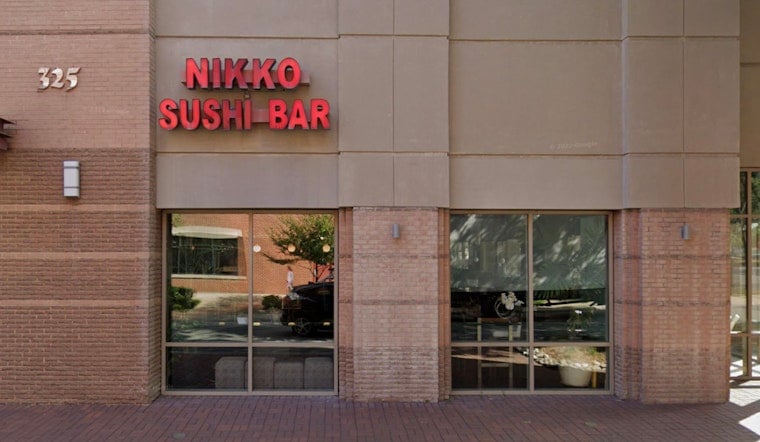
Nikko Japanese Restaurant & Sushi Bar, the sushi spot that anchored the ground floor of South End's pink-glass Arlington building for 19 years, has permanently closed after the property changed hands for roughly $4 million. The restaurant shut down on August 18, and its 6,800-square-foot space is now slated for a sushi-steakhouse fusion concept with no name or opening date yet announced.
Johnny Walker of Monument Commercial Partners, which represented the sellers, confirmed the closure came after the sale of the property at 325 Arlington Ave Unit 108, according to the Charlotte Observer. Walker described Nikko as more than a restaurant, calling it a legacy, and wrote, “Thank you, Charlotte, for the unforgettable memories, the loyalty and the love.” Xavier Grier served as lead broker at Monument Commercial Partners on the deal, per the same report, while the buyer went unrepresented and asked not to be named.
Two buyers have since stepped forward publicly. Tyon D. Thompson and Allan Jones announced on social media that they closed on the Nikko location after ten months of negotiations, with plans to launch what they describe as a premier steak, seafood, and sushi venue in the space.
A 27-Year Run That Began on South Boulevard
Nikko's roots in Charlotte stretch back further than its time at The Arlington. Chef and owner Joanna Nix originally opened the restaurant in 1999 at 1300 South Boulevard, according to Creative Loafing Charlotte, before it relocated to the Arlington Avenue address in 2007, marking the start of the run that just ended after 19 years in that building. Over that span, the restaurant built a reputation for innovative sushi and Japanese cuisine and was regarded as a top spot for ramen, per the Observer's reporting. Charlotte Observer readers ranked it the second-best Japanese restaurant in the city and awarded it bronze for best sushi in the 2025 Charlotte's Best poll.
Nikko also evolved into something more than a dinner destination, operating in what the Observer described as a modern, club-like atmosphere that drew large late-night crowds. That transformation brought both popularity and controversy over the years.
Pandemic-Era Citation and a Parking Lawsuit
In October 2020, the Charlotte-Mecklenburg Police Department issued an ABC violation citation to restaurant owner James Nix after viral videos showed dense, unmasked crowds dancing inside the venue during state pandemic restrictions, according to WFAE. The fallout reached beyond the restaurant itself: Carolina Panthers defensive back Josh Hawkins was released by the team shortly after appearing unmasked in footage recorded inside Nikko, the station reported.
The restaurant's presence in The Arlington also generated friction with its upstairs neighbors. In April 2016, Nikko filed a lawsuit against more than 100 condominium owners living in the building's residential units in a dispute over parking spaces, according to Axios Charlotte.
Inside The Pink Building's Prime Real Estate
The Arlington itself is something of a Charlotte landmark. Completed in March 2003, the tower stands 24 stories tall with 115 condo units and is known locally as “The Pink Building” for its distinctive pink-tinted glass facade, representing Charlotte's first residential high-rise, according to Wikipedia. The building sits directly adjacent to the LYNX Light Rail's Carson Station and the South End Rail Trail, a transit-heavy location that helped drive foot traffic to Nikko for nearly two decades.
Before the sale, the commercial unit was marketed off-market as a second-generation restaurant condo spanning 6,357 to 6,960 square feet with a patio and commercial kitchen, with the business assets sold separately from the real estate itself, according to a listing on Realmo. That structure helps explain why the new owners were able to move quickly toward opening a different concept in the same footprint.
Why South End Restaurant Space Commands a Premium
The roughly $4 million price tag reflects just how scarce turnkey restaurant real estate has become in the neighborhood. Charlotte's metro-wide commercial retail vacancy rate dropped to 2.8% in late 2025, creating an extraordinarily tight market for second-generation restaurant spaces, according to Henderson Properties. South End has meanwhile grown into a young, high-income urban corridor, with a median resident age of 29 and an average household income exceeding $90,000, per Movoto. That combination of scarce supply and deep-pocketed demand helps explain why Nikko's old dining room is already headed toward its next act as a sushi-steakhouse fusion concept, even before a name has been settled on.





