

























































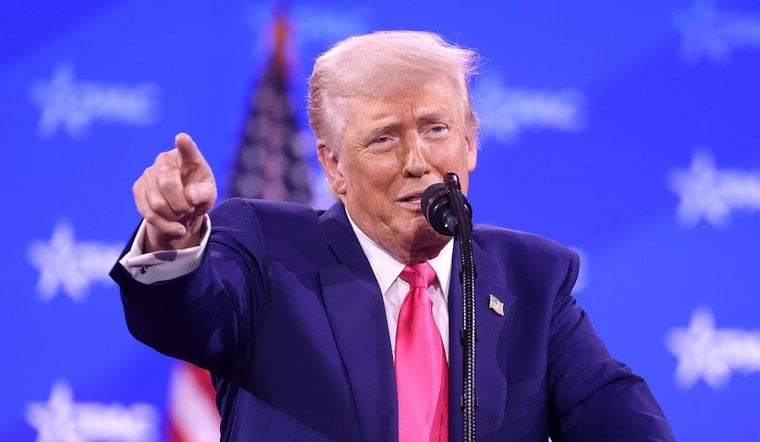
President Donald Trump has ordered the Pentagon to substantially reduce planned joint military exercises with South Korea, just days before the 11-day drills involving 18,000 South Korean soldiers were slated to begin this week. Trump said the exercises are costly and instructed Defense Secretary Pete Hegseth to scale them back significantly.
According to Queen City News, which cited Associated Press reporting, Trump said the exercises send an inappropriate and hostile signal to North Korea. He also said South Korea declined to help denuclearize Iran. The drills in question are Ulchi Freedom Shield 2026, an 11-day annual exercise scheduled to run from August 17 through August 27 across South Korea, including Gyeonggi and Gangwon provinces near the Demilitarized Zone, according to Al-Monitor.
A High-Stakes Drill Cycle Interrupted
The timing carries added weight because this year's exercise was designed to incorporate multi-domain operations against modern battlefield threats, including unmanned drones, GPS jamming, and cyberattacks, per Al Jazeera. The same report notes that U.S. and South Korean forces were expected to practice joint operations in complex scenarios, including a live-fire exercise to test joint precision targeting and maneuver, plus a wet gap crossing, and had planned distribution of prepositioned military equipment.
Beyond the tactical scope, the 2026 iteration was set to serve as an evaluation platform for Full Operational Capability validation — the second phase of a three-stage bilateral plan to transfer wartime operational control from the U.S. to South Korea, according to English News1. The outlet also reported that linked outdoor maneuver training tied to the exercise was already scheduled to drop to a historic low of 14 cases this year, down from 44 in 2025, even before Trump's announcement.
Echoes of Trump's First Term
Trump previously sought to end the joint military exercises during his first term, and in 2018 in Singapore, he conditioned stopping the war games on future negotiations proceeding appropriately. During his first term, in 2018 and 2019, Trump suspended the Ulchi Freedom Guardian summer exercise and ended major spring drills known as Key Resolve and Foal Eagle, replacing them with smaller mission-tailored training, according to Navy Times. Trump has called the wargames provocative in the past and said in 2018 in Singapore that stopping them would save a tremendous amount of money.
That Singapore trip came after Trump met with North Korean leader Kim Jong Un, one of three meetings between the two men during Trump's first term, from 2017 to 2021. Trump posted a photo of himself standing next to Kim and said the two get along great despite the unfriendly look in the picture. He has also said North Korea has been unthreatening and respectful while he has been in the White House, and he has expressed interest in continuing discussions with Kim about North Korea's nuclear program, with the two having discussed the North's nuclear program during their meetings.
North Korea's Response and the Alliance's Legal Backdrop
North Korea's foreign ministry has called the U.S.-South Korean training a rehearsal for an aggressive war, and per the ministry, the training is triggering a different level of instability in the region. The joint exercises are designed to improve readiness against North Korean threats, and the alliance underpinning them traces back to the 1953 Mutual Defense Treaty signed after the Korean War armistice, which legally obligates both nations to mutual defense, according to a report from EveryCRSReport.
The summer war games themselves have deep institutional roots, tracing back to 1976, when South Korea's Ulchi civilian mobilization exercise was combined with U.S. military training. That exercise evolved into Ulchi Focus Lens, then Ulchi Freedom Guardian in 2008, and eventually today's Ulchi Freedom Shield, according to Newsmax.
Budget Pressures and Congressional Guardrails
The order also lands amid broader fiscal strain on the Pentagon. Defense Secretary Hegseth warned during a Senate Appropriations Committee hearing in July that military troop training across the Department of War would be curtailed without an $87.6 billion supplemental defense request, a need driven primarily by U.S. operations involving Iran, per PBS News.
Congress, meanwhile, has already moved to constrain how far any troop drawdown in South Korea can go. The Senate passed the Fiscal Year 2026 National Defense Authorization Act in December 2025, inserting statutory provisions that bar the Pentagon from spending funds to reduce the baseline of 28,500 U.S. Forces Korea troops without prior executive certification to Congress, according to The Korea Times. Separately, under the 12th Special Measures Agreement signed in late 2024 covering 2026 through 2030, South Korea agreed to contribute 1.52 trillion won, or roughly $1.13 billion, in 2026 toward the cost of hosting U.S. troops — an 8.3 percent increase over 2025, per a report cited by EveryCRSReport. It remains to be seen how substantially Hegseth will reduce the drills on such short notice, and how South Korean defense officials will adjust their wartime command evaluation timeline as a result.





.jpg)