

























































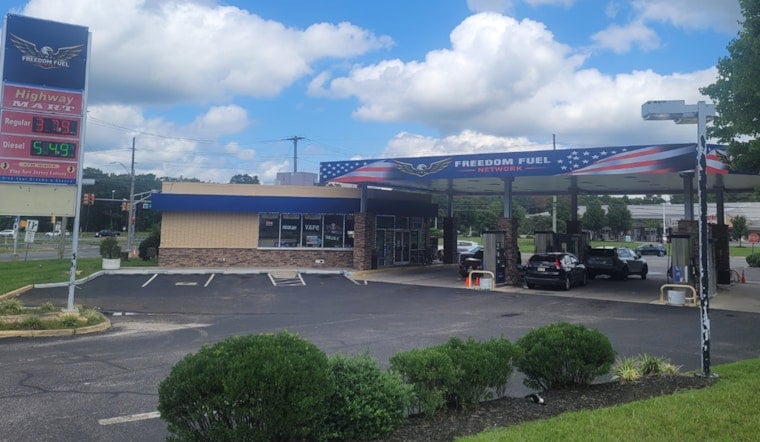
A federal judge in the Eastern District of Pennsylvania has ordered a company tied to the Trump-promoted Freedom Fuel Network to keep at least $2.75 million in a bank account while a lawsuit accusing it of taking nearly $4 million in fuel without paying plays out in court. The order, issued Friday, marks the first major legal consequence for the gas station chain that President Trump praised this summer as a model for lowering prices at the pump.
The lawsuit, filed by Georgia-based Mansfield Oil Co. against KRSM Inc. and its head, Syed Kazmi, claims KRSM lifted approximately 150 tanker loads of fuel — totaling 1,124,594 gallons and valued at $3,998,868.46 — from Mansfield's account at the Sunoco Twin Oaks Terminal in Aston, Delaware County, between May 21 and July 7, according to The Philadelphia Inquirer. Court filings cited by Queen City News state that KRSM was contractually required to pay Mansfield's invoices within 10 days of receipt under a credit agreement Kazmi signed in January 2022, and that the company never did.
Mansfield's attorneys allege that KRSM sold a portion of that fuel at discounted prices to stations in the Freedom Fuel Network, and that the arrangement helped the fledgling chain generate the kind of publicity that caught the White House's attention. Mansfield's bank told the company in July that KRSM had refused draft requests for payment, the lawsuit states, and Mansfield sent revised invoices to KRSM that same month before filing suit in federal court on August 19.
From the Roadside to the Retail Pump
Attorney Urs Broderick Furrer, who represents Mansfield Oil, said the unpaid fuel taken from the company's terminal account was delivered to at least 10 Pennsylvania gas stations listed on the Freedom Fuel Network's website, out of 29 locations the chain currently claims across New Jersey and Pennsylvania, per the same account reported by the Washington Post. The alleged pipeline from an unpaid wholesale account straight to branded retail pumps is central to Mansfield's case, though the defense disputes that any theft occurred at all.
Attorneys Mauro Tucci and Paul Toner, representing KRSM and Kazmi, have denied the nonpayment claims, characterizing the dispute as an ordinary commercial accounting disagreement over fuel invoices that Mansfield mispriced or misplaced, the Washington Post reported. That framing puts the case squarely in conflict with Mansfield's version of events, and no court has yet ruled on which account is accurate.
A Chain Born to Honor the 47th President
Freedom Fuel Network first drew attention when its debut rebranded station opened in Dresher, in Upper Dublin Township, Montgomery County, offering regular gasoline at $3.47 per gallon — a price set to honor Trump as the 47th president — at a time when regional pump averages topped $3.90, according to PhillyVoice. Hoodline first covered that debut in July, when industry analysts were already questioning whether the pricing was sustainable. Trump had said in July that Freedom Fuel stations were taking the lead on lowering gas prices and urged other retailers to follow suit, and a Trump administration spokesperson, Taylor Rogers, told The Hill that Freedom Fuel stations were doing their part to answer the president's call, per The Hill.
The national average price for regular gasoline stood at roughly $4.07 per gallon on Sunday, according to AAA figures cited by Queen City News, underscoring why the chain's steep discount drew both praise and scrutiny. Delaware corporate registration documents show Freedom Fuels Network LLC was incorporated on June 23 by Randy Brown, a senior special teams coach for the NFL's Baltimore Ravens and former Republican mayor of Evesham Township, New Jersey, along with Yoni Gontownik, a New Jersey investor and former commodities executive at Mercuria, according to NOTUS. It remains unclear how the corporate structure separating Brown and Gontownik as incorporators relates to the Kazmi family businesses that control many of the network's retail sites.
A History of Fuel Disputes and State Scrutiny
This is not the first fuel-related legal trouble tied to the Kazmi family. Federal court records show businesses associated with the family faced a February default order requiring them to pay more than $600,000 to another fuel supplier after failing to pay for more than 230,000 gallons of gasoline, according to Mediaite.
Freedom Fuel's steep discounts have also triggered state-level review. New Jersey's Attorney General's Office and Office of Weights and Measures launched compliance inspections at Freedom Fuel locations in July to evaluate pump calibration, fuel quality, and compliance with the state's law barring retailers from selling gasoline below net acquisition cost. Separately, six of the eight Freedom Fuel stations operating in New Jersey face state Department of Environmental Protection violations and $197,350 in proposed fines for failing to properly maintain and register underground fuel storage tanks, per When In Your State.
White House Distances Itself
A White House spokesperson said on Saturday that the Trump administration has had zero contact or dealings with KRSM Inc. or Syed Kazmi, reemphasizing that Freedom Fuel Network is a private company that received no federal funding, according to the Inquirer's reporting. That statement echoes an earlier comment from a White House official in July, who told The Hill that Freedom Fuel Network is a private company and had not received federal funding. The distinction matters for a chain whose branding and pricing strategy were explicitly built around presidential praise, even as the president himself touted roughly 25 stations in the network back in July.
For now, the legal fight centers on whether KRSM's failure to pay Mansfield amounts to a straightforward billing dispute, as the defense insists, or a scheme that allowed discounted fuel to reach Freedom Fuel pumps without ever being paid for, as Mansfield alleges. The court's order to preserve $2.75 million in assets suggests a judge saw enough risk of dissipated funds to intervene before the underlying claims are resolved, but no findings of wrongdoing have been made.





